These Are The Implications Of The Vatican Choosing Algeria As The First Stop On Its Africa Tour.
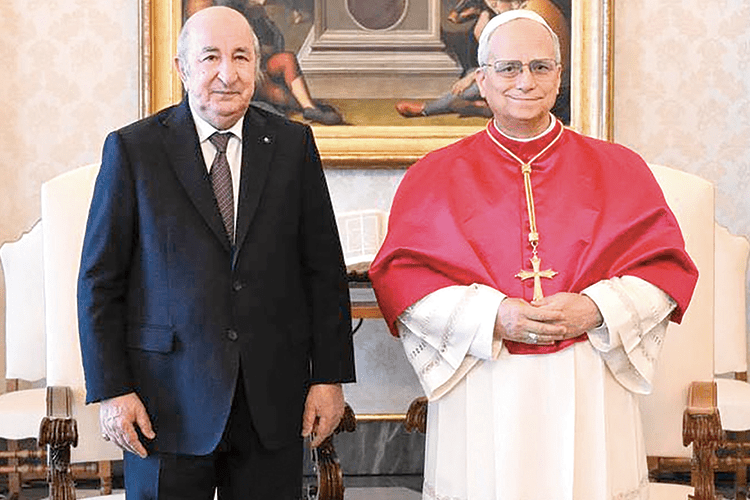
Some Algerian elites viewed the visit of Pope Leon XIV of the Vatican to Algeria, starting on Monday, as an opportunity to highlight its role as an active regional power in promoting dialogue and strengthening values of tolerance between peoples and religions.
They saw this event as far exceeding the religious dimension, extending to political and strategic levels, in light of a global scene in crisis due to the wars and crises in the Middle East, where the religious dimension has been overtly present.
The uniqueness of the Vatican Pope’s visit to Algeria lies in its “selectivity,” according to Ms. Saida Salama, a professor of political science and international relations at “University of Algiers 3.” In a statement to “Echorouk,” she pointed out that the visit “is an event that transcends its religious nature to carry deep political and diplomatic dimensions.”
Ms. Saida Salama’s interpretation is based on the fact that “the Pope’s visits around the world remain limited and selective, which gives any chosen destination special weight, especially in light of current international transformations and the increasing tensions and conflicts witnessed.” This indicates that choosing Algeria as the first stop for his African tour carries significant implications.
This visit, the professor of political science added, could “present an image of Algeria as an open state that supports coexistence and interfaith dialogue, which is an extension of a deeply rooted historical path. As everyone knows, Algeria has hosted prominent religious figures throughout its history who contributed to spreading the values of peace, tolerance, and living in freedom and coexistence, which will make it a symbolic platform for religious and civilizational dialogue.”
The visit also falls within Algeria’s use of soft power tools, according to Ms. Saida Salama, by “enhancing its positioning as an actor calling for de-escalation and dialogue, in contrast to an international reality where slogans of peace are sometimes exploited to justify conflicts and deepen divisions, which highlights the need for realistic models that lend credibility to these values.”
The visit also opens important channels of communication with the Vatican State, as a diplomatic actor with global moral influence, which enhances Algeria’s ability to support just causes and establish approaches based on peace and understanding. Furthermore, it is “a strategic opportunity to highlight Algeria’s status as a stable, open, and active state in consolidating the values of dialogue and coexistence in international relations.”
For his part, Mr. Redouane Bouhidjel, a professor of political science at “University of Algiers 3,” believes that the visit comes in a turbulent international geopolitical context characterized by wars, energy crises, and the reshaping of alliances, which can be considered a clear signal to the international community of Algeria’s rise as a pivotal regional actor.
This fact, according to Mr. Bouhidjel’s statement to “Echorouk,” reinforces Algeria’s role as a mediator between the North and the South, and specifically between Europe on one hand, and Africa and the Arab and Islamic worlds on the other. Moreover, the event can be utilized “to enhance Algeria’s image as a stable and reliable partner in this unstable regional environment.”
In the speaker’s opinion, the Vatican is not merely a religious entity, but an international actor with a global network of influence. This means that the Vatican operates with the logic of symbolic powers, and in return, Algeria seeks to invest in this visit to present itself as a model for coexistence and a space for Islamic-Christian dialogue, intersecting with an international trend towards using the religious dimension as a tool for de-escalating conflicts.
Added to this is the Euro-Mediterranean dimension, which obliges Algeria to assume its responsibilities as an actor in light of the global energy crisis due to what is happening in the Middle East and the Gulf, and as a strategic source of energy.
Here, the visit can become an indirect message that Algeria is a reliable political and civilizational partner, not just an energy supplier.
The other dimension of this visit, according to Mr. Bouhidjel, is that it has established Algeria as a gateway for the Vatican to the African continent, or what can be called the “connecting node” between Africa and Europe, especially after Africa has become a human force for Catholicism in many parts of the continent, which gives Algeria a launching platform for political and religious influence in Africa.
Moreover, the Pope’s visit to the city of Annaba in far-eastern Algeria, carries many connotations and symbolism, by linking Christianity to its African origins and presenting Algeria as a shared historical space between Islam and Christianity.
This dimension, the speaker adds, contributes to redefining Mediterranean identity and creates what can be called a shared civilizational narrative instead of a clash between the two sides