4 Messages From The US “White House” Blow Up The Warped Makhzen Narrative!
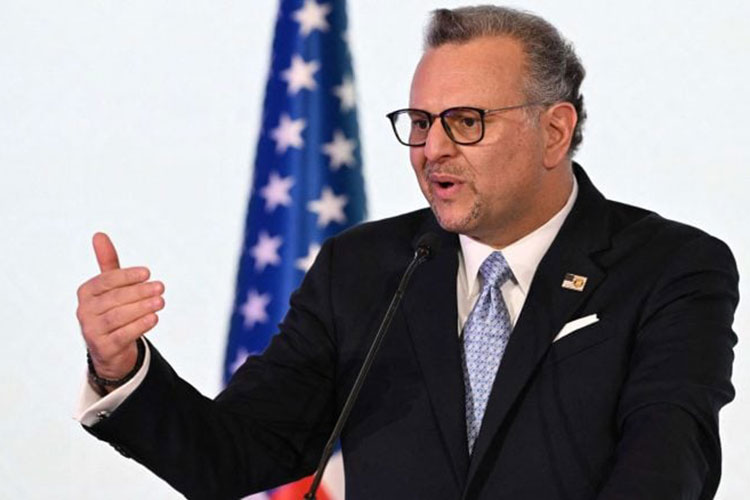
The senior advisor to the U.S. President for Arab and African Affairs, Mr. Massad Boulos, stated that Algeria does not bear responsibility for obstructing efforts to settle the Western Sahara issue, describing it as a «very good partner» for the United States, and praising the constructive role of President Abdelmadjid Tebboune and the Algerian government in this file.
Mr. Boulos pointed out, in an interview with the English version of the «France 24» channel, to the holding of three rounds of negotiations with the participation of the foreign ministers of Algeria, Morocco, and Mauritania, and the leadership of the Polisario Front, adding that these meetings, despite being «constructive and productive», did not lead to a final agreement regarding the conflict.
The senior U.S. advisor clarified that Algeria has provided great assistance in this file, noting that «the Algerians in the end cannot impose a solution on the Sahrawis by force», before adding: “but they can certainly encourage, and we believe they are already doing so”.
Mr. Boulos added that Washington is still waiting for the Polisario Front to submit its observations and proposals regarding the so-called autonomy plan, noting that his country does not see, at the moment, an imminent solution to the Western Sahara conflict, despite the rounds of talks that took place with the participation of Morocco, the Polisario Front, Algeria, and Mauritania.
He explained that the United States worked on Security Council Resolution 2797, which he said pushes toward reaching a «mutually acceptable» solution, stressing that «there is still much to be done, and more work to be accomplished», and that the American side continues to “engage and communicate with the Polisario Front”.
Mr. Boulos’s statements dismiss any responsibility of Algeria in stalling the settlement process of the Western Sahara conflict, at a time when Moroccan propaganda tries to implicate Algeria as a main party to the conflict, and also confirms that the issue is still on the table within the UN process, and that reaching a settlement for it passes through a political path that ensures the consensus of the two parties to the conflict.
Mr. Boulos’s statements come following a series of diplomatic contacts he conducted in New York on the sidelines of the UN General Assembly proceedings, which included two separate meetings with the Minister of State, Minister of Foreign Affairs, National Community Abroad and African Affairs, and the Moroccan Foreign Minister.
Commenting on the statements made by the senior official in the White House, former ambassador Amar Belani said that Boulos’s talk carried four messages that “put an end to the Moroccan narrative which considered that the Western Sahara file was settled in its favor”.
Mr. Belani explained, in a reading of the interview published on his Facebook page, that the first of these messages is Boulos’s acknowledgment of the absence of an imminent solution to the conflict, despite the diplomatic efforts made recently. He quoted him as saying: «there is no solution at the moment that can be felt or touched», considering that this statement contradicts the proposal that presented the UN resolution 2797 as decisive for the file, and that what remains is the implementation of its outcomes.
The former diplomat pointed out that negotiations are still stalling after three rounds, which means, according to his reading, that the UN resolution does not constitute a final result as much as it provides a framework for negotiations, and that reaching a settlement requires an agreement between the parties concerned.
Mr. Belani stopped at the second message, which he saw as Washington waiting for the response of the Polisario Front, without setting a deadline or issuing a warning to it. He said that Boulos confirmed that the U.S. administration is waiting for the Front’s observations regarding the submitted proposals, which he considered an indication that Washington does not deal with the process with the logic of imposing a pre-determined result or setting a final date for resolution.
As for the third message, it concerns, according to Belani, the U.S. position toward Algeria, after Boulos praised what he described as a constructive partnership with it, and thanked the Algerian authorities for their role in the political process. The former ambassador considered that this praise contradicts the Moroccan proposal that presents Algeria as the main obstacle to settling the conflict.
Mr. Belani added that the fourth message is Boulos’s clarification that Algeria «cannot impose a solution» in Western Sahara, but it can encourage the political process, a role that he said Washington acknowledged Algeria is performing.
The former ambassador linked this position to the nature of the roles played by the parties in the UN process, noting that Morocco and the Polisario Front are the two parties to the conflict, while Algeria and Mauritania participate as two neighboring countries in supporting the process and cooperating to reach a settlement.
Mr. Belani concluded that the statements of the American official mean, from his point of view, that the U.S. administration did not grant Morocco a «blank check», and that Resolution 2797 cannot be considered on its own a final solution to the conflict.
He finally underscored that the negotiating framework does not automatically produce a settlement, and that any agreement requires the acceptance of the parties involved, considering that obtaining the acceptance of the Polisario Front remains a fundamental factor in reaching a viable solution.