Cardinal Jean-Paul Vesco: “The Pope’s Visit to Algeria, A Historic Milestone with Symbolic, Spiritual, and Political Messages”
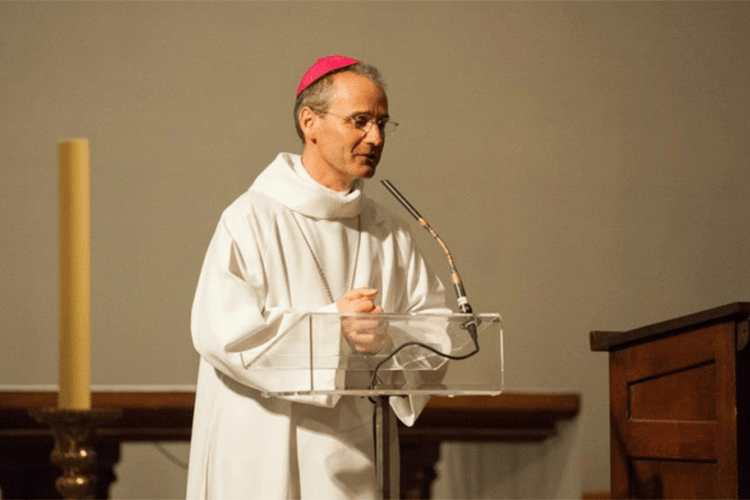
The Archbishop of Algiers, Cardinal Jean-Paul Vesco, highlighted the exceptional significance of Pope Leo XIV’s visit to Algeria. This visit was held under the banner “Peace Be Upon You.” The Cardinal called the event a historic milestone. He said it carried symbolic, spiritual, and political meanings.
During his appearance on Monday as a guest on the “Guest of the Day” program on Algerian Radio’s Channel 3, the Cardinal affirmed that the Pope is a “man of peace,” emphasising the relevance of this message in an international context marked by escalating conflicts.
He further explained, “War has resurfaced.” He said, “The world is witnessing a questioning of international law and the mechanisms meant to guarantee peace.” He added, “Believers are called to be living consciences that call for peace,” and they must transcend all religious differences.
The Cardinal emphasised that “this visit transcends the religious sphere.” He believes the Pope’s arrival is “an event of particular importance, not only for the Church, but for all the Algerian people.” He highlighted that “the Pope is coming for the sake of the Algerians,” which gives the visit a broader dimension.
He also pointed out that “the Holy Father addressed messages to Christians, Muslims, and young people alike, with an approach focused on openness and dialogue.” He highlighted “the importance of the words he spoke from Algeria, a country at the crossroads of cultures and civilisations.”
In the same vein, the Cardinal considered that “the official invitation extended by President Abdelmadjid Tebboune reflects the diplomatic dimension of this visit.” He recalled that the Pope is both a head of state and a religious leader. “He is responding to an invitation that carries profound significance in a world often marked by divisions.”
The Cardinal said he had encouraged this visit since the Pope was elected, telling him, “You should be the first Pope to visit Algeria.” The Pope responded positively to this invitation.
Speaking about the significance of the visit, the Cardinal explained that Algeria “lies on the shores of the Mediterranean Sea, at the crossroads of influences between North and South, East and West.” He also recalled the historical legacy associated with Saint Augustine, one of the most prominent figures of Christianity, who was born on this land, considering this historical depth to lend the visit an additional symbolic dimension.
He added that “the Pope’s visit program reflects this symbolism through highly significant stops, particularly the Martyrs’ Memorial, the Great Mosque of Algiers, and the Notre Dame d’Afrique Basilica,” explaining that this route “carries profound meaning,” as it simultaneously embodies “national memory,” “Islam as the majority religion,” and “the Christian presence,” in a coexistence based on mutual respect and recognition.
On the historical front, the Cardinal touched upon the memory of colonialism and the War of Independence, considering that “the Pope’s visit to the Martyrs’ Memorial represents a powerful gesture,” given that this monument “symbolises the spirit of a people and their attachment to freedom.”
He also stressed the “need to acknowledge the wounds of the past,” affirming that “colonialism itself is a destructive and criminal act,” while simultaneously calling for overcoming tensions and building lasting fraternity.
On a personal level, the Cardinal shared his experience in Algeria, where he has lived for over twenty years and holds citizenship, expressing his love for the country and describing it as a “belonging formed over time,” based on a deep connection with Algerian society. He also spoke of a “French-Algerian” identity, which he considers an enrichment that allows for a different reading of history and relations between peoples, noting that “the same events were not experienced in the same way,” referring to the differing memories on both sides of the Mediterranean.
In closing, the Cardinal emphasized the human and fraternal dimension of the visit, preferring to speak of “appreciation” and “respect” rather than simply “coexistence,” stressing that “the world suffers from a lack of fraternity,” and expressing his hope that “this visit will highlight the possibility of genuine relationships between people of different cultures and religions,” and that it will leave a lasting impact.