France’s Silence and Refusal to Open the Archives of Nuclear Tests in Algeria
International activist Jean-Marie Collin, known for his work on nuclear nonproliferation and security and defence issues, with particular expertise on French nuclear policy, criticised President Emmanuel Macron for failing to uphold the promises he made in 2017, which he termed the “forward deterrence” doctrine. This doctrine included a commitment to nuclear protection for European populations, which Collin argued contradicts “the current management of the humanitarian, environmental, and social consequences of the 17 nuclear explosions conducted in the Algerian Sahara and the 193 others carried out in French Polynesia between 1966 and 1996.”
Jean-Marie Collin stated that assistance for victims (French, Polynesian, and Algerian) and the rehabilitation of contaminated territories remain incomplete, raising questions about France’s claim to be a “responsible nuclear State.”
This criticism appeared in an article by the activist, known for his fight against nuclear proliferation, published in the April issue of the American magazine Inkstick, titled: “Can France Expand Nuclear Deterrence While Ignoring Its Legacy of Nuclear Tests in Algeria?” Collin asked: “How can a state that claims to protect European populations ignore the damage inflicted on other territories?”
The prominent French activist explained: “Since 2017, President Emmanuel Macron has promoted the idea of extending the protection offered by the French nuclear arsenal to include certain European countries. This prospect of “Europeanizing” deterrence is based on the argument of a deteriorating security environment, marked by Russia’s invasion of Ukraine and uncertainty about the United States’ security guarantees in Europe”. He noted that “European countries currently prohibit any deployment of nuclear weapons on their territories” due to the risks associated with such weapons.
Jean-Marie Collin criticised France’s failure to take responsibility in Algeria for cleaning up the sites of the nuclear tests conducted by the colonial army in the Algerian Sahara. He considered this a contradiction in France’s official policy on this sensitive issue, writing, “This inconsistency is particularly evident in the management of the nuclear legacy in the Sahara.” He added, “Paradoxically, it is now Algeria, a non-nuclear-weapon state, that is taking concrete steps to address these consequences. Long reduced to a diplomatic dispute between Algiers and Paris, the issue is now evolving. Algeria is no longer limited to demanding apologies; it has begun implementing concrete measures to rehabilitate its territory.”
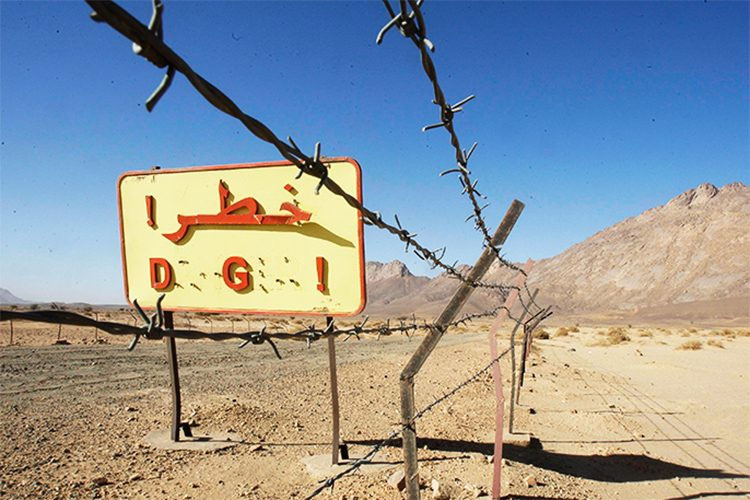
The expert on countering nuclear proliferation discussed some of the damage caused by these explosions and their repercussions on people and the environment in the areas exposed to radiation. He pointed out that “Explosions in Algeria exposed French military personnel, civilian workers, and local populations to ionising radiation, resulting in numerous radiation-induced illnesses. Environmentally, the legacy is equally troubling. Algerian researchers have mapped the atmospheric test area of Hammoudia, near Reggane, identifying 421,679 fragments of contaminated sand spread across an area of approximately 4,814 square kilometres (1,859 square miles). These findings highlight the scale of the environmental challenge.”
In addition, “radioactive waste was deliberately buried under the sand: scrap metal, aircraft, and trucks used during the explosions”, the article read. The author emphasises that “the presence of such materials underscores France’s obligation to act responsibly and ensure transparency regarding technical and topographical archives. Yet to date, the French executive remains silent and refuses to open the archives related to this period.
Jean-Marie Collin highlighted Algeria’s efforts to clean up France’s nuclear waste, noting that, “Faced with this situation, Algeria has structured a national agenda. In 2021, it created a National Agency tasked with rehabilitating former French nuclear explosion sites in the south of the country.”
This initiative came after Algerian authorities grew weary of Paris’s repeated requests for maps to accurately locate buried waste and for the agency to assume responsibility for its rehabilitation, Cllion added. “President Abdelmadjid Tebboune and the Algerian chief of staff have repeatedly and officially called on France to provide the maps needed to precisely locate buried waste and to assume responsibility for rehabilitation operations. The Algerian Parliament has also taken up the issue. On Feb. 13, 2025, the National People’s Assembly organised, for the first time, a study day dedicated to French nuclear explosions in Algeria. Ten recommendations were adopted, including the creation of a National Centre for Nuclear Memory. This marks the institutionalisation of the issue at the national level.
He also noted that Algeria has strengthened its external contributions in this regard: “At the international level, Algeria has also strengthened its engagement. In September 2025, during the 69th General Conference of the International Atomic Energy Agency (IAEA), it organised a side event, much to the displeasure of French diplomacy, on the remediation of contaminated sites. In October 2025, Algeria co-sponsored a United Nations resolution entitled “Addressing the legacy of nuclear weapons,” calling for an international meeting on victim assistance and environmental remediation. The meeting will take place on April 24, 2026. In addition, work is underway at the African level. And the African Union formally recognised the “Algiers Declaration” on colonial crimes, which calls for assessing the ecological impact of colonialism, including nuclear experimentation.”
Military action now complements this political momentum, according to Colin. As early as 2021, two engineering units were created to begin securing former test sites. Since February 2026, a more ambitious intervention phase has been underway at Taourirt Tan Afella, where 13 underground explosions were conducted, four of which were not fully contained. Radiation measurements are currently being carried out, a base camp has been established, and a secure storage site has been set up for the first radioactive materials collected.
Collin concluded that “the current dynamic opens up a double perspective. Algeria is a signatory to the Treaty on the Prohibition of Nuclear Weapons (TPNW) but has not yet ratified it. If it does so, it could strengthen its international legitimacy and gain political and technical support for environmental remediation. The Saharan desert would then no longer be merely the site of a catastrophe inherited from the past, but also a space for political and technical recovery in the service of nuclear justice.” He asserted that “at the same time, France, as a recognised nuclear-weapon state, cannot build the future of its nuclear deterrence in Europe without confronting its own history. Strategic credibility cannot exist without nuclear justice. It is time for Paris to stop running from its past”.