Arrests in Mali Raise Questions About Junta's real intentions

الشروق أونلاين
-
-
2133
-
0
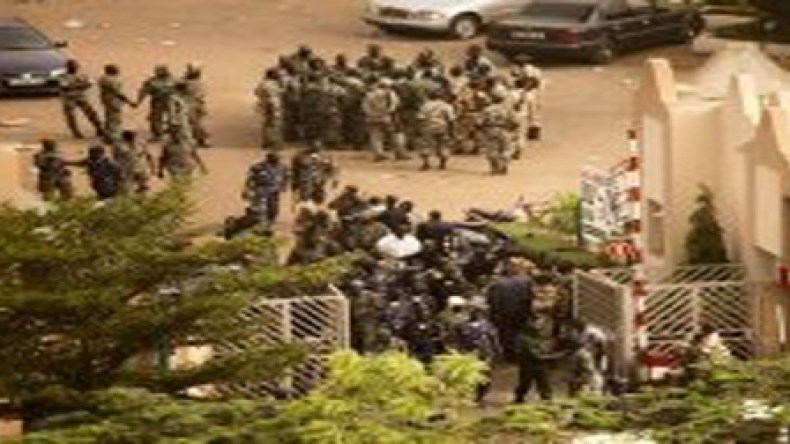
Casting a serious doubt on Mali’s transition back to civilian rule after a military coup last month which toppled President Amadou Toumani Touré, soldiers have arrested a number of leading political figures in the capital Bamako, according to members of the opposition.
- A former prime minister, Modibo Sidibé, was among those arrested, as was a leading member of the opposition and former finance minister, Soumaïla Cissé, who was injured while being seized, the opposition figures said. The men were arrested at their homes by the soldiers, some of whom were masked.
- The wave of overnight arrests — Journal du Mali, a Malian Web site, cited at least five — suggests that the junta that seized power on March 22 is not yet ready to give it up despite a series of solemn promises and ceremonies over the previous 10 days, including the swearing-in of a new civilian president.
- The arrested political figures were apparently taken to a military encampment outside the capital, Bamako, that serves as headquarters for the junta, the opposition members said.
- The junta has made no official declaration about the arrests. Mr. Cissé and Mr. Sidibé, who had been arrested previously by the junta, were to have been presidential candidates in an April 29 election that the coup squashed.
- The junta, led by an American-trained captain and other junior officers, ended two decades of democratic rule in Mali when it overthrew the government, seized the national television station, looted ministries and unwittingly turned over half the country to rebels in the north.
- President Amadou Toumani Touré’s government, hailed in the West as a democratic exemplar for the region, crumbled without a fight — suggesting that democracy was far less firmly implanted in Mali than outsiders had long believed and leaked embassy cables had indicted.
- After West African neighbors closed their borders with Mali and froze its funds in the regional bank, the junta leader, Capt. Amadou Sanogo, signed an agreement on April 6 that seemingly ended the coup. Now opposition members are expressing bewilderment at the arrests, saying they put the restoration of democracy in a very uncertain light.
- “The situation is very confused,” said Tièma Hubert Coulibaly, head of the Union for Democracy and Development party, who took part in negotiations to form a new government. “Nobody understands why they were arrested. There has been no explanation. There is a great deal of confusion.”
- Mr. Coulibaly said he was taking “precautions” for himself, adding that “a whole bunch of people” had been arrested.
- Despite the agreement with the regional grouping of West African states, Ecowas, ostensibly ending military rule, it has not been clear how willingly the junta would step aside.
- Captain Sanogo suggested even before the interim president, Dioncounda Traoré, was sworn in last week that he would be keeping a hand in running things, saying that “after 40 days we would sit down with Ecowas to decide on another team.”
- So even with the selection Tuesday of an interim prime minister, Cheick Modibo Diarra, a scientist, and the inclusion of civilians in negotiations for the transitional government, real command still appears to rest with the military.
- “These men have at their disposal a very powerful lever of power, in the relationship of forces,” Mr. Coulibaly said. “They have weapons.”
- Among others who were arrested, according to Mr. Coulibaly and Journal du Mali, were a former defense minister, a former director general of the national police and Mr. Touré’s former chief of staff.
- Mr. Coulibaly suggested that Captain Sanogo was not in full control of his forces, a view echoed by the chief aide to another leading political figure, Ibrahim Boubacar Keïta, a former prime minister who was also to have been a candidate on April 29.
- “There is a dichotomy between coup leader Sanogo and his troops,” said Mahamadou Camara, chief of staff for Mr. Keïta. “I think that Captain Sanogo does not really control them.” In any event, he added, “it’s rare to see the military give up power after only 15 days.”