Algeria in Push to Cut Reliance on Foreign Grain

-
-
1112
-
0
Algeria has launched a drive to boost its cereals output after a sharp fall in the price of oil, its main source of revenue, forced it to question how much longer it can afford to import most of its food.
-
The North African country is one of the world’s biggest grain importers and last year it spent $3.98 billion buying foreign cereals — a bill it was able to foot from oil and gas sales that account for 97.5 percent of its exports.
For this year at least, an expected good harvest has relieved some of the pressure but the drop in oil prices from nearly $150 per barrel last year to around $60 now is a reminder that Algeria’s dependence on imported food leaves it vulnerable.
“Oil has been a curse for Algeria. We export oil and import everything else including cereals, sugar, medicines, milk,” said Lyes Kahouadji, an independent agriculture consultant.
“The drop in oil prices could be a gift as it is putting pressure on the government to reduce our dependency on imports,” he told Reuters.
FINANCIAL SWEETENERS
One part of the government’s response is to provide new financial incentives for farmers. The state already subsidises many agricultural inputs and fixes the prices at which farmers sell their cereal crops.
“The government will reduce by 20 percent the price of pesticide,” said Bachir Koukatou, head of agriculture services for the municipal government in Mila, a town at the heart of Algeria’s cereal-growing country.
“It will also purchase a quintal (100 kg) of wheat at 4,500 Algerian dinars ($62) instead of 3,500.”
Improving farming techniques is another front in the drive to boost output, said Shakhri Mohamed El Hadi of Algiers University’s Technical Institute for Large-scale Farming.
The Institute, which works closely with the Agriculture Ministry, is planning next season to implement new techniques for irrigation in periods of drought, and for rotating crops to improve soil quality.
A drought last year cut Algeria’s grain harvest to 2.1 million tonnes — around half the figure for 2007 — and forced it to double the amount it usually spends on importing cereals.
“This is not acceptable. Being so dependent is a shame, and we should do all we can to bake our bread with our own wheat,” said Abdelaziz Bouzidi, president of a local chamber of agriculture in the Mila region.
FARMERS COUNT ON RAIN AND ALLAH
An Agriculture Ministry official told Reuters this year’s grain harvest was expected to be much better, with production of between 3.5 million and 4 million tonnes.Customs data showed imports of some cereals in the first quarter fell sharply on the same period last year in anticipation of the improved crop.
Local officials in Mila, 450 km (280 miles) east of the Algerian capital, said they were expecting a harvest this year of 140,000 tonnes from their region, against 100,000 tonnes last year.
“This season should be a good season. We got plenty of rain,” said local official Koukatou.
But farmers know that if the rains fail again next year, they could still face another poor harvest, and there was scepticism that the government’s measures would work.
“The incentives the government is talking about are very positive but we prefer to wait and see their implementation on the ground,” Bouzidi said.
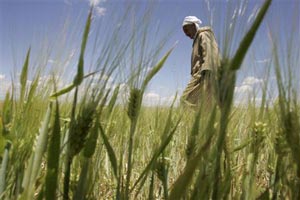
Surveying his field of durum wheat, Mila region farmer Mahmoud Aziouz said he was looking forward to a good crop when the harvest starts early in June.
But he was not convinced the authorities could do much to improve things in the long-term. “If the government is serious about helping us that’s good news,” he said. “But so far, I’ve heard nothing about these new measures.”
“I am pragmatic and I prefer to count on Allah to give us enough rain.”