Conceding Western Sahara To Morocco Is A “Dangerous Decision”
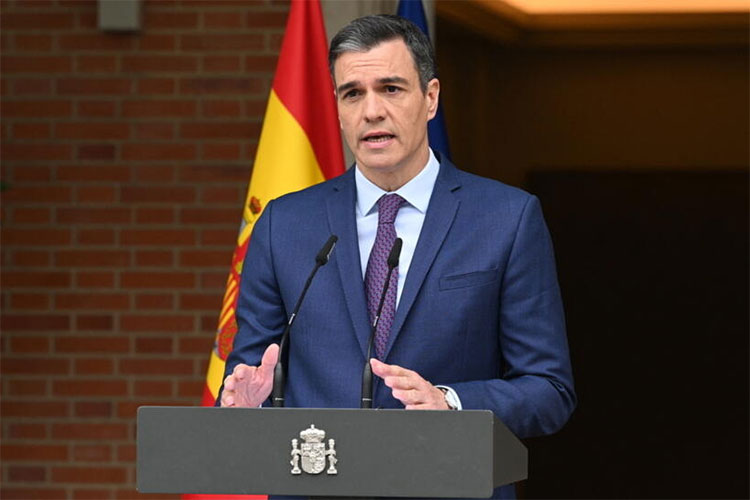
The repercussions of the change in Spain’s stance on the Sahrawi issue continue to cast a shadow over the domestic scene, causing more trouble for Pedro Sánchez’s government, as it is responsible for this shift that gave the Moroccan regime everything without receiving anything in return.
This is the conclusion of a study prepared by a senior official in the Spanish Army General Staff, responsible for managing medium and long-term strategic planning.
The study was conducted by Arias Otero, an analyst in the Planning Department of the Spanish Army General Staff, a key unit responsible for medium and long-term strategic planning. It was published by the Spanish National Defense Studies Center and contained strong criticisms of Pedro Sánchez’s government regarding its policy towards the Moroccan regime, which, as is well known, caused a severe and unprecedented crisis with Algeria about three years ago.
In the study, the Spanish Army commander warned that the Spanish government’s decision to support the Moroccan autonomy thesis regarding Western Sahara without obtaining clear concessions sends a dangerous message that: “Changes in positions, such as those that occurred with the recognition of the (alleged) sovereignty of the Moroccan regime over Western Sahara, without obtaining any return for Spain, indicate the possibility of taking an action that approaches the theory of appeasement.”
The study estimated that “this behavior of conceding certain demands without demanding anything in return is a dangerous approach in dealing between conflicting states,” and described the Moroccan regime as the aggressor: “Following this approach of appeasing the aggressor involves serious risks, such as the impossibility of knowing when the aggressor’s demands will end, as well as determining the limits and lines of concessions by the attacked party.”
More than three years after Madrid’s decision to support the Moroccan regime’s autonomy plan in Western Sahara, political and media elites in Spain have not yet discovered what Spain gained in return for changing its position.
It has been unofficially discussed on more than one occasion that the return was the Moroccan regime’s recognition of Spanish sovereignty over the occupied cities of Ceuta and Melilla, and the establishment of customs checkpoints there, considering them land borders between Madrid and Rabat.
However, the Moroccan side has continued to obstruct the establishment of customs checkpoints in the two occupied cities until today, which has put the Spanish government led by the socialist Pedro Sánchez in a great embarrassment before public opinion in his country.
He has been accused of giving the Moroccan regime what no previous Spanish prime minister had given, but without gaining anything. He also lost a lot with Algeria due to that stance, whose political and economic repercussions have not been fully overcome until today. As is well known, the Treaty of Friendship and Good Neighborliness signed between the two countries in 2002 remains suspended by a decision from Algeria.
Based on the study, Spain’s problems with the Moroccan regime continue even after the blank check given by the Sánchez government to Rabat regarding the Western Sahara issue.
Furthermore, Spain’s membership in both NATO and the European Union does not guarantee explicit protection for the cities of Ceuta and Melilla under Article 5 of the North Atlantic Treaty in the event of aggression, confirms the planning official at the Spanish Army General Staff, citing what happened in 2002 in what was known as the Perejil Island crisis, says Arias Otero, because Spain resolved the crisis alone after threatening force.