“Harraga”… The Moroccan Makhzen’s Weapon for Blackmail in the Sahrawi Issue
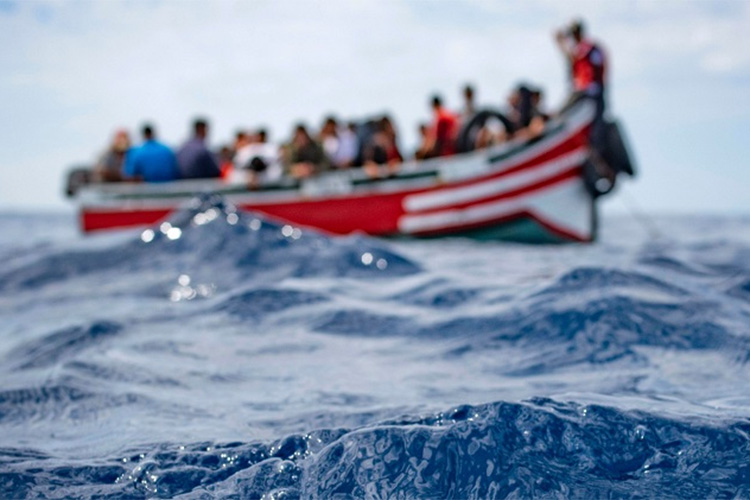
The Moroccan Makhzen regime continues to use irregular migration as a weapon for political blackmail, directing thousands of migrants towards Spain whenever it wants to exert pressure to extract concessions, especially in the issue of Western Sahara, in complete disregard for international laws and a clear disdain for international norms and conventions.
In this context, Sahrawi writer and political analyst, Taleb Ali Salem, said in an interview with the Spanish newspaper “La Gaceta” that Morocco does not deal with migration as a social phenomenon that requires treatment, but rather employs it as a hybrid weapon in its political battles, replacing the logic of regional cooperation with a policy of threat and intimidation.
He added that “the Moroccan regime uses the migration card to create crises when it fails to extract concessions through official channels,” pointing out that these practices confirm that this regime “does not hesitate to traffic in human beings as bargaining tools” and that what is happening “is not a momentary event, but part of an integrated strategy adopted by the Makhzen for decades, based on transforming human suffering into a diplomatic pressure card.”
For his part, Sahrawi human rights activist, Baba Ali Hasana, said in an article that the Moroccan regime exploits migrants, especially minors, as tools for political blackmail without any regard for their humanitarian situation or basic rights, adding that what happened in May 2021 constitutes a “stark example” of this exploitation, where Morocco pushed more than 9,000 migrants, including about 1,500 minors, to cross the border into the city of Ceuta within 24 hours, in a move that “was not spontaneous, but politically calculated.”
He explained that the Moroccan authorities did not only open the borders, but later refused to take back the children, despite the efforts made by Spanish child welfare institutions, which placed the host country under a great legal and humanitarian burden, pointing out that the minors were held in temporary centers, some in unsuitable conditions, due to the sudden number and the pressure of the crisis, while Morocco remained silent, refusing to bear its responsibilities.
Baba Ali Hasana stressed that this incident is not an exception, but rather falls within a systematic policy in which Rabat uses migrants as a pressure card, whenever it wants to create a crisis or convey political messages, adding: “The Moroccan regime does not deal with migration as a humanitarian or social challenge, but as a tool within the negotiation and blackmail agenda, indifferent to the consequences of that on the lives of thousands of people.”
In this context, Spanish researcher, Javier Ruiz, commented that Morocco manages a “black market for migration,” pointing out that the Moroccan regime does not hesitate to create crises and employ vulnerable groups as pressure tools, disregarding international laws and international conventions, in a systematic behavior that reflects the nature of a power that sees human beings as a means to achieve its political interests, even if the price is trafficking in human dignity and the security of the entire region.
According to testimonies from migrants and organizations such as “Border Forensics,” “Iridia,” and the “Moroccan Association for Human Rights,” the Melilla massacre on June 24, 2022, was not a spontaneous result, but a planned operation in which the Moroccan Makhzen participated with prior coordination.