Moroccan Demands For Bourita’s Head After Defeat Versus Algeria At AU
The loss of the Moroccan regime’s candidate in the elections for the vice-presidency of the African Union’s Peace and Security Council, Latifa Akherbash, to her Algerian counterpart, Salma Malika Haddadi, left a state of outrage in the Alawite kingdom, and voices rose to demand accountability for those who caused this defeat, which Moroccans do not view as an ordinary defeat.
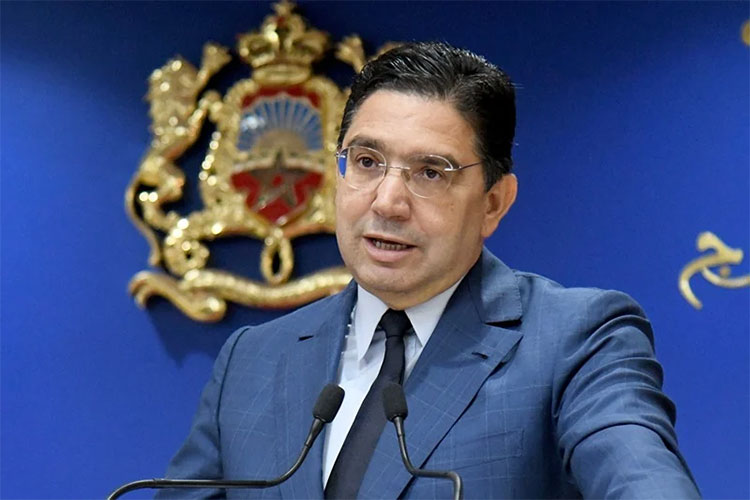
Moroccan Foreign Minister Nasser Bourita was harshly criticized as being directly responsible for this resounding defeat, which stretched over seven rounds, in which the Moroccan candidate was always behind the Algerian candidate, which made the defeat of the Moroccan regime’s candidate more than certain, since Algeria was only one or two votes short of reaching the quorum.
The Moroccan newspaper Tal Kal, which is close to the Alaoui Palace, summarizes the extent of the pain caused by this defeat to the Moroccan regime and the state of frustration caused by the election results among its close circles and its electronic flies on social networks. The newspaper titled: “African Union: Morocco in the Peace and Security Council, a calculated defeat.”
The newspaper describes the electoral elections led by the Moroccan regime’s representatives in AU institutions as a “STRESS TEST,” which in Arabic means “stress test,” a medical mechanism that measures “the nature of the heart’s work during physical activity,” referring to the extent of the suffering faced by the Alawite regime as it faces Algeria, which reminded it of the harsh phase it lived through before its withdrawal from the Organization of African Unity (OAU) in 1984.
The only Moroccan newspaper to acknowledge the existence of a fierce competition between Algeria’s candidate and her Moroccan counterpart, which ended with the loss of the Alaouite palace candidate, because everyone initially denied the participation of the Moroccan candidate in the election race, and “Tal Cal” hinted in its article that Bourita’s days are numbered at the head of the Alaouite regime’s diplomacy.
Moroccans blame Bourita for not withdrawing his candidate, Latifa Akherbash, from the race before the defeat, which they consider a scandal because it came against a country they consider an enemy, Algeria, because all the rounds before the decisive round were lost by the Moroccan candidate, which the newspaper described as a “calculated defeat.”
The size of the Moroccan shock can also be measured by the fact that the largest Moroccan online newspaper, Hespress, published the news that “the Moroccan king, Mohammed VI, is in the hands of God,” before deleting the news after about five minutes.
Observers understood the publication of this news, despite its seriousness, as an attempt by the Moroccan regime to direct the attention of the Moroccan people from the defeat against Algeria to a greater incident: the death of their ailing king.
Accompanying this controversy, Sabri El Hou, a Moroccan expert on international law and the Western Sahara conflict and president of the Academy of Strategic Thinking, strongly criticized the Moroccan regime’s decision to participate in the elections for the vice-membership of the African Peace and Security Council, without certain guarantees of victory, as long as the matter concerns Algeria.
“Morocco’s choice to run against Algeria in any continental, UN or other positions must be based on a study and weighting of the odds of winning and losing, and a determination to win from the beginning under the penalty of not running at all,” he said in an article.
“In case of uncertainty and doubt about Moroccan victory, it is better not to run at all and support another candidate from friendly countries! When it comes to the fight against Algeria, small details and details are calculated on an ant-egg scale, because they are very sensitive.”
This prompted him to accuse his country’s Foreign Minister Bourita of ‘recklessness for which he must be held accountable,’ because ”Morocco has no margin of error in its diplomatic battles, especially against Algeria, and any failure must be held seriously accountable.”