PM Sellal urges Algerians to “tighten their belt” and not to pressurize the government

-
-
1213
-
0
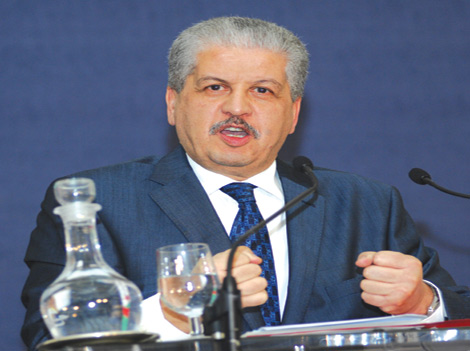
Prime Minister Abdelmalek Sellal asserted on Wednesday in Algiers, that the State will pursue its major investment projects and its policy of subsidy on the wide-consumption products despite the dwindling oil prices on the international market.
In a statement to the press on the sidelines of the 23rd Algerian Production Fair, Sellal said that the government has taken precautions regarding these price slumps and plans to pursue the five-year programme of public investments for 2015-2019.
The Algerian Premier further urged the Algerians to “tighten their belt” , as he put it, and not to bring pressure to bear on the government on account of the projected austerity measures dictated by the runaway decline of oil prices on the world market.
In the same context, President Bouteflika instructed on Tuesday the government to “rule out all questioning of the public investment policy which remains the driving force of growth and job creation, and which also allows to meet the social needs of the population, notably in the fields of education, higher teaching and training, healthcare and housing.”
During a restricted council devoted to the fluctuations of world oil market, the president of the republic affirmed that Algeria has “flexibility” to deal with the current crisis in oil price, he dubbed “worrying”, calling for the “rationalization” of public spending, imports and domestic energy consumption
President Abdelaziz Bouteflika assigned the government to inform the citizens about this crisis of declining oil prices and reassure them about the State’s capacities to rapidly curb its negative impacts on the national economy.
During this council held Tuesday on the immediate and urgent responses to plummeting oil prices, and thus curtailing Algeria’s export revenues for 2015, President Bouteflika underlined that the government has to ”explain to the national opinion, the reality and the challenges of the current oil price crisis.”
The OPEC decision to maintain unchanged its output ceiling at 30 mbpd, in the moment when the market is already oversupplied with the emergence of the shale oil has contributed to the price fall.
This decision has also put the OPEC countries in an unprecedented economic and financial situation, announcing brutal and formidable decrease of their oil revenues.
From an average $90-to-100 barrel last summer, oil prices have sharply dropped to less than $70 following the OPEC meeting, and may fall below the level of $60.
Algeria, whose oil revenues make up 97 percent of its hard currency earnings and 60 percent of the government’s budget, is beginning to feel the impact of the fall in oil prices that led it to lose almost 50 percent of its value and reach its five-year low.