Prejudice & the Paralympics

-
-
5113
-
0
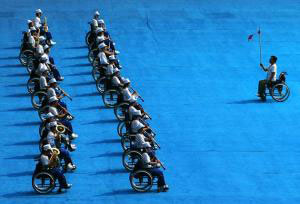
The Games are another chance for China to show the world what it can do. Yet this is a country where disabled people are shunned.
Wheelchair-friendly London cabs with distinctive Beijing taxi livery are waiting outside the Bird’s Nest stadium, buses fitted with ramps cruise the city and all over the capital there are banners and bunting proclaiming the arrival of 4,200 disabled athletes for the Paralympics, which start this weekend.
But it is not until you are inside the Paralympic Village itself that you see a single Chinese person in a wheelchair or one with any other obvious disabilities; China’s 83 million disabled are a largely invisible presence in a country where disabilities are viewed as a source of shame in some families, particularly in urban areas, and where discrimination is widespread.
The Paralympics are being hailed as an opportunity for China to deal with these deep prejudices and as a catalyst for improving the situation for people with disabilities in China. Experience in other cities hosting the Paralympics has shown that the situation for the disabled improves after the Games. Cynics in the city say that the Paralympics will do as much to change prejudices against the disabled in China as the Olympics did to improve human rights. Precious little, in fact.
Disabled people face enormous difficulty getting jobs and health care. Many of China’s 12 million blind people can take jobs only as blind masseurs at special blind-massage parlours. Disabled Chinese are regularly referred to as can fei, which basically means “useless cripple”, although there have been efforts to have disabled people referred to by the direct translation can ji ren.
But Communist ideologues keen to promote China as a nation of healthy, strong model workers and farmers during the era of Mao Zedong spent a lot of time reinforcing prejudices against the disabled. They were not allowed to marry, and forced sterilisation of the disabled was common practice, as was selective abortion.
In May, an official guide for Olympic volunteers had to be rewritten after it characterised the disabled as “stubborn and controlling” and “unsocial and introspective”. The shocking references were attributed to a translation error, and the Beijing organisers were deeply embarrassed by the way the media launched a broadside over the story, although the Chinese version was pretty similar, in effect.
“The most unacceptable thing for me is not being recognised by families and by society as a whole,” wrote one disabled commentator, Ai Na. “Once a family has a disabled person, many people presume this family must have done bad things, that it is a kind of karma. When I was a little girl, if my brother brought friends home, I had to stay in my room and lock the door. This behaviour came to be normal some time later. Every time friends or relatives come by, I get nervous. Playing outside for me is like entering a strange and frightening world.”
One European athlete in a wheelchair told of how a whole roomful of migrant workers in a hotel canteen stopped eating and stared open-mouthed when he entered the room. But foreign athletes visiting the capital city say that great advances have been made even in the past few years in making the city easier to negotiate as a disabled person.
Beijing, which has one million disabled citizens, has undergone a three-year programme to improve accessibility at train stations, airports, hotels, hospitals and shops. Li Caimao, the director of the city of Beijing’s Disabled Persons Affairs Committee, who is himself a polio victim, admitted discrimination still exists but hopes the Paralympics will break down some of the prejudices. “In the past 10 years, China has built more facilities for disabled people, and I feel China has paid more and more attention to disabled people. The laws to protect them have been revised this year. The government has made some policies to encourage disabled people to take part in society, and the attitude of Chinese people towards the disabled is improving.”
Among the efforts being made to welcome disabled athletes has been a lifting of a ban on guide dogs in Beijing for the two months around the Olympics and Paralympics, although blind athletes need special authorisation to bring their guide dogs.
The May earthquake in Sichuan, which killed upwards of 170,000 people, left many thousands of people maimed, as rescuers were often forced to perform quick amputations to rescue people from the rubble. A commonly expressed fear among the parents of children who had lost limbs in the quake was that they would not now be allowed to take the college entrance examination, because students must pass a medical examination first which often bars disabled people from entry.
One disabled blogger, who wrote under the nom de plume Hai Xiao Beiyi, addressed an open question to Wen Jiabao, the hugely popular Prime Minister of China who has a grandfatherly image since his tireless relief efforts during the earthquake. “What can China’s 20 million poor disabled people do? Why can our country’s good policies not be put into effect? Why can disabled people not be given money in a direct way. There are many disabled people who are willing to be independent and self-reliant and to reduce the burden on their families. But when they set up a stall, some urban officials drive them out, even insult them. Why do they do this?”
Xiao Hai, a disabled man from Shandong, wrote that joblessness among the disabled is the highest in the country. “It’s incredibly difficult for us to get a job. We need to live, to raise our families and get a job. Compared to able-bodied people, our education, medical treatment and housing conditions are worse. Sometimes we even get discriminated against or insulted.”
One of the most famous disabled people in China is the wheelchair-bound former Paralympian Jin Jing, who was hailed as a hero in China when she shielded the Olympic flame from pro-Tibet protesters who threw themselves at her and tried to snatch away the torch during a chaotic leg of the relay in Paris on 7 April. She became a focus of national defiance in the face of international displeasure at China’s crackdown in Tibet in March. Images of her holding on to the torch were broadcast repeatedly on Chinese television. She even received a message of support from the French President, Nicolas Sarkozy.
But Jin Jing’s subsequent refusal to endorse a nationwide boycott of the French supermarket chain Carrefour and her call for better international understanding earned her the ire of nationalists around the country.
Another well-known public figure who is disabled is Deng Pufang, the son of the former supreme leader of China, the late Deng Xiaoping. He was paralysed after being thrown from a window during the period of political tumult in China known as the Cultural Revolution (1966-76). He is now president of the China Disabled Persons Federation.
Mr Deng believes that the success of the Paralympic Games would help boost China’s disabled people and contribute greatly to the development of the world Paralympic Movement.
One Beijing resident, Li Xuemei, 64, whose husband is blind, thinks the Paralympics will earn more respect for the disabled. “When we are in the bus, the conductor is particularly warm to us and many passengers are willing to give their seats to us. And when we are in streets, volunteers are also willing to guide us,” she said.
Yang Yang, who has been in a wheelchair since a swimming accident at the age of 10, lives in Chengdu in Sichuan province, where wheelchair access is primitive. But he said: “China has made a lot of improvements for disabled people. As to Chinese people’s attitude to disabled people, I think people have changed. The Paralympics will be an opportunity for China and Chinese people to pay more attention to disabled people. What worries me most is that all these good things, people’s attention and the many special facilities, cannot last forever. I hope these things are not just for a short while. I hope China can persevere in doing these things.”
China is expected to have a good Paralympics, just as it had a great Olympics. Beijing topped the medals table at the Athens Paralympics and is fielding 332 athletes for the 2008 event.