Reasons behind Chicken Prices Increase

-
-
283
-
0
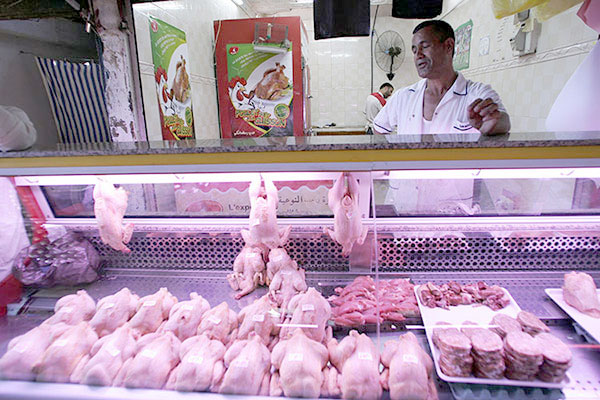
Cause of the increase of the chicken is the reluctance of breeders from production because of the large financial loss that they recently suffered as a result of the low prices of white meat which reached 200 DZD, General Manager of the Company of Poultry, Aissat Mohamed Ouidir, told the Algerian Radio 1, while being at the Morning Guest program.
“All these factors led to a lack of production in front of the large demand in the Algerian market”.
“Poultry breeding conditions in Algeria are inappropriate – given the specificity of this field, that requires a moderate temperature to ensure the chicken growth – as several problems occur especially in the summer due to high temperature and the lack of air conditioning inside the poultry farms, which led to the suffocation and death of a large number of chicken.”
“There is a need to provide conditioners inside the chicken breeding houses, and not to rely only on natural ventilation to provide all conditions for breeders to ensure the healthy growth of chickens and provide considerable production to avoid higher prices in the future”.
“Algeria has all the structures for poultry farming, as it made considerable efforts in this area, this is why it must work to cover the needs of the national market.”
“Our company produces about 8000 tons of chicken that is oriented for consumption per year, and 18 million chicks per year, of which 12 million are marketed to private breeders. Algeria produces 500 million chicks annually”.
“In the framework of the investment program that is adopted by the company, we opened new units for slaughter in Oued Djar, where 2000 chickens are slaughtered per hour, and in Berouaguia where there will be the slaughter of 1500 chickens per hour, and the modernization of Tapokert abattoir in Tizi Ouzou province. There are 10 points of sale in the company, where the price of chicken is 350 DZD per kilogram”.
“Algerian citizen consumes between 14 to 15 kilograms of chicken a year. Private companies contribute in covering the national production and some of them fail to adopt some health surveillance of poultry, and the majority are committed to the intensive vaccination program”.