Study on climate change in Algeria: Echorouk got it exclusively

الشروق أونلاين
-
-
1756
-
0
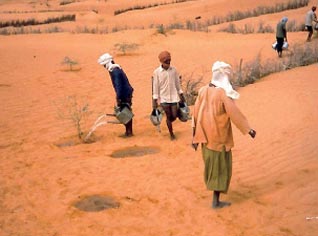
High temperatures, fires, droughts, floods, high humidity, epidemics and diseases, are some of the results of global warming in Algeria, which had noticed serious signs in the recent years.
-
Echorouk obtained a modern study by a specialist in climatology Dr. Abderrahman Medjrab. It showed the relationship between the current climate change and these phenomenons in Algeria.
-
-
Dr. Medjrab said changes in the weather is rather the phenomenon of volatility of the seasons and overlap related to each other, which begun in the recent years, known as climate change in the world, particularly in the Mediterranean.
-
-
“Change in temperature back to 600 years, however this rise was relatively small, and in the last 15 years significant increase of temperatures was noticed, due to the global warming”.
-
-
Algeria has been affected by climate change in the world during the past 15 year. The phenomenon of cold weather in the eastern regions particularly in Constantine on the 3rd February 1999, when temperature dropped to 13 degrees grade, and on the 23rd November 2000, Chelef, west of Algeria, recorded more than 62 mm of rain drops that caused a flooding in less than 24 hours, Algiers also noticed sudden floods on the 11th November 2001, which reached 260 mm in less than 24 hours, on the 27th January 2005 Tiaret, west of Algeria, snowfall exceeded 13 cm and temperature dropped to 13 degrees grade and in Bayad snowfall reached 21 cm, while temperature dropped to 15 degrees grade, in Medea 60 cm of snowfall and 9 degrees grade and 14° in Setif, east of Algeria.
-
-
An alarming situation
-
-
-
The latest study by the professor Medjrab on climate change on water surface in the west of Algeria, which was presented during the World Conference of the Geographers in Tunisia 2008, including the west of Algeria, considered the region of semi-dry and Dry climate, showed that Algeria’s climate will know a big rise in temperatures raging between 4.2 and 5.6°, particularly, since the rate of vaporisation is estimated to 80% in Algeria, 87% in Tunisia, and over 80% in Morocco, meaning that there is the problem of warming and high rate of vaporisation.
-
-
“We tried in this study to know the general direction of rain fall and temperature, as well the impact of the two elements on water in dams. First we discovered that the annual rainfall from 1913 to 2005 was in a steady decline, using Man Kanden and Spearman testing, starting from 1970. This decline was recorded in 16 out of 21 stations which were subjected to experience. We found, through the use of Man Kanden tests, that there is no increase in the amount of rainfall at the annual level, however, on the seasonal level, we found a significant decline in the amount of rainfall in six stations, on the other hand, there was a decrease in 19 stations during the winter, meaning that this change happened during this season”.
-
-
“So, the general direction of falling is declining, particularly in autumn and winter, most important periods for agriculture. As for the overall direction of temperature, we used the same stations, 21 from 1950 to 2006 (28 years) and we observed that the average temperature was over the normal, which begun from 1990, with an average maximum temperature of 32.4° in 2004, and for the minimum temperature we found 21.2° in 2003, in Oran, west of Algeria.
-
-
“In order to learn more of these changes, we arranged the same years in some coastal and inland cities, depending on the importance of temperature. We found that the hottest years were 2003 with 33° and 2004 with 23.3° in Oran as a coastal city, and 37.8° in 2005 in Chlef, west of Algeria, as an inland.
-
-
Soil erosion, reduction of plants’ life cycle and high rate of salinity in the ground
-
-
-
The National Office of Meteorological warned of the natural disasters in Algeria during the coming years, asking the public authorities to take the necessary measures in order to avoid damages, through applying the law on conducting the natural disasters, as well as issuing an executive decree which defines functions of the various sectors that are involved in case of nay emergency, as that Algeria will live in a series of various climate fluctuations in the coming period.