Vlaminck: Expressing mood with color

-
-
835
-
0
Paris, where the revolution that changed the political order of Western societies was sparked by an outburst of popular rage, is also the city where an explosion of artistic rage put an end to a thousand-year-old Western tradition of figural art.
This message may not be the point of the book “Vlaminck, un instinct fauve,” which accompanies the show on view at the Musée du Luxembourg until July 20, but readers and viewers will decipher it for themselves as they gaze at the œuvre of the man who mattered most among the half-dozen painters at the heart of the Fauve movement.
The quiet Maurice de Vlaminck, born in Paris in 1876, was not the most likely figure for a revolutionary role. His parents were music teachers. The boy learned to play the violin with his father, who later initiated him to musical harmony. His two hobbies, reading popular fiction in illustrated editions and collecting the brightly colored vignettes distributed with coffee packets, did not exactly point to a future career as an artistic firebrand. Nor did his attempts at painting while in his late teens. It all started with a chance encounter when Vlaminck, 23, was about to finish his national service in the army.
On the train that took him to Paris from Chatou in the Paris area, the future artist engaged conversation with another young man, André Derain. The two struck up an instant friendship that would last a lifetime. They decided to spend the next day painting together, and when Vlaminck left the army in September 1900, the aspiring artists rented a studio for a year in which they worked together until Derain in turn went to complete his national service.
How Vlaminck emerged that year as a driving force in the nascent Fauve movement remains a mystery. To sustain himself, he gave violin lessons or performed in bands at night and painted in the daytime. Two paintings, both dated 1900, show that it was then that he broke with the century-old European tradition of individualized portraiture. The precise circumstances in which he painted “Sur le zinc” (At the Bar) and “L’homme à la pipe” (Man Smoking a Pipe), alternatively known as “Le Père Bouju” (Old Bouju), are not known.
“At the Bar” reveals an awareness of Toulouse-Lautrec’s snarling portrayals of prostitutes and solitary drinkers, but goes far beyond sardonic scrutiny. In this study of an aging prostitute, Vlaminck makes no attempt at probing the sitter’s psychology. This is the impersonal cartoon of a type. The woman’s breasts aggressively jut forth under the white dress, in which a flower is stuck, and a cigarette limply hangs from her heavily rouged lips. Drink addiction is suggested by her reddish nose tip. While the woman’s features were clearly observed from life, no trace remains of her individuality. Tragedy is conveyed through the expressiveness of contrasting color and oversimplified line. Nothing of the kind had yet seen the light of day in Western art.
In “Old Bouju,” similar exaggeration distorts the man’s appearance, with his hat tilted at a rakish angle and his red scarf tied around his neck in an attempt at foppishness. Although individual features like the big slanting eyebrows or the high cheekbones are noted, here too Vlaminck chose to paint an expressive type, not to fathom the sitter’s personality.
In a telling parallel, Vlaminck, when looking at nature, ignored landscape details, merely seeking an excuse to express his mood through violent color and brushwork. The Fauvist revolution was under way.
“Sous bois” of 1904 is a symphony of colors in which the subject is almost irrelevant. Black strokes purportedly depicting trunks and branches create a staccato rhythm across a space shot through with green, yellow, red and blue. The colors bear no relationship to material reality.
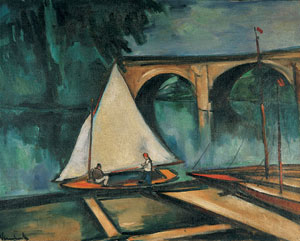
Within a year, Vlaminck made another leap, deconstructing the physical world into colored particles in motion. “Le Pont de Chatou” (The Chatou Bridge) from the Museum of Fine Arts in Houston or “Les Ramasseurs de pommes de terre” (The Potato Pickers) from the Kunststiftung Merzbacher in Küsnacht near Zurich, both done in 1905, are landscapes in name only. While the influence of van Gogh is clear, Vlaminck went further. In “The Chatou Bridge,” paint runs down in curving strokes as in some uncontrolled stream of visual consciousness. Black touches punctuate the composition like furious exclamation marks. The wheels of a cart are carmine red and blackish blue. Here, color transcribes turmoil in the mind, not physical perceptions.
In “The Potato Pickers,” nature disintegrates into fireworks of color streaks. Four silhouettes, merely outlined, barely maintain a figural character. The temptation to dissolve the visible world into color fragments tumultuously swishing about grew stronger. With “La Seine à Chatou” (The River Seine at Chatou), from the Wadsworth Atheneum Museum of Art in Hartford, Connecticut, the shorthand rendition of boats, houses and trees coming above the abstract tapestry of the lower half suggests that Vlaminck was thinking of breaking with figural art.