A French Objection Within Bilateral Commission to the Term “Martyr”
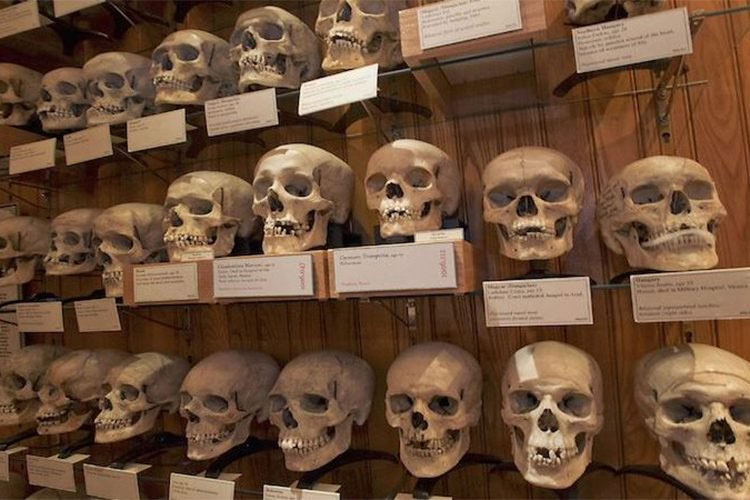
A report by the Cultural Affairs and Education Committee of the French National Assembly revealed that there is a French objection to the word “martyrs” in the report of the Joint Memory Commission between the two countries, about identifying the identities of the skulls of Algerian resistance fighters placed in the French museum.
These details were revealed through a report by the Cultural Affairs and Education Committee of the French National Assembly, dated November 7, 2023, devoted to studying the bill approved by the Senate related to the restitution of human skulls belonging to public archives.
During the discussions, the French Minister of Culture, Rima Abdul Malak, said in her response to the MPs’ questions, saying: “Thank you all for this calm and in-depth debate on an important and eminent subject. Regarding the Algerian human skulls, about which several of you have questioned me, I would first like to emphasize that a bilateral commission having carried out rigorous scientific work reached a consensus, validating the identification of twenty-four skulls recognized as Algerian”.
“In the absence of law, what followed was not restitution in the legal sense of the term, but a deposit. It was the story that was told in Algeria that sparked controversy and confusion, particularly because of the use of the term “martyr”, she added.
The discussions were not without spiteful interventions from some right-wing MPs (the Republican bloc- LR), as MP Annie Genevard stated that she opposes some of the proposed amendments to the bill, noting that the law must guarantee the completion of the process of handing over skulls for “funeral purposes,” noting that the Minister Culture touched on the issue of restituting the Algerian martyrs’ skulls, and although they were done for funerary purposes and were carried out for funerals, the French party was unable to prevent the “Algerian story.”
The French MP levelled several accusations against Algeria against the backdrop of the restitution of the skulls of resistance fighters and martyrs, and claimed that Algeria “restituted the skulls for political exploitation.” According to her, the law “if the condition of handing over skulls for funeral purposes is deleted, will open the doors wide to all intentions, including those that we do not want,” in a clear indication that many French parties did not accept, on the one hand, the restitution of the skulls of Algerian martyrs and resistance fighters, and did not accept, on the other hand, the Algerian party’s insistence on using the term “martyr.”
The LR’s MP, with expressions of hatred evident in her intervention, added that Algeria “made the process of restituting the skulls a tribute to the martyrs, which gave the process political goals.”
In a clear insult to the martyrs of the Algerian resistance, the RN’s MP Caroline Parmentier, belonging to the extreme right leader Marine Le Pen, criticised President Emmanuel Macron’s decision to hand over the skulls to Algeria, claiming that it was a disaster because they were not all Algerians and that Macron was seeking to obtain a diplomatic achievement behind this operation.
Previously, The proposal for enacting a law that would allow France to restitute the skulls of Algerian martyrs was supposed to be presented during a special session of the parliament scheduled for March 2023 after it was submitted nearly a year ago to the French Senate, and was approved, the French RFI MP Carlos Martens Bilongo revealed, in a statement to Echorouk on February 2023.
The parliamentary session that was scheduled to consider the bill was postponed due to the racist campaign against the left-wing MP of African origins, during a plenary session of the French Senate, by one of the far-right’s RN MPs, Grégoire de Fournas, as he directed racist expressions to him that led to the suspension of the session by the president of the French Parliament, Yaël Braun-Pivet, at the time, and the RN’s MP was punished.
This proposal came within the framework of a bill in the French National Assembly, dated November 2, 2022, N° 398 titled “A Proposal for a Law Aiming to Authorize France to Restitute the Algerian Skulls”, which copy is available to Echorouk, was presented by 84 MPs and included three articles, the first of which stipulated that; “From the date of entry into force of this law and by way of derogation from the principle of the inalienability of French public preserves set out in article L. 451-5 of the heritage code, the thirteen Algerian skulls kept in the national preserves placed under the care of the National Museum of Natural History – Musée de l’Homme, cease to be part of these preserves”.
Article 2 states that “the administrative authority has, from the same date (the law’s entry into force), a period of one month at most to hand over these archives (skulls) to the authorities of the People’s Democratic Republic of Algeria”.
The 3rd Article stipulates that the twenty-four skulls that were deposited with the People’s Democratic Republic of Algeria in July 2020 are definitively returned to the latter.
The French Association “Le Grand Maghreb” have also submitted a request to the Ministry of Higher Education, the Environment and Scientific Research to facilitate the procedures for handing over the skulls to Algeria, to enable the latter to bury these skulls with dignity in their original land, adding that “France, known internationally for its defence of human rights, is not honoured by depriving martyrs of a dignified end, which is burial, just as the history of France does not accept dark stages in its historical past”, according to the expression of the source.
Marking Algeria’s Independence Day on July,2,2020, President Abdelmadjid Tebboune announced that the country would receive the remains of 24 of its independence fighters killed during the Algerian popular resistance against French colonialism. In a military ceremony, he announced that “in a few hours” military planes arriving from France would land at the Houari Boumediene Airport with the remains of the martyrs.
“They [martyrs] have been deprived of their natural and human right to be buried for more than 170 years. Led by Cherif Boubaghla and Sheikh Ahmed Bouziane, the leader of the Zaatcha (Oasis) Resistance and their brothers, the remains include a skull of a young man who was younger than 18 years old,” said Tebboune.
French colonial rule faced fierce resistance in Algeria, which was then met with a brutal crackdown by colonial forces.
In the 19th century, France shipped off the skulls of 37 resistance fighters to be stored at the Musée de l’Homme in Paris.
Algeria has been demanding to return the skulls since 2011 for their burial — a demand rejected by Paris.
Later, French President Emmanuel Macron announced that French officials were ready to enact a law that would allow them to hand over the remains, though the process was delayed for years.
Tebboune pledged after he came to power on Dec. 19, 2019, to restitute the fighters’ remains and bury them in Algeria.
France occupied Algeria for 132 years starting July 5, 1830, until July 5, 1962, when the country declared its independence from colonial rule.
During the struggle for independence, more than 1.5 million Algerians were killed, while hundreds of thousands more were injured, went missing or were forced from their homes.