Moroccan Drugs and Weapons Trafficking Networks in Southern Spain
Concerns are growing within European security services regarding the increasing role of criminal networks linked to Morocco in leading both drug and arms trafficking in southern Spain.
These networks’ activities were not limited to smuggling hashish across the Strait of Gibraltar to the north. They also involved gangs linked to Morocco in transporting and distributing military weapons to drug traffickers. As security investigations have indicated, this has contributed to the militarisation of organised crime and increased security threats in Andalusia and along the Mediterranean coast.
According to the Spanish newspaper El Español, criminal networks linked to Morocco and southern France have become pivotal in supplying weapons to drug traffickers in Spain. These networks have established organised smuggling routes that transport thousands of assault rifles and large-calibre weapons to southern Spain.
Sources within the Spanish security services, citing numerous media reports reviewed by the Algerian Press Service, indicated that these organisations rely on extensive networks in Turkey and Eastern European countries. This allows them to acquire weapons from conflict zones and then transfer them to the black market in Europe.
The sources explained that gangs linked to Morocco and southern France have, in recent years, expanded their operations within smuggling networks operating in the Campo de Gibraltar region, the Costa del Sol coast, and the Guadalquivir estuary golf of Cadiz—key routes for drugs entering Europe.
In this context, the same sources confirmed that these networks are increasingly supplying local gangs with assault rifles, making the presence of weapons of war almost a constant feature in drug trafficking operations, particularly those involving narcotics distributed by Moroccan gangs under the Makhzen regime.
The data also indicated that weapons are often transported overland from France, concealed in modified vehicles with secret compartments, known to investigators as “heated cars.”
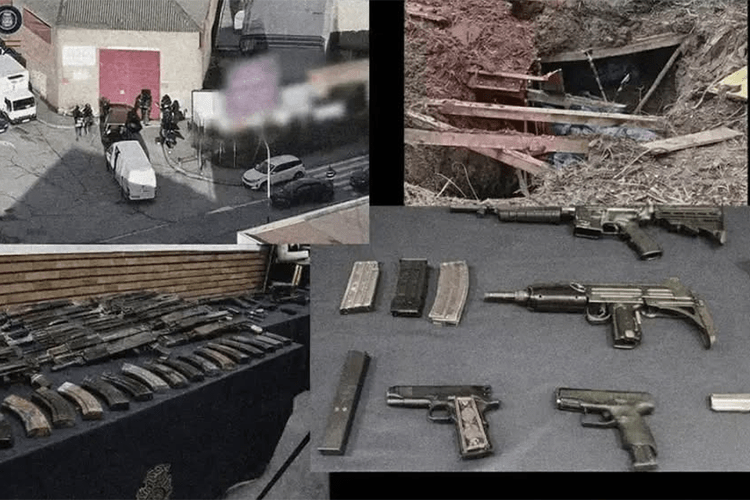
A recent security operation revealed the use of vehicles of this type to transport weapons from France to Spain in what was described as one of the largest seizures ever seen in Madrid.
In another operation led by anti-narcotics units in Marbella, police discovered a massive underground drug cache known as “Narcozulo.” Inside, they found thirty packages of cocaine weighing a total of 1,056 kg, as well as an arsenal of weapons, including AK-47 assault rifles, AR-15s, UZI machine guns, three pistols, and sophisticated communication and jamming equipment.
The operation resulted in the arrest of four people, three of whom are Moroccan nationals, and the seizure of three luxury vehicles, two of which were stolen.
Investigations confirm that these weapons were intended to secure drug smuggling operations originating from Morocco or to protect clandestine warehouses where shipments were hidden before distribution.
This operation, in turn, led to further investigations in the Algeciras area, where police seized an additional 25 firearms, including 19 assault rifles and 6 pistols, hidden inside a vehicle whose driver had left it for several hours before returning to retrieve it.
Security experts believe that the proliferation of these weapons is linked to Morocco, which has become a key transit point for these arms into Spain. This reinforces concerns that the region is becoming a logistical hub combining drug trafficking and arms dealing.
Sources within the Spanish Civil Guard confirmed that gangs are no longer hesitant to use weapons of war during confrontations with police, a practice that was previously rare. In less than six months, specialised units have seized more than fifty rifles, and several shooting incidents have resulted in injuries to members of the security forces.
Several reports reviewed by the Algerian Press Service indicate that, in light of these developments, concerns are growing within European security circles about the role of networks linked to Morocco in fueling this criminal market. Traditional drug trafficking routes have transformed into conduits for the reciprocal transfer of weapons of war, bolstering the power of criminal gangs and exacerbating the security threat in Southern Europe.