Algeria Punishes Spain Again In The Second Hydrogen Corridor Project
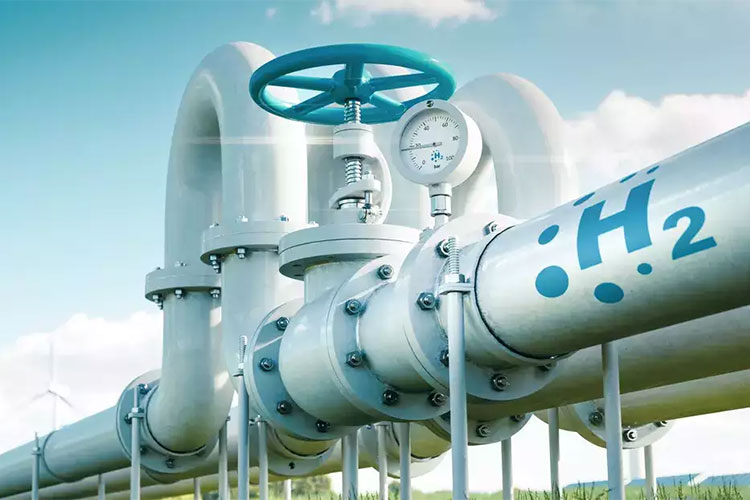
Some economic and political elites in Spain read Algeria’s decision to exclude Madrid from the Second Southern Hydrogen Corridor project in favor of Italy as a continuation of Algeria’s anger against Spain since the decision of the Prime Minister-designate, Pedro Sanchez, to change his country’s position on the Sahrawi issue in a way that serves the agendas of Morocco’s Makhzen regime.
This issue was the focus of the Spanish specialized newspaper El Economista, which spoke of Madrid’s tendency to lose a bet it has been working on for a long time, namely its transformation into a green energy center in Europe.
The newspaper wrote: “Last January, the Spanish government celebrated Germany’s inclusion in the H2Med project, a green hydrogen corridor that will be operational in 2030. In parallel with this project, the Second Southern Hydrogen Corridor project “SoutH2” was born, which is the pipeline that Berlin wants. “It will increase the energy independence from Russia. It will connect Algeria, Tunisia, Italy, Austria and finally Germany”.
The newspaper discussed in detail the project launched last week by the Minister of Energy and Mines, Mohamed Arkab, and said that this corridor is considered part of the “Transmed Gas” pipeline after its completion, which is a pipeline with a length of 2,475 kilometers and currently has the capacity to funnel 33.5 billion cubic meters of Natural gas to Italy, starting from the Algerian region of Hassi R’Mel, where there are the largest natural gas reserves in the country, one of the largest in the world. From there, it extends over a distance of 920 km to the Tunisian city of El Haouaria in the Ras El Taieb region overlooking the Mediterranean Sea, and from there to Sicily, then through the Strait of Messina to northern Italy, then to Slovenia, Austria and finally, after its extension, to Germany.
The newspaper goes on to explain that the pipeline transporting green energy from Algeria has a length of 3,300 km, in addition to its production capacity of 4 million tons per year. This would allow it to transport “more than 40 percent” of the import target set by the REPowerEU program, while more than 70 percent of the canal network connected to SoutH2 is being planned, allowing the corridor to be connected to green hydrogen production stations.
The newspaper focused on the meeting between Energy Minister Mohamed Arkab and the German State Secretary for Economic Affairs and Climate Protection, Stefan Wenzel, last Monday in Algiers, during which Arkab expressed Algeria’s desire to become a supplier of about 10 percent of green hydrogen to Europe.
To confirm the seriousness of this project, El Economista spoke of another meeting held last Wednesday in the German city of Munich to discuss the second southern corridor. For this purpose, 78 experts, legislators, industrial leaders and European Commission officials from Algeria, Tunisia, Italy and Germany met and discussed the possibility of facilitating the transport of green hydrogen across borders, and Sonatrach committed to invest 25 billion euros to improve the production of hydrogen and the infrastructure for its transport.
The newspaper also sees this project as serving Italian interests, pointing out that the meeting between Italian Prime Minister Giorgia Meloni in Algeria and President Abdelmadjid Tebboune aimed at strengthening cooperation between the two countries in the field of energy. It pointed out here that Germany will have two corridors that will increase its energy independence from Russia starting in 2030. This comes at a time when France is preventing Spain from laying pipelines to the heart of Europe, with the aim of reducing Spain’s economic and political weight both in Europe and elsewhere in North Africa.