Algiers Declaration Renews Refusal To Militarize Solution In Libya

-
-
1014
-
0
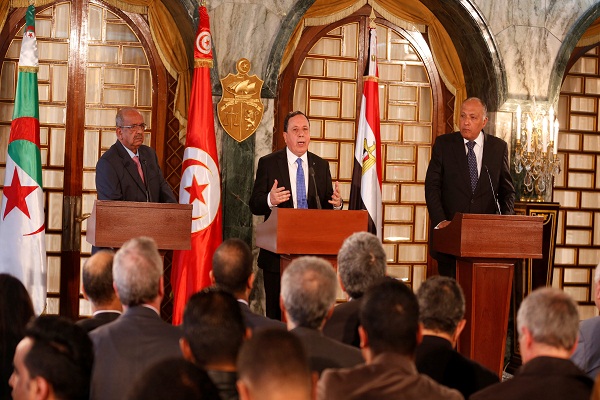
Algeria, Tunisia and Egypt Foreign Ministers asserted the need to refrain from any measures that would obstruct the political settlement process in Libya, renewing the commitment to support the political solution through the comprehensive dialogue, rejection of foreign intervention and military option.
Algerian Ministerial Declaration to support the comprehensive political settlement in Libya, which culminated in the meeting of the Foreign Minister, Abdelkader Messahel, and his Egyptian counterpart, Sameh Shoukry and Tunisian, Khemais Al-Jhinaoui, includes “the absolute necessity to refrain from using violence, incitement or taking any measures which would lead to escalation that prevents the continuation of the path of political settlement in Libya, and directly affect the continued suffering of the Libyan people, especially on the economic and humanitarian levels”.
Algeria’s ministerial declaration to support a comprehensive political settlement in Libya warned: “”The deterioration of the situation has implications for the security and stability of Libya and the region as a whole and is in the interest of terrorist groups because it gives them room to expand their criminal activities”, confirming the importance of strengthening coordination and exchange of information between the security interests of the three countries as an effective means to combat terrorism”.
Algiers Declaration also confirmed the importance of adhering to the steadfast positions of the participating countries regarding the resolution of the Libyan crisis, which is based mainly on Libya’s unity, territorial integrity, sovereignty, and the political solution as a way to address the crisis through comprehensive dialogue, and the rejection of external intervention and military option.
The Ministers commended the efforts that are made by Algeria, Egypt and Tunisia in their efforts to bring the Libyan parties closer together, to involve all actors and to expand the circle of consensus, renewing their full commitment to supporting Libya and accompanying it on the path of political settlement of the crisis.
On the other hand, the foreign ministers of Algeria, Tunisia and Egypt expressed their satisfaction with the Libyan parties for reaching a the terms of the Libyan political agreement on the amendment. They also praised the importance of the mechanism of Libya neighboring countries, which was initiated by Algeria and its proposal to resolving the Libyan crisis that is based on promoting dialogue and national reconciliation.
Foreign Ministers expressed their “satisfaction with the Libyan parties to determine the terms of the Libyan political agreement on the amendment, and encouraging them to expedite the launch of the negotiation process with the aim of adopting consensual formulas and completing the implementation of the terms of the political agreement.”
The ministers of the three countries also praised the “positive steps to form a joint committee for dialogue and meetings that brought together important Libyan political and field figures”.
“Algiers Ministerial Declaration to Support the Comprehensive Political Settlement in Libya asserted the importance of the mechanism of Libya neighboring countries, which was launched at the initiative of Algeria in May 2014, on the sidelines of the ministerial meetings of the Non-Aligned Movement, and the approach that was adopted by this mechanism in resolving the Libyan crisis, based on accompanying the Libyan people on the path to restore security and stability, and mention the various outputs of its meetings”.
During its last meeting that was held in Algiers on May 8, Libya’s neighboring countries agreed on the necessity of committing themselves to promoting national reconciliation in Libya, and rejected all kinds of violence and foreign intervention, especially the military intervention, in order to establish the national reconciliation in the country.
The ministers also praised the role of their countries (Algeria, Tunisia and Egypt) in advancing the international political process and the efforts of the United Nations Mission to continue the process and considered the transfer of the UN Mission headquarters in Libya to Tripoli as a “positive step”.
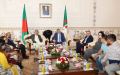
During the meeting, the ministers of the three countries reviewed the security situation in Libya and the armed confrontations that are witnessed in several cities and regions of the country, and efforts of the Libyan parties at the national and local levels which aimed at resuming the comprehensive national dialogue, and establishing the national reconciliation within the framework of the tripartite initiative which includes Algeria, Tunisia and Egypt, and efforts are made by the three States to encourage the Libyan parties to find consensual solutions to the points of contention that impede the implementation of the political agreement.
During the last meeting that was held in Algiers on May 8, the Libyan neighbors agreed on the necessity of committing themselves to promoting national reconciliation in Libya, and condemning all kinds of violence and foreign intervention, especially the military intervention, in order to established the national reconciliation in the country.
In conclusion, it was agreed that the next meeting would be held in the Arab Republic of Egypt and that the date would be set later in consultation between the foreign ministers of the three countries.