Ali Haroune reveals details on the suspension of elections of 1992

الشروق أونلاين
-
-
870
-
0
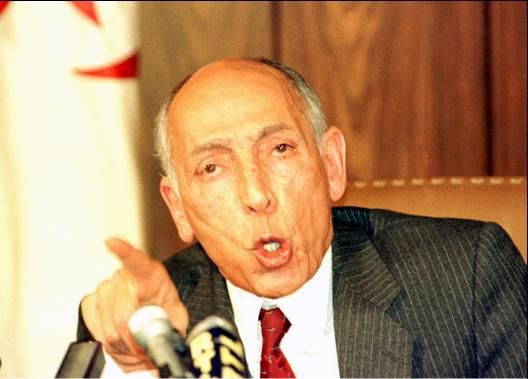
Late President Mohammed Boudiaf adressing his last speech
Ali Haroune, one of the four masterminds of the suspension of electorate process in 1992 following the land slide victory of the Islamic Salvation Front (FIS), has just published a book, where he reveals interesting details on the forcing- out of former President Chadli Benjdid, and the resort to late Mohamed Boudiaf to replace him from 1992 to 1994 before being assassinated.
- Former Minister of Human Rights in the cabinet of Sid Ahmed Ghozali (1991-1992) says in his fresh issued memoires entitled: “Clarification: Promotion of Human Rights and Fears (1991/1992),” that “FIS achieved undisguised and spectacular victory in the first legislative elections in the multipartism era.”
- “Larbi Belkhir (Interior Minister) looked defeated while stepping at the microphone to announce the elections 1st round catastrophic results: FIS: 188 seats, FFS: 25 seats, FLN: 15 seats,” Ali Haroune says.
- “The first cabinet meeting after the first round elections results decided to suspend the process in order to save the country from being seized by extremist Islamists and civil war risk,” Haroune mentions in his book, adding: “General Nezar who was sitting at the left of Ghozali endorsed the decision.” Haroune specified that Minister of Justice Leila Asslaoui and Minister Anissa Benameur welcomed enthusiastically the decision.
- Ghozali and Nezar decided to establish a commission composed of four influential figures, including General Abdelmadjid Taghit (Commander of the Navy Forces) and General Touati on behalf of the military institution, in addition to Minister of Communication Aboubakr Belkaid and Minister of Human Rights, Ali Haroune, the author added.
- The next step of the commission was to implement the suspension of the elections process on the ground, despite the categorical rejection of the political class, which called on respecting the will of the people.
- Then, the commission was looking for a legal exist to this dilemma, Haroune says, adding “amid this controversy, the commission focused on the article 84 of the constitution of 1989 which talks about the vacation of the post of President and how to fill it. The commission decided to replace President Chadli Benjdid through a legal way, leaning on article 84 which stipulates that President is replaced in case he is unable to practice his constitutional functions due to serious disease, resign or death.”
- The solution then was to force Chadli announcing his resign on air, in order to avoid second-round elections, Ali Haroune admits. Secrets meetings were held between Nezar and Chadli, says the author, which ended by forcing President Chadli to address the people and announce his resign note written commonly by Taghit, Haroune and Touati.
- Mohammed Boudhiaf, one of the emblematic figures of the Algerian Revolution, and who lived in Morocco, was contacted to replace Chadli.
- Boudiaf hesitated for a while, before accepting the proposal, to become the fourth President of Algeria (1992-1994).