Anti-Corruption: Algeria’s PM Calls Upon Foreign Countries to Help Recover Smuggled Money
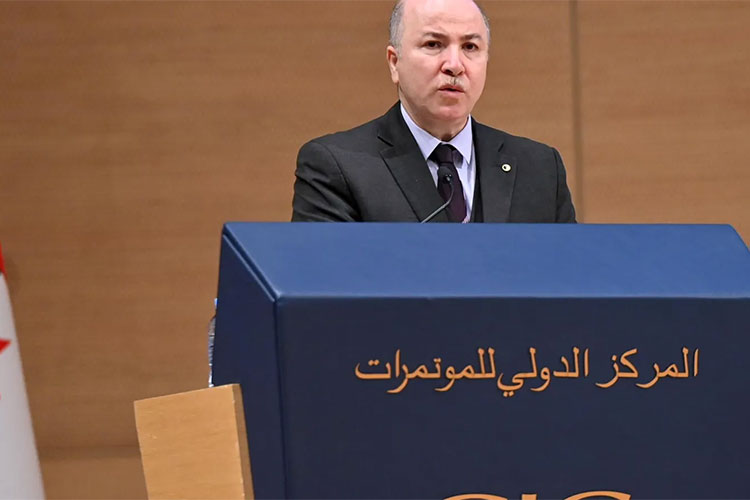
The Prime Minister, Aimene Benabderrahmane, called on foreign countries “calling for the fight against corruption” and ” the fight against bribery” to stand by Algeria in recovering the money that the former corrupt persons smuggled abroad, saying: “The war against corruption in Algeria has gone beyond the theorizing stage. Today, it has entered the stage of application and implementation in the field”.
During his supervision of the forum for the official launch of the National Strategy for Transparency, Prevention and Combating Corruption, at the International Conference Center on Saturday, in the presence of members of the government, high-level foreign and Arab delegations and 300 participants, Benabderrahmane said: “Some countries have turned into havens for corrupt people. I call on all countries to help us and help developing countries to recover the smuggled money”.
During the forum, supervised by the Supreme Authority for Transparency, Prevention and Combating Corruption, the Prime Minister added: “These countries ask to combat bribery without assisting us. Rather, some provide a haven for money smugglers. I take the opportunity to request our accompaniment with the appropriate mechanisms. These abuses lead to corruption, and you are more aware of it.”
Benabderrahmane affirmed the government’s commitment to combating corruption and accompanying the authority supervising the implementation of the strategy that extends between 2023/2027 in this regard, considering that its official launch coincided with the commemoration of the twentieth anniversary of the African Union Convention to Prevent and Combat Corruption, as well as with the first anniversary of the inauguration of the Supreme Authority for Transparency and prevention of corruption, praising the efforts of the President of the Republic since his election, who has paid great attention to the ethics of public life and the fight against corruption in all its forms. For this purpose, many undertakings have been implemented, especially those related to promoting good governance, and a comprehensive reform of justice to ensure its independence and modernization.
Benabderrahmane recalled the various articles of the 2020 constitution that contain corruption, including protecting the national economy from any form of manipulation, activating the role of civil society to participate in the conduct of public affairs, the duty to declare property and avoid situations of conflict of interest, and that jobs and terms in state institutions are not a source of wealth or a means to serve private interests.
In this regard, the Algerian government – according to him – has included the fight against corruption, economic and social life in its annual work plan, by setting organizational and procedural rules aiming directly or indirectly at ensuring the transparency of the management of public money, moving away from nepotism and clientelism, and separating corrupt money from politics, which the President of the Republic – says the Prime Minister – was its pioneer, through his strict decisions that he took at the time. Through that, he purified political work from everything that distorts or deviates from prioritising the country’s supreme interest and distancing it from every personal, partisan or circle’s interest.
Benabderrahmane explained that corruption is a transnational phenomenon, and takes multiple and complex forms, which requires strategic planning based on scientific foundations and methodologies, through the use of the experiences of countries that preceded Algeria in this field, and cooperation and exchange of experiences with organizations that are active in this framework, and mainly, through the concerted efforts of all actors on the national and international arena.
The Prime Minister concluded that this national strategy will become, from now on, a binding document for all parties, as it should be implemented and monitored to follow up on its implementation following the measurable indicators established under the monitoring and evaluation systems attached to this strategy, during the five-year period 2023-2027, which will be supervised by a national commission is made up of various officials and social partners, headed by the chairman of the supreme authority.