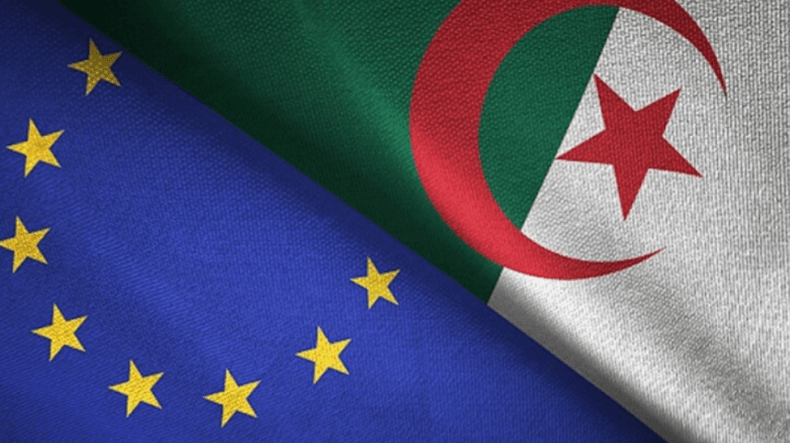
European Union countries announced that they had reached a preliminary agreement on a temporary and dynamic gas price ceiling, which Algeria rejected.
Europeans confirmed their determination to start negotiations for collective purchases of natural gas, with reliable partners, including Algeria, Norway and the United States of America.
After marathon negotiations at the EU headquarters in the Belgian capital, Brussels, the European bloc countries agreed, on Thursday, to adopt a plan to reduce the rise in energy prices and their weight on families and companies, by adopting measures to set a ceiling for the price of gas within the framework of the Dutch free market reference for the European continent known as TTF, which will be practical within two to three weeks, according to French President Emmanuel Macron.
The leaders of the European Union also reached an agreement on collective purchases of natural gas, provided that negotiations will be initiated with what they described as “reliable partners”, such as Norway, Algeria and the United States of America.
As is known, Algeria is bound by bilateral agreements to market gas in Europe, and the various contracts concluded include clauses about the final destination of Algerian gas, which allows Sonatrach to benefit from additional revenues if the supplied gas is transferred to a country then to a destination other than what the contract stipulated. Especially since there are initiatives for European solidarity in this regard and the transfer of gas from one country to another, according to demand and need.
President and General Manager of Sonatrach, Toufik Hakkar, had previously confirmed that the issue of the gas price ceiling was not related to the free market mechanisms and that the criterion is the “market”, given that the two parties are linked to official contracts signed between them.
In response to a question by Echorouk, Hakkar said during a press conference that followed the signing of the agreement to review the prices of gas contracts with Spain’s Naturgy two weeks ago; “As you know, European countries are among the countries that most adopt free market mechanisms, and price ceilings have nothing to do with any connection to free market mechanisms”.
“Even the gas price ceiling is an idea that must be discussed, but this does not serve the market and does neither serve the interests of consumers nor producers in the medium and long term… We hope to return to a balance between supply and demand while respecting market mechanisms and this is the most important for us.”
Previously, The European Union’s energy commissioner hailed a “long-term strategic partnership” with Algeria Tuesday (11 October) as the bloc turns to Africa’s biggest gas exporter to fill a gap left by Russian supplies.
As the relationship with Russia, so far EU’s biggest gas supplier, is irreversibly broken, we are turning to the EU’s reliable suppliers to fill in the gap,” said Kadri Simson.
“In this respect, we are offering Algeria a long-term strategic partnership.”
Simson is the latest in a string of top European officials to visit Algeria in search of more natural gas since Russia cut gas supplies to Europe in retaliation against Western sanctions.
Algeria has helped Europe diversify its energy supplies by pumping more gas to Italy, which in July signed a deal to import billions more cubic metres via an undersea pipeline from the Algerian coast.
Algerian-EU cooperation in the field of renewable energy is very important since Algeria has various income diversification possibilities, including natural resources, abundant sunshine, and hydrocarbon energy capable of boosting the country’s reindustrialization. According to a 2005 study by the German Aerospace Center (DLR), Algeria has the highest concentrated solar power (CSP) production potential in the world, as well as significant photovoltaic (PV) and wind energy capacities. To diversify its energy mix dominated by gas and oil, Algeria aims to reach 15,000 MW of solar energy by 2035. The country has also signed a partnership with Germany whose objective is to produce, and eventually, export green hydrogen via the pipelines connecting it to Europe.
In parallel, the EU’s Green Deal is aiming for climate neutrality by 2050 and a cut in Europe’s greenhouse-gas emissions by at least 55% by 2030. The Fit for 55 packages, a set of proposals by the Commission to revise and update EU legislation, suggest initiatives to increase the current EU-level target of at least 32% of renewable energy sources in the overall energy mix to a minimum of 40% by 2030. In parallel, the REPowerEU Plan, a set of financial and legal measures in response to the global energy market disruption, aims to accelerate the EU’s green energy transition with investment in clean energy production, and energy efficiency projects as well as through the diversification of Europe’s energy suppliers.
Long-term cooperation on renewable energies seems to be in both parties’ interests, although the pressing issue of Europe’s energy security and the possibility to increase Algeria’s gas export to the EU remains a priority as confirmed by the declaration made by the EU’s Commissioner for Energy, Kadri Simson, in Algiers last Tuesday about the European Union’s intention to expand the nature of its partnership with Algeria in the long term.
In conclusion, while Algeria has little spare capacity to increase its hydrocarbon exports in the short term, it holds far more promise for Europe as a long-term partner in renewable energy. The EU will increasingly invest in countries that prioritize renewable energy projects in order both to decouple its energy sector from Russian hydrocarbons and fit its long-term climate action objectives. In tandem, investing in renewable energy sources could translate into considerable socioeconomic benefits for Algeria by freeing up large volumes of natural gas, currently used for domestic electricity generation, for additional exports to the EU.
Recommendations By Brussels International Center
under the title “Europe’s Energy Crisis and the Opportunity for an EU-Algeria Renewable Energy Cooperation”, a report published on Monday, October 17 on the BIC’s website analysed the energy cooperation between the two parties and provided key recommendations:
-The EU should continue supporting Algeria in the creation of favourable investment conditions to allow for both countries’ transition towards renewable energies. One way could be cooperation to improve Algeria’s investment climate by aligning the terms of public tenders and power purchase agreements with international best practices.
-Algeria and the EU should work on an agreement entailing the necessity to install renewable energy production capacities equivalent to the volumes of fossil fuels supplied to Europe. Such initiatives could involve the construction of solar and wind installations – and perhaps even concentrated solar power stations, whose cost might be balanced by their capacity to provide power for several hours after sunset.
-Renewable energies require high technological capacities and high investment costs. Through the European Investment Bank (EIB) and the European Bank for Reconstruction and Development (EBRD), the EU should boost Algerian investment in thermal power plants, considering the price of the solar kilowatt-hour is lower than the price of energy production from fossil fuels. One avenue could be a partnership through technology transfer to train local researchers in the fields of new energy technologies in exchange for an Algerian engagement to use part of the dividends from hydrocarbon exports to finance the energy transition. Europe could also accompany Algeria in creating opportunities for pilot projects involving green hydrogen by exploring ways to exploit low-cost energy in industrial activities.