French Officials Joined the Convivial Ramadan Iftar in Paris Grande Mosque
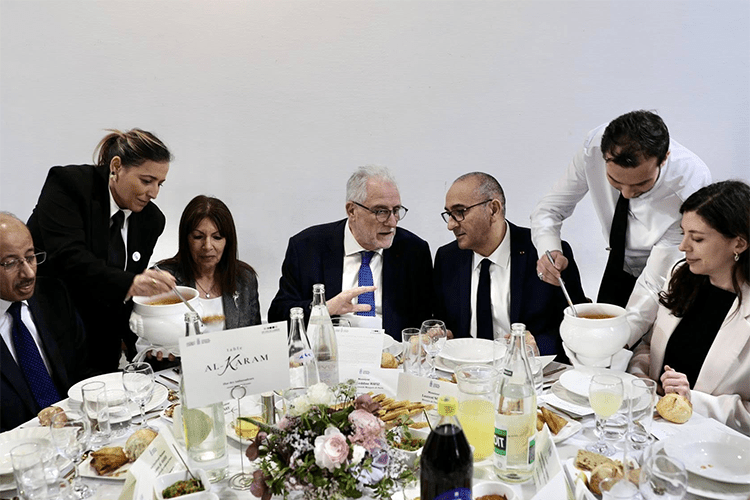
In an expected move, French Interior Minister Laurent Nuñez accepted the rector of the Grand Mosque of Paris, Chems-Eddine Hafiz’s, invitation to attend the iftar meal, which the mosque has hosted in recent years during Ramadan.
The iftar was attended by French politicians, ambassadors from Arab and Islamic countries, and religious figures of various nationalities.
On Thursday, March 12, 2025, the Grand Mosque of Paris hosted its fifth annual Ramadan iftar. Among the prominent figures attending was the current Interior Minister, Laurent Nuñez, whose ministry oversees religious affairs. Also present was Marie-Pierre Vedrenne, the Minister Delegate for Citizenship in the government of Prime Minister Sébastien Lecornu, according to a statement released by the Grand Mosque of Paris on its X account.
The French presence at this iftar dinner extended to include political and administrative figures from various levels, such as the president of the “France-Algeria Association,” former minister Ségolène Royal; the mayor of Paris, Anne Hidalgo; the prefect of Paris and the Île-de-France region, Marc Guillaume; the Paris police chief, Patrice Faure; the mayor of the 5th arrondissement, Florence Berthout; and several members of the French National Assembly and Senate. Also in attendance were ambassadors from several Arab and Islamic countries to France, the director of the Arab World Institute in Paris, and the director-general of UNESCO, MPs, senators, elected officials, and representatives of various religious groups.
The ambassadors of Saudi Arabia, Bahrain, Bangladesh, Comoros, Djibouti, Egypt, Gambia, Jordan, Kazakhstan, the Arab League, Palestine, the Muslim World League, Mauritius, Mauritania, Oman, Sudan, Tajikistan, Tunisia, Turkey, Yemen, as well as representatives of Algeria, Azerbaijan, the United Arab Emirates, Gabon, Iraq, Kosovo, Morocco and Chad, participated in this important event.
Over the five years that the Grand Mosque of Paris has hosted the Ramadan iftar, only one French Interior Minister has been absent: former Minister Bruno Retailleau. This absence sparked considerable political and media controversy in France, as his justifications were not universally accepted. He cited his respect for the principle of secularism, while simultaneously participating in other Christian and Jewish religious events.
Since assuming his post as French Interior Minister, Laurent Nuñez declared that he would not follow the approach of his predecessor at the Hotel de Beauvau. Nuñez criticised the handling of relations with Algeria and repeatedly refused to be drawn into media disputes with Algerian authorities. His de-escalation choice culminated in an official visit to Algeria in mid-February, during which he was received by the President of the Republic and praised the visit’s outcomes.
So how can we interpret the French government’s presence at the iftar hosted by the Grand Mosque of Paris, a religious institution known for its close ties to the Algerian state? Could this be seen as an indication of a quiet movement to restore the lost calm in relations between Algeria and Paris?
Professor of Political Science and International Relations at the University of Algiers 1, Toufik Bougaada, believes that the French Interior Minister, and by extension the French state, is seeking to maintain the recently restored channels of communication between the two countries, following his visit to Algeria last month.
The analyst told Echorouk that “Laurent Nunez, by accepting the invitation of the rector of the Grand Mosque of Paris to the Ramadan iftar, has decided to chart a different course from his predecessor at the Hotel de Beauvau. This new approach prioritises establishing a truce with Algeria and, by extension, with its large community in France, numbering in the millions, which cannot remain hostage to the disputes between the two countries.”
According to professor Bougaada, “there is a trend on both sides to reduce the great tension that has characterized bilateral relations, which erupted following the biased position in favor of the Moroccan regime taken by French President Emmanuel Macron in the summer of 2024 on the Western Sahara issue, a fact that emerged remarkably before and after the French Interior Minister’s visit to Algeria about a month ago.