“Exclusive”: Echorouk sheds light on landmarks of late Chadli Bendjedid’s memoirs

-
-
1975
-
0
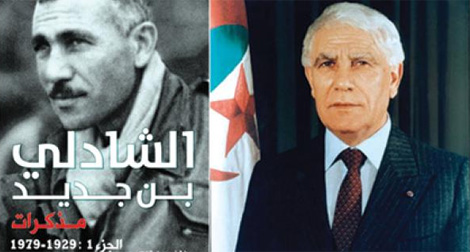
In an exclusive report, Echorouk delves into the milestones of the lifetime memoirs due to be published in early November 2012 of the late former Algerian President Chadli Bendjedid who passed away last Saturday at the age of 83 at the Ain Naâdja military hospital in Algiers after battling with a long illness.He was buried on Monday at the Martyrs’ square of Al Alia cemetery in eastern Algiers with full honours in the presence of President Abdellaziz Bouteflika and other senior officials amid a large crowd of mourners.
During the revolutionary war for Algeria’s independence, the man was pointed at the head of eastern military base then, deputy head of the northern military operations. At the country’s hard-won independence, he was the first officer of the eastern base to enter the Algerian territory with the view to facilitating access to the military troops stationed at the frontiers.
He was then appointed head of the of the sixth military district, the present fifth military district base din the province of Constantine, eastern Algeria and supervised the evacuation of the French troops from this Northern Constantine.
In 1964 Chadli Benjedid was appointed commander in chief of the second military district in Oran, western Algeria, and aborted the coup conducted by colonel Taher Zebiri in 1967.
During the 1970s he was a staunch opponent of the reforms initiated by the late president Houari Boumedienne especially in the agriculture and industrial sectors. He considered that land should be given to the people who worked it.
Despite his staunch opposition to Houari Boumedienne, the man was one of his intimates and kept an unflagging friendship with the late president until his death.
Once in office he started an iconoclastic policy that faced fierce opposition from the barons of the old guard. One of the measures consisted in breaking loose from the traditional ally the Soviet Union and an historic trip to Brussels, after Italy then the United Sates in 1986.
13 years after taking office, he was forced to resign in the wake of the troubles that swept through the country in 1992 living room to a directorate to take the destiny of the country. History will record his famous words before living power: “When I had to choose between power and conscience, I chose the second one, he said repeatedly, adding by the same token that history had been unfair to him”.
As said in his memoirs, late Chadli Bendjedid made the decision to introduce multiparty elections in 1988, as ordinary Algerians responded with outrage to the brutal military quelling of riots and protests sparked by a slumping economy and soaring food prices.
Prompted by a mixture of genuine sympathy and political self-interest, Bendjedid dismissed the prime minister and the head of military security before organising two referendums that sealed constitutional and electoral reforms.
The Islamic Salvation Front (FIS) was one of 39 parties formed as a result, and was seen as the principal challenger to the National Liberation Front (FLN), the party of power, which had led the anti-colonial uprising against the French occupation.
The first test of the new system came in local elections in June 1990 and resulted in a devastating defeat for the FLN, as Islamic candidates captured the bulk of seats. The government accepted the result but, in March 1991, three months before the country’s first free general election, introduced crude new electoral rules that appeared little short of blatant gerrymandering.
The measures sparked a new wave of popular protest and, just three weeks before the June 27 poll, troops were sent to clear the Islamic Salvation Front from key city centres that it had occupied forcefully for 10 days.
He also imposed a four-month “state of siege” that banned strikes, demonstrations and subversive publications, and ordered late-night curfews in trouble spots. In October a second electoral law was introduced.
Despite this, when the first round of the delayed elections was finally held on December 26 1991, the result was a stunning victory for the Islamists of the FIS, who secured more than 47 per cent of the vote, more than twice the share of the FLN.
The second round of voting, set for January 16 1992, was never held. Rather than wait for the Islamist landslide, the army moved in, cancelling the elections. With the liberal reforms he had initiated spinning wildly out of control, Bendjedid was compelled to step down.
He rose in the fifties through ALN military framework to become commander of the 13th battalion, which was based near FLN sanctuaries in Tunisia. It was at this time that he became close to Houari Boumedienne, an FLN leader who would become the post-independence defence minister.
After independence Bendjedid himself was appointed military commander of the region around Algeria’s third city, Constantine. Two years later he rose to take charge of the area around Oran, the country’s second city, near the border with Morocco.
In 1965, when Boumedienne launched a coup to overthrow Ahmed Ben Bella, the FLN leader and independent Algeria’s first president, Bendjedid was, then named a member of the Revolutionary Council. He was promoted to the rank of Army colonel in 1969.
In his memoirs, late Chadli Bendjedid spoke in length about the murky case of senior ALN officer Chabani who wanted to cleanse the military ranks notably from those officers who fled from the French Army to join the ANP and how he was later secretly tried by a military court and executed in shady conditions at the behest of Houari Boumedienne and National Gendarmerie Chief Bencherif and by others of his declared foes.
Chadli Bendjedid said that he had no direct role in this somber affair masterminded, he stressed, by those in highest power at that time.
By the mid-1970s, while still at the helm in Oran, Bendjedid had become disenchanted with the policies of Boumedienne, particularly the development of land collectivisation. Yet as the oldest and most senior officer in the ANP army, he was put forward as the sole candidate in the party election after Boumedienne’s death in 1978.
Chadli Bendjedid declared in his acceptance speech that he had no interest in the wealth and honour his appointment might bestow upon him. He vowed to carry on Boumedienne’s policies, but in fact set out on a long process to rid Algeria of his predecessor’s tight influence.
Ben Bella was released from house arrest. Other political exiles were allowed to return home. But the economic picture was mixed. Three years after Bendjedid’s election, when Algeria celebrated the 20th anniversary of independence, the country’s industry was working far below capacity.
While some development projects had been paid for with revenue from oil and gas, agricultural productivity was disappointing. From having been a successful food exporter, Algeria was increasingly forced to rely on imports to feed its fast growing 23 million-strong population at that time.
Year by year food shortages became increasingly acute. With prices high, peasants left the impoverished countryside for industrial areas, and some cities claimed an annual population increase of eight per cent.
The increasing number of young men – 57 per cent of the population was under 21 and almost half were unemployed – remained the pivot of political stability. The country’s debt spiralled to $17 billion.
Internationally, Chadli Bendjedid positioned Algeria in the non-aligned movement that rejected overt Soviet influence but also resisted the close ties with America that had been forged by governments in neighbouring Tunisia, Egypt and Morocco.
Instead, he gave Algeria the role of referee-mediator in disputes arising from Middle East violent confrontations. Ready to soothe, advise and mediate, he acted as an intermediary between Iran and the United States in 1981 during the siege of the American embassy in Tehran, and received the hostages when they were freed. He also provided a safe haven for PLO guerrillas fleeing the Israeli military invasion of Lebanon in 1982.
He was coming to the end of his second four-year term as president when, in October 1988, the sporadic riots broke out that would lead to his liberalising effort. As well as promising electoral reform, Bendjedid promised to reduce state interference in the economy.
As the 1991 general election campaign descended into violence and Islamic leaders called for jihad, Bendjedid – a devout Muslim himself – resigned from the chairmanship of the FLN in a last ditch move to put himself above the increasingly factional dispute.
But it was soon clear that events had gone beyond such gestures. He was brought to announce his resignation as president on January 12 1991.
Chadli Bendjedid largely avoided the political fray thereafter, but his lifetime memoirs are slated to be published early next month to make them coincide, as he wished, with the celebration of the 58th anniversary of the outbreak, on November 1st 1954, of the glorious Algerian revolution against the French colonial yoke.