France’s Western Sahara Shift: Macron Miscalculated Algeria’s Reaction
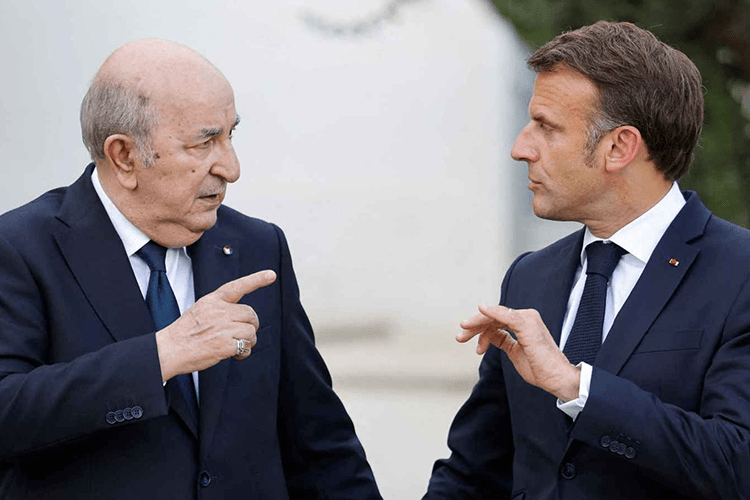
French historian Benjamin Stora has sharply criticized President Emmanuel Macron’s approach toward Algeria, describing it as “inconsistent” and ill-suited to managing relations with a country whose shared history with France remains deeply scarred by war, colonial violence, famine, and unresolved historical trauma. Stora also believed that Macron miscalculated the diplomatic fallout of his Western Sahara position two years ago.
In an interview published Thursday by the French newspaper L’Opinion as part of a three-page feature titled “Presidential Elections: Algeria, a Battleground for 2027”, Stora argued that Paris had failed to grasp the long-term consequences of its recent diplomatic choices — particularly Macron’s position on Western Sahara. Stora attempted to identify the root causes of the crisis that has plagued bilateral relations, which seem to have barely overcome one obstacle before encountering an even greater one.
According to Stora, Franco-Algerian relations have become trapped in a cycle of recurring crises, with each attempt at reconciliation quickly overshadowed by new tensions. Asked to assess Macron’s policy toward Algeria, the historian said the French president’s approach had been marked by “sharp fluctuations” and “impatience,” qualities he viewed as incompatible with a deeply sensitive historical relationship. “Thus feeding on unhealed wounds, nostalgia for French “grandeur”, and an increasing focus on identity politics.” Stora added.
The French historian explained that Macron had initially sought to reset relations with Algeria through a series of symbolic gestures between 2017 and 2022. During that period, the French president recognized the French state’s responsibility in the disappearance of activist Maurice Audin, condemned the use of torture, and commemorated Algerian demonstrators killed in Paris on October 17, 1961. Macron also marked the 60th anniversary of the Evian Accords with a major address at the Élysée Palace on March,19, 2022. “Macron followed in the footsteps of his original political camp, the left, and demonstrated a genuine desire to move forward.” Stora added.
For Stora, however, those reconciliation efforts were ultimately undermined by France’s shift on the Western Sahara issue; “All of this collapsed,” he said, “when Macron recognized the alleged sovereignty of the Moroccan regime over Western Sahara in October 2024.”
The French historian argued that Algeria had, until then, shown willingness to engage constructively with Paris, particularly through the creation of a joint committee of historians aimed at addressing contentious aspects of colonial memory. Algerian President Abdelmadjid Tebboune had strongly supported the initiative despite persistent anti-French sentiment within Algeria, Stora noted: “But France’s position on Western Sahara abruptly reversed that momentum”.
Stora suggested that Macron may have underestimated the emotional and political weight of the shared colonial legacy linking both societies across the Mediterranean. He pointed to the enduring memory of the Algerian revolution, including the displacement of nearly two million Algerians into camps and the mobilization of 1.5 million French soldiers and 2 million Algerians (out of 9 million) who were displaced to camps during the war that is still resonating in their minds”.
“These figures still resonate deeply,” Stora said, referring to the approximately 900,000 Algerians and more than 2 million dual nationals currently living in France. “Nearly six million people have been affected directly or indirectly by this shared history.”
He added that fears of a complete diplomatic rupture between Paris and Algiers in 2024 generated significant anxiety among Franco-Algerian communities in France.
The historian also observed that Algeria has once again become a major theme in French domestic politics ahead of the 2027 presidential race. While the issue dominated political debate during the era of Charles de Gaulle, Stora said it largely disappeared until the 2007 campaign of Nicolas Sarkozy, who sought to attract voters from the far-right National Rally movement associated with the Le Pen political family, which worked hard to achieve the abrogation of the Evian Accord and immigration agreement.
Stora concluded by warning that unresolved historical memory continues to fuel identity tensions on both sides of the Mediterranean. “Memory that is neglected,” he said, “is poorly transmitted and ultimately feeds illusions of identity. Therefore, this matter must be resolved.”