Germany’s Ambassador In Algeria Sends Encrypted Messages To Morocco

-
-
472
-
0
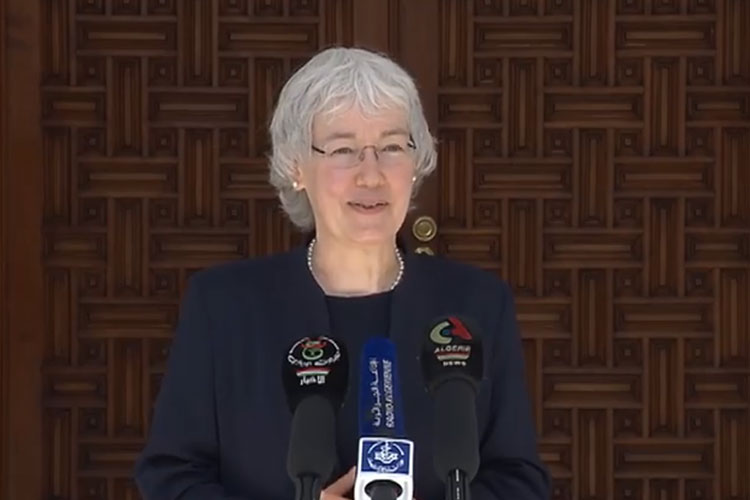
• From Algeria, Germany sent encrypted messages to Morocco, launched by the Ambassador of the Federal Republic of Germany, Elizabeth Wolbers, after being received by the President, Abdelmadjid Tebboune, with whom she tackled cooperation relations between Algeria and Berlin and the Western Sahara issue.
The German ambassador described Algerian-German relations as “excellent”, at a time when German-Moroccan relations are experiencing a major crisis, since the beginning of this month.
• At the end of this encounter, Her Excellency Elizabeth Wolbers said in a statement to the press that she was “honored” to be received by the President of the Republic, describing the relations between the two countries as “excellent”.
“We discussed the possibility of further enhancing our bilateral relations, especially the economic segment which represents one of the strongest areas in our relations,” she said, recalling that Germany “has always contributed, through its companies, to the diversification of the Algerian economy by creating jobs and transferring technology.
In the same vein, the German diplomat referred to increased cooperation in the energy sector, considering that it is a partnership “focused on energy transition issues where there are several projects to be developed, including the field of green hydrogen”.
In this regard, she said that “the Algerian Minister for Energy Transition and Renewable Energies Chems Eddine Chitour will take part, next Tuesday and Wednesday in Berlin, in a high-level international meeting on the international energy dialogue”.
In addition, replying to a question on Western Sahara, Wolbers said that Germany “advocates a solution based on international law within the framework of the UN process”, expressing its wish to see “soon the appointment of a new UN Special Envoy for Western Sahara to reinvigorate the process”.
On Libya, Wolbers hailed the appointment of a government of national unity, supported by the parliament and all parties in Libya, expressing the hope that this government there “will enable Libya to move towards peace, unity and demilitarization of the country”.
Regarding the Western Sahara issue, which was among the most prominent reasons behind the Moroccan “heresy”, Morocco cut off communication with the German embassy in Rabat, the ambassador stressed that “Germany is pleading for a solution based on international law within the framework of the United Nations,” and expressed her hope that a special UN envoy to Western Sahara would be appointed in the near future, in order to resurrect the track”.
The first message that the German ambassador wanted to send to Rabat by describing Algerian-German relations as “excellent”, to the effect is that Berlin is comfortable with its distinguished relations with Algeria, and that what the Makhzen government did by suspending communication with its embassy in Rabat, would not affect Germany’s relations with countries of the Maghreb, which consider Algeria as its hub, and this increases the isolation of Morocco.
• As for the second message, related to the German position on the Sahrawi issue, is that Berlin is continuing its policy in support for the legitimate right of the Sahrawi people to self-determination in accordance with United Nations resolutions, and that it is indifferent to Morocco’s anger at this clear-cut German position.
• The Moroccan Foreign Ministry decided early this month to completely cut off communication relations with the Federal Embassy of Germany in Rabat, and Foreign Minister Nasser Bourita attributed the decision in a correspondence addressed to the Prime Minister to what he described as “a deep misunderstanding with Germany on fundamental issues of concern to the Kingdom of Morocco”, and this contingency thwarted a European maneuver that Rabat had always dreamt of.