Mystery of Algeria’s Reaction to Macron’s Congratulations
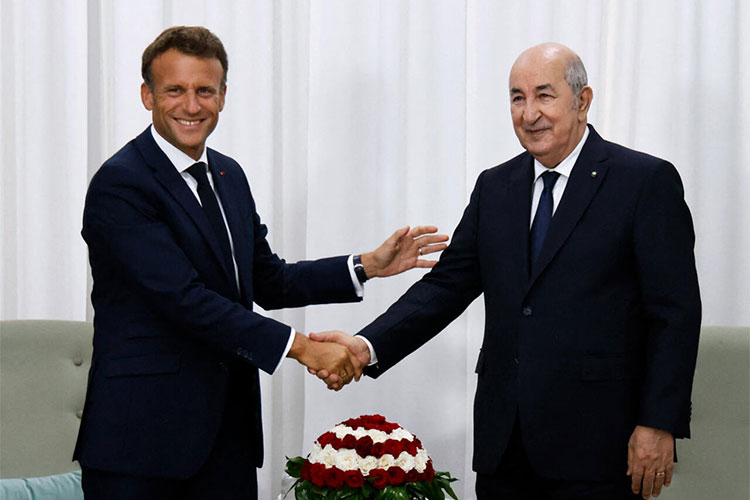
The congratulations of the French President, Emmanuel Macron, to his Algerian counterpart, Abdelmadjid Tebboune, on his reelection for a second presidential term, passed differently because the Algerian official media and even the presidency of the republic did not deal with it as is the case with the congratulations of the presidents, kings and princes of other countries.
On the French Presidency’s website, it is noted that the congratulations were circulated on Sunday, September 8, immediately after the announcement of President Tebboune’s victory for a second term by the head of the National Independent Elections Authority, Mohamed Chorfi. Still, the Algerian Presidency of the Republic did not mention this congratulation, and the “Algerian Press Agency”, considered its semi-official spokesperson, was late in circulating the statement by a full day.
By browsing the Algerian Presidency of the Republic’s Facebook account, no reference to the French President’s congratulations can be found, even though the same account included congratulations from various presidents, kings and princes to President Tebboune on his reelection for a second term.
As for the Algerian News Agency, although the French President’s congratulations came on Sunday evening (immediately after the announcement of the results), its publication as a telegram in the news agency was delayed by one day, at exactly 6:05 p.m., a significant time difference during which any news loses its media value.
The timing of publishing the French President’s congratulations came much later than Macron’s congratulations, which suggests the hypothesis that it was deliberately avoiding a warm reaction, just as the Presidency of the Republic dealt with Macron’s congratulations, which disappeared from the Presidency’s Facebook account, unlike the rest of the congratulations.
Macron’s congratulations, which were almost absent from the official and private Algerian media, stated: “The President of the French Republic, Emmanuel Macron, extends his warmest congratulations to the President, Abdelmadjid Tebboune, on his re-election as President of the People’s Democratic Republic of Algeria on September,8, 202, as well as his best wishes for success.”
“France is particularly attached to the exceptional relationship that binds it to Algeria, in all areas, whether it is memory, economy, mobility between our two countries, educational and cultural cooperation, but also security and the fight against terrorism. On the regional and international scene, dialogue between our two countries is essential, particularly in the context of Algeria’s presence on the United Nations Security Council”, the Elysée’s press release added.
“Strong with the bonds of friendship that unite France and Algeria, the President of the Republic (Emmanuel Macron) intends to resolutely pursue with President Tebboune the ambitious work undertaken with the Algiers Declaration to renew the partnership that unites our two countries. France will continue to stand alongside Algeria and the Algerians with the respect and friendship that govern our relations.”
The Algerian official press agency’s telegram omitted excerpts from the French president’s congratulations related to areas of cooperation that are of most interest to the French side, such as the memory, economy, mobility (people’s movement) file and cooperation in the field of education and culture, which are sectors that the French side considers very sensitive.
A careful reading of the APS telegram shows that the Algerian side ignored the French president’s call for cooperation in files that he is betting heavily on, most notably the memory file, which has made great strides in the past two years since the establishment of the Algerian-French joint committee to calm down the memory wars.
Macron’s call for cooperation on the issue of illegal immigration, which was expressed in the word “mobility” or movement of people, was also ignored, as the French authorities claim that their Algerian counterparts do not receive their citizens who are on French soil illegally, in addition to the lack of enthusiasm for cooperation in the economic field, a call that remains in the eyes of Algerians just words that lack credibility, because Paris, over decades of Algerian observations questioning the seriousness of the French party, has kept its promises just ink on paper, and the issue of car factories’ projects remain the most prominent example of this.
Algeria also ignored the call for cooperation in the fields of education and culture, two sectors on which Paris is giving great importance to maintain its influence in the former colony.
These data indicate that Algerian-French relations have suffered great damage, for which the French side bears responsibility, and that repairing this damage remains in the hands of the French side.