No European Oversight of Algeria–Niger Sovereign Agreement
The European Union’s demand for clarification over the deployment of Algerian People’s National Army units in Niger has drawn sharp criticism in Algeria.
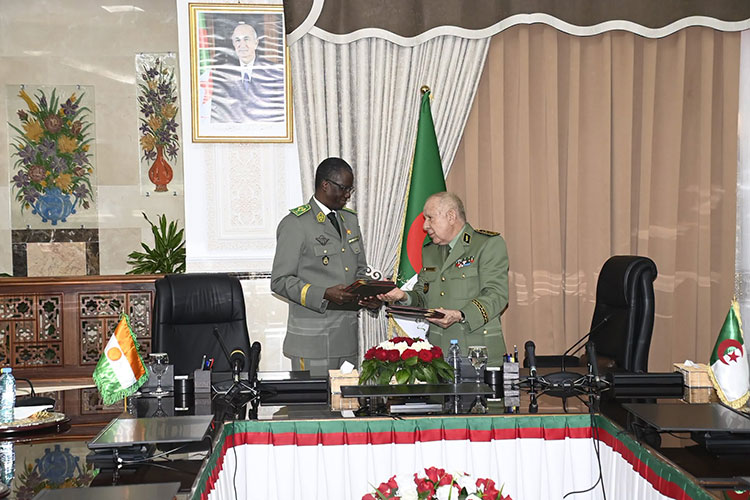
The deployment, which received parliamentary approval, falls under a bilateral military agreement between two sovereign states and was carried out at the request of the Nigerien authorities. As such, it requires neither the approval of external parties nor any accounting to institutions that have no legal standing in the agreement.
The EU’s position, expressed by its spokesperson for Foreign Affairs and Security Policy, Anouar El Anouni, has raised questions about the limits of Brussels’ intended role in the Sahel. The spokesperson said the bloc was closely monitoring the deployment of Algerian units and was seeking clarification regarding its scope, objectives and legal basis. The move has been widely viewed in Algeria as interference in a matter involving sovereign prerogatives and security arrangements between two neighbouring countries.
As a matter of principle, military cooperation between Algeria and Niger is not subject to EU oversight. Brussels’ monitoring of developments in the region does not confer on its institutions the right to question sovereign states about their bilateral agreements. Algeria, for its part, took the decision through its own constitutional mechanisms, at the request of the Nigerien authorities and within the framework of bilateral cooperation.
In this context, former Algerian ambassador Abdelaziz Rahabi criticised the European position, questioning the grounds on which Brussels could demand explanations over the implementation of a publicly announced military agreement between two neighbouring countries, whose terms concern only the parties involved.
In a strongly worded Facebook post entitled “Deployment of Forces in Niger: On What Grounds Is Europe Demanding Clarifications?”, former Algerian ambassador to Madrid and Mexico City, Abdelaziz Rahabi challenged the European Union’s authority to demand explanations from Algiers over the deployment.
Rahabi took issue with a statement by an EU spokesperson declaring that the bloc was closely monitoring the deployment of Algerian military units in Niger and expected clarification regarding its scope, objectives and legal basis.
He questioned how the EU could justify such a reaction to the implementation of a publicly announced military agreement between two neighbouring countries, whose terms and conditions concern only the two sovereign states involved. More significantly, he pointed out that the European spokesperson had explicitly stated that Brussels expected explanations from Algeria, without even the customary reservations generally exercised when commenting on matters beyond the EU’s immediate jurisdiction.
“Europe is addressing us as though we were bound by a conventional commitment to it on these issues, or as though it represented a military organisation in charge of the Sahel,” Rahabi argued.
In the absence of any such status, he added, Brussels appeared to be suggesting that Algeria should consult it in advance about developments in the region or, at the very least, provide it with explanations after the fact.
Rahabi also criticised what he described as Europe’s persistent inability to move beyond outdated perceptions of Africa, stressing that the EU had no grounds to question either the sincerity of its partners or the sovereignty of their domestic mechanisms for approving international agreements.
“Otherwise, this could expose Europe itself to genuine demands for explanations from Algiers,” he warned.
His remarks amount to a broader rejection of what he sees as an implicit European claim to political oversight over decisions taken by sovereign African states, particularly when those decisions concern bilateral security cooperation in the Sahel.
Former parliamentarian Lakhdar Rezzag Baara, meanwhile, linked the European position to the broader transformations taking place across the Sahel. He argued that certain European capitals had yet to come to terms with the fact that the region was no longer an open arena for their traditional influence. Algeria, he said, had moved beyond merely monitoring threats along its southern borders and was now taking the initiative to protect its strategic interests.
In a Facebook post, Baara argued that the Algerian military deployment was more than a temporary act of cooperation. Rather, it reflected a shift in the way Algeria approaches its strategic neighbourhood, moving towards direct involvement in safeguarding its interests and shaping regional balances of power. He stressed that Algeria was under no obligation to seek European permission to act within its own geographical sphere.
The former MP also drew attention to information published by Chad Tribune, citing sources it described as confidential, alleging that France, the United Arab Emirates and Israel had been undertaking efforts within European circles to push for sanctions against Algeria and Niger over their military and economic cooperation agreements. The report also pointed to a role played by French President Emmanuel Macron in the alleged initiative.
Baara linked these allegations to what he described as possible attempts to exert political and diplomatic pressure on Algeria and obstruct its strategic engagement in the Sahel. He argued that what concerns certain European actors, particularly France, is the extent to which the Algerian-Nigerien agreements signal a shift in the region’s balance of influence. These claims, however, remain attributable to Chad Tribune and its sources and have not been independently verified.
The criticism comes as Algeria and Niger continue to deepen cooperation across several fields, amid overlapping security and economic challenges that require countries in the region to coordinate their efforts to protect their borders and national interests, independently of the influence-based arrangements that prevailed in previous periods.
For his part, military historian and researcher Tewfik Hamel argues that the transformations the region has undergone since the 2011 Libyan war, the crisis in northern Mali and the spread of armed groups and weapons-smuggling networks have rendered the traditional distinction between domestic security and developments in neighbouring countries increasingly inadequate in addressing emerging threats.
Recruitment and financing networks, smuggling routes and safe havens, he explains, now extend across the borders of several countries before their consequences are felt inside Algerian territory.
In an article published in Echorouk under the title “Algeria’s Defence Doctrine: The Gradual Shift from Territorial Protection to Neighbourhood Security”, Hamel cites the January 2013 terrorist attack on the Tiguentourine gas facility in In Amenas (southern Algeria), as a defining moment that exposed the vulnerability of any rigid separation between Algeria’s internal security and developments in its surrounding region.
Although border surveillance remains essential, he argues, it is not sufficient on its own to address the sources of threats, the conditions that give rise to them or the mechanisms through which they are reproduced beyond national borders.
In this context, Hamel explains that the concept of strategic depth does not necessarily entail establishing spheres of influence or maintaining permanent military deployments in neighbouring countries. Rather, it encompasses a wider network of territories, relationships, routes, infrastructure and political developments that may have direct repercussions for Algeria’s national security.
The academic further notes that the reassessment of neighbourhood security, which began years before the current developments in Niger, was reflected in increasingly firm presidential rhetoric.
In January 2020, President Abdelmadjid Tebboune described the prospect of Tripoli falling to forces loyal to Khalifa Haftar as a red line. In June 2021, he reiterated that Algeria was prepared to intervene, in one way or another, to prevent such an outcome.
No operational plan for military intervention in Libya was publicly announced or implemented. Nevertheless, Hamel argues, these statements demonstrated Algeria’s willingness to raise the anticipated political and military costs of a regional development it considered exceptionally dangerous.
Deterrence, he explains, can begin with the declaration of an unacceptable threshold; it does not require every publicly stated threat to culminate in the actual use of force.
During the same period, however, Tebboune approached the crisis in Mali differently. While recalling that the Constitution provided for the possibility of intervention, he maintained that a military solution was not the answer and advocated restoring the Malian state’s presence and institutional capabilities.
For Hamel, this contrast reveals more about the nature of Algeria’s decision-making than the simplistic distinction between an old and a new defence doctrine.
Political objectives, the nature of the threat, the legitimacy of a request for assistance, the anticipated costs and the possibility of withdrawing from a mission are all variables that determine whether military force is employed or deliberately kept in reserve.
Differences in policy choices, he concludes, should not automatically be regarded as contradictions without first examining the circumstances that produced them.
Ultimately, the controversy over the deployment of Algerian forces in Niger goes beyond a disagreement over a military operation. It reflects a broader shift in the geopolitical dynamics of the Sahel, where regional states are increasingly asserting control over their security choices and strategic partnerships. For Algeria, cooperation with Niger is a matter of sovereign decision-making, shaped by shared security concerns and regional interests. Any attempt to place such arrangements under external scrutiny risks reviving the very logic of political tutelage that African countries have long sought to overcome. The message from Algiers is clear: partnerships in the Sahel must be built on mutual respect for sovereignty, not on demands for accountability from parties with no legal or political mandate over them.