OPEC May Maintain Quotas, Market Balanced

-
-
2120
-
0
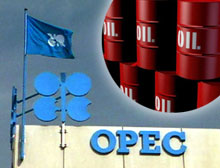
OPEC ministers gave their strongest indication yet that they will leave oil-production quotas unchanged at this week’s meeting as faltering growth in some of world’s biggest economies stifles demand.
The market is “very well-balanced,” Saudi Arabian Oil Minister Ali al-Naimi said late yesterday as he arrived in Vienna for the Oct. 14 meeting of the Organization of Petroleum Exporting Countries. Shokri Ghanem, chairman of Libya’s National Oil Corp., said in London today there’s no need for to alter quotas, echoing comments made by Qatari Oil Minister Abdullah al-Attiyah in an Oct. 10 interview.
The meeting is “broadly seen as rolling over existing production targets,” Lawrence Eagles, head of commodity strategy at JPMorgan Chase & Co. in New York, wrote in a research note yesterday.
Growth in oil demand will be uneven next year, with the International Energy Agency forecasting a 4.3 percent increase in China and a 0.8 percent reduction in Europe’s five biggest countries. OPEC, which supplies 40 percent of the world’s oil, is benefiting as prices stay above the $70-to-$80-a-barrel band that al-Naimi reiterated is “ideal.”
Crude for November delivery fell 54 cents, or 0.7 percent, to $81.67 a barrel in electronic trading on the New York Mercantile Exchange at 12:31 p.m. London time. Prices have settled above $80 for the past seven days, the longest stretch since August.
‘Happy’ With Market
“Everyone is happy with the market,” al-Naimi said to reporters when asked whether OPEC should boost supplies this year. “Consumer, producer, everyone is happy,” he said.
The Saudi minister, representing OPEC’s biggest oil producer, declined to comment further on the group’s policy this morning. More ministers will arrive in the Austrian capital today and tomorrow, where they will hold informal talks before their policy meeting on Oct. 14.
Algerian Oil Minister Youcef Yousfi said yesterday in Algiers that oil prices of $90 to $100 a barrel are “reasonable” considering current output levels.
OPEC raised production by 5 percent from a five-year low in March 2009, and now exceeds its own target by 1.9 million barrels a day, about the same amount as Angola produces. Output from the 12 members was 29.1 million barrels a day in September, according to Bloomberg estimates.
Boost Production
OPEC may boost production by about 600,000 to 700,000 barrels a day in 2011, according to Statoil ASA, Norway’s biggest oil and gas producer. The increase wouldn’t come until the second half of the year, to allow time for inventories to decline first, Sandrine Toerstad, head of market analysis at the company’s oil-trading and supply unit, said in a presentation in Oslo today.
Demand for OPEC’s crude will decline from 29.2 million barrels a day in the fourth quarter of this year, to 28.3 million in the second quarter of 2011, before recovering thereafter, according to the group’s monthly report which was released today.
While China’s gross domestic product will grow 8.9 percent in 2011, according to the median estimate in a Bloomberg News survey of 24 economists, the poll shows growth of 2 percent for Germany, Europe’s biggest oil consumer.
OPEC agreed to a record 4.2 million-barrel-a-day cut in production in late 2008 as global demand fell 0.6 percent, the first decline since 1983. Members are now adhering to about 57 percent of that cut, the monthly report showed.
“We don’t want to rock the boat and do something that maybe will have a negative effect on the world economy,” OPEC Secretary-General Abdalla El-Badri said in a Sept. 14 Bloomberg Television interview from Vienna.
Spare Capacity
Rising production from the group diminishes the cushion of spare capacity available to be brought on at short notice during supply disruptions, a trend which is positive for prices over the next couple of years, according to a report today by Sanford C. Bernstein & Co.
West Texas Intermediate crude, the U.S. benchmark grade, will average $85 in 2011, according to the median of 23 analysts forecasts in a Bloomberg News survey this month. All of the respondents said OPEC will leave production targets unchanged when oil ministers meet this week.
OPEC may still seek higher prices given that the dollar is weakening because of speculation the Federal Reserve will sell bonds to revive economic growth, said JPMorgan and Bank of America Merrill Lynch. Oil is traded internationally in dollars.
Currency Debate
The Chinese yuan last week climbed to its strongest level against the dollar since 1993. The Brazilian real has rallied for eight straight weeks against the U.S. currency, a decline that the country’s finance minister, Guido Mantega, last month called a “currency war.”
“If we continue to see what the Brazilian finance minister described as a currency war, it is likely that OPEC will take notice and will demand a higher price for its oil,” Merrill’s head of global commodity research, Francisco Blanch, said in an Oct. 7 interview in London.
OPEC’s members are Algeria, Angola, Ecuador, Iran, Iraq, Kuwait, Libya, Nigeria, Qatar, Saudi Arabia, the United Arab Emirates and Venezuela.
–With assistance from Zoe Schneeweis in Vienna, Ahmed Rouaba in Algiers, Grant Smith, Rachel Graham and Juan Pablo Spinetto in London and Robert Tuttle, Fiona MacDonald in Kuwait City and Marianne Stigset. Editors: Stephen Voss, Raj Rajendran.