Paris Grand Mosque Dean Reminds France of Its Responsibility Towards Memory
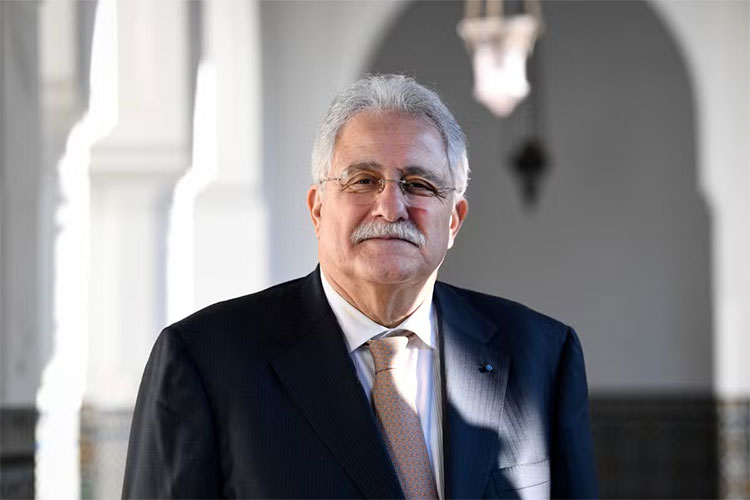
The Dean of the Grand Mosque of Paris, Chems-Eddine Hafiz, devoted his weekly article for the second time in a row to criticizing the French authorities for their denial of the sacrifices of the “Muslim infantrymen” who sacrificed their lives to defend France in World War I, as they were excluded from the commemoration that was dedicated last week to this category of warriors.
Chams-Eddine Hafiz wanted to send a message to French President Emmanuel Macron, alerting him to the need to honour his memory words, which have become the subject of many questions regarding Algeria, as the first victim of France’s colonial policy on all levels, human, social and economic, even though Algerian soldiers benefited from higher salaries compared to their other counterparts.
In his article last week, entitled “The song of the forgotten: between sacrifice and indifference”, the dean of the Paris Mosque criticized the French authorities for excluding the “Muslim Riflemen” from commemorating their memory like others, writing: “On Sunday, under a grey sky heavy with silence, France celebrated its dead, its soldiers frozen in marble, its anonymous heroes, the names engraved in gold letters on silent monuments. But in the depths of these commemorations, an absence was felt, like a forgotten echo that resonates in the void. They are the Muslim riflemen, these men who came from the other side of the sea, from North Africa, from black Africa, these soldiers who endured mud, hunger, and war to defend a homeland whose taste and breath were unknown. They, whom history seems to erase, have fallen into an insidious oblivion, an oblivion to which today’s politicians seem to consent, indifferent, perhaps even relieved not to have to evoke them”.
The number of Muslim victims who were forcibly recruited to fight alongside the French occupation army in World War I amounted to about seventy thousand, the majority of whom were Algerians, according to the article published at the end of last week, because Algeria recruited from its sons, seven regiments of Algerian riflemen, two Tunisian regiments, and several troops of maharist (camel warriors), in addition to Moroccan auxiliary units.
Chams-Eddine Hafiz rejected the policy of double standards: “It is the forgetting that politicians today seem to accept, indifferent, perhaps even relieved that they do not have to mention them”, considering this position as “the silence of shame, the silence of politicians who turn their eyes away from a shared history, which is perhaps too complex, perhaps too heavy for those who see in it only the ghosts of the distant past to bear”.
He stressed that this position “is not just forgetting, it is a refusal, it is almost a form of concession, a gesture that tells the living and the dead that there are sacrifices that we prefer to avert our eyes from because mentioning the Muslim riflemen also means accepting that France has not always been the one we like to describe in official speeches, but rather remembering that our freedom is built on the shoulders of men who came from far away, and to whom we owe our respect and appreciation.”
The dean of the Paris Mosque, who was recently received by President Abdelmadjid Tebboune, wanted to remind the current French President, Emmanuel Macron, of the positions of his predecessors in the “Élysée Palace” in dealing with the issue of memory, which continues to poison relations between Algeria and its former colony, France, which is unable to overcome this dilemma, in his weekly column published on Friday, November 15, 2024, he stopped at the background of the establishment of the Grand Mosque of Paris in 1926.
According to the dean’s article, the construction of the Grand Mosque of Paris is nothing more than a tribute to the Muslim soldiers who sacrificed their lives defending France. It began with the construction of a wooden mosque in 1916, then Islamic-style cemeteries and private hospitals for them, before it was decided to assign the responsibility of building and managing the mosque to the Habous Association.
Accordingly, the city of Paris provided a land of 7,500 square meters located in the 5th arrondissement.; “This land, which occupied the site of the former Pitié (Mercy) Hospital been demolished, became the site of the Grand Mosque of Paris. Work began on March 1, 1922, and the first stone was laid shortly after, on March 19”.
The weekly column of the Dean of the Paris Mosque has become a point of criticism of French policies towards Muslim communities. The angle of criticism is usually determined by the nature of the occasion, in a trend that emphasizes the role that the Paris Mosque has come to play in defending Muslim communities, and the Algerians in particular.