“Singapore is Algeria’s gateway to Southeast Asia, China and India
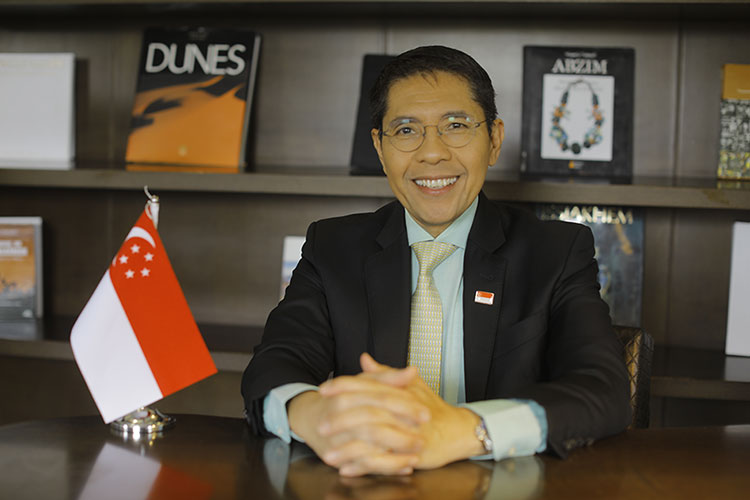
Algeria is an important country and is well positioned to contribute to the UN Security Council discussions.
Algeria is one of Singapore’s top 10 trading partners in North Africa and the Middle East.
Singapore is a great example of coexistence and remains proud of its ethnic and religious diversity.”
1. You are coming for a working visit to Algeria soon. We understand it is your first visit to Algeria. What are your hopes for this visit?
First of all, on behalf of the Government and people of Singapore, I would like to congratulate Algeria on its Anniversary of the Revolution. I am honoured to be in Algeria to commemorate the 40th Anniversary of Diplomatic Relations between Singapore and Algeria. My visit serves to reaffirm our good ties with Algeria and explore new areas of cooperation in areas of mutual interest, including vocational training and information technology.
2. Tell us more about Singapore and Algeria’s diplomatic relations.
We officially established diplomatic relations on 12 May 1983 but our friendship went back a long way. Distinguished diplomat and former Algerian Foreign Minister Lakhdar Brahimi visited Singapore often during the years when he was the representative of the National Liberation Front in Southeast Asia based in Indonesia. According to the memoirs of a Singapore diplomat, Mr Brahimi said that “he would never forget the support which Singapore had given to Algeria during its struggle for independence”, particularly from our former Prime Minister Lee Kuan Yew. Likewise, Singapore appreciates Algeria as an old friend which had worked closely with us on Non-Aligned Movement issues and other issues of mutual concern at the United Nations and other fora.
3. How would you describe the state of bilateral relations since then?
Today, Singapore–Algeria relations remain warm and friendly. We celebrated many milestones together. Algeria’s participation at the inaugural Asia–Middle East Dialogue (AMED) in Singapore in June 2005 was a key milestone for our bilateral relations. It placed Algeria on the mental maps of Asian business leaders. It is important to build on these regional andmultilateral initiatives to build trust and respect amongst nations within and across regions globally. Then Senior Minister Goh Chok Tong also had a successful visit to Algeria in 2006 as our engagement of the Middle East was ramping up. Nonetheless, more can be done and my visit to Algeria is to explore how our two countries can work together for mutual benefit.
I would also like to comment that football makes the world go round. Singaporeans love football like Algerians. We are proud that Algerian players, who are some of the best in the world, have played in Singapore Premier League clubs. I hope that people-to-people ties through sports or cultural exchanges can also take place.
4. How can Singapore and Algeria work together in the international fora to strengthen multilateralism and uphold the rule of law?
Singapore strongly supports Algeria in taking on the role as a Non-Permanent Member of the United Nations Security Council (UNSC) for the term 2024–2025. As a key African and Arab nation, Algeria is well positioned to contribute to the discussions at the UNSC. We will continue to work closely with Algeria to strengthen the role of multilateralism in promoting trade, sustainable development, regional and global peace, and making the UN more relevant, resistant and fit for purpose.
Recent developments in the Middle East and other global crises remind us that we cannot take peace for granted. As a small state, Singapore has no control over global events. The security and even the existence of Singapore depend on the international community having trust and respecting each other; upholding the fundamental principles of sovereignty and territorial integrity as well as respect for international law.
5. How can Singapore–Algeria economic cooperation be further enhanced?
In 2022, Algeria was among Singapore’s top 10 largest trading partners in the Middle East and North Africa, with total bilateral trade in goods amounting to US$1.02 billion. There is scope to further enhance our two-way trade and investments between Algeria and Singapore. I will be meeting with representatives from the Algerian Chamber of Commerce and Industry (CACI), Algerian Economic Renewal Council (CREA), and Algerian Confederation of Citizen Employers (CAPC) during my visit to explore more opportunities on the economic front.
Algeria remains a sizeable and lucrative market for foreign investors. Algeria’s strategic geographical location at the crossroad of Africa and Europe, abundance of natural resources, and growing middle class outline Algeria’s potential as an investment destination. As the world’s 5th largest liquified natural gas (LNG)exporter, Algeria has been investing in export infrastructure such as pipeline and terminals.These present opportunities for Singapore companies seeking to participate in Algeria’s growth.
I am heartened by the success of Singapore-based companies like Portek and Olam in Algeria. Portek will be commemorating its 20th anniversary of managing the Bejaia Mediterranean Terminal (BMT). I hope their success stories will motivate other Singapore companies to consider doing business in Algeria. We also welcome Algerian firms to use Singapore as your gateway to Southeast Asia, China, India and beyond.
6. Singapore is an attractive place for global businesses. How can Algerian companies benefit from Singapore?
First, Singapore has a vibrant network of global traders for a tiny city-state only twice the size of Algiers. Today, there are some 400 global traders anchored in Singapore. In the energy sector, there are more than 150 major energy players in oil, gas and LNG who have chosen to anchor their key business activities in Singapore, generating $19 billion in economic value-add in 2021.
Second, Singapore is Asia’s leading oil trading hub, and the third largest in the world. This network of companies enables collaboration and deal-making among counterparties, making it easier for them to conduct business and trade in our city-state.
Third, Singapore’s conducive business environment and strong governance, robust financial and legal ecosystem makes Singapore the choice for global traders and MNCs. To better support their needs, we remain open to international talents and continue to invest in our workforce to ensure a pool of skilled trade talents. Companies can also tap on Singapore’s extensive R&D and innovation platforms to scale and grow their business.
In addition, Algerian businesses can leverage on Singapore’s strategic location as a gateway to Asia-Pacific and Southeast Asia to seize growth opportunities in the region. Together, ASEAN, India, and China make up nearly half of the world’s population. These markets are growing at an average yearly GDP growth rate of between 4.5% and 6.8%. Our digital infrastructure makes it easy for businesses to access information and strong connectivity infrastructure (including comprehensive logistics solutions) facilitates greater trade flows.
7. What is your biggest challenge as Second Minister of Foreign Affairs, and how do you deal with them?
As a small country, Singapore’s most pressing concern is to maintain our relevance in an increasingly complex world. We are navigating a period of increasingly tense superpower rivalry, global economic disruption, and looming climate change while dealing with a more fragmented and turbulent world. We are also finding new ways to create opportunities for Singaporeans overseas, while supporting our nationals abroad.
Besides engaging foreign leaders and personalities, I make time to explain our foreign policy to Singaporeans. After all, foreign policy begins at home.
Some Singaporeans may question the government on our foreign policy stances, or have their own ideas on how Singapore’s foreign policy should be. For example, some may prefer that Singapore does not make statements on international events and focus on our domestic issues instead. I try to educate them about the implications of our foreign policies on our domestic policies as well. I frequently encourage Singaporeans to engage their peers from other countries, not just our neighbours Malaysia and Indonesia, but around the world. It is only through engaging others that we better understand their perspectives.
8. Besides Foreign Affairs, you also oversee Education. Having one of the best education systems in the world, how significant is the role of education in Singapore’s development?
Singapore’s greatest resource is our people, given our small size and the lack of natural resources. Education plays a critical role in developing the right talent and workforce to help Singapore thrive and remain a city of opportunities.
Meritocracy is a core tenet of our education system. Through education, we strive to ensure that every Singapore child, regardless of background, will have a good start and opportunities to fulfil their potential. We are constantly working on providing more resources to support and uplift students from more vulnerable backgrounds, so that they too have the opportunity to move up in life.
We also focus on developing the right competencies and skills in our students – a growth mindset, critical thinking, problem solving, global awareness, and cross-cultural skills. We make concerted efforts to nurture in young students the joy of learning, help students develop the motivation to learn and pursue their interests, and reduce the overemphasis on academic results. Our teachers and schools put in a lot of effort to celebrate the diversity of abilities and talent, guide students to discover their strengths and interests, and embrace broader definitions of success. When students leave school, we hope they remain curious, and are equipped with the right skills and mindsets to keep learning through life. This is what will help Singapore in our next phase of development.
9. How do you hope to facilitate greater cooperation between Singapore and Algeria? What are some similarities between our countries?
In my education portfolio, I oversee the Institute of Technical Education (ITE) and Polytechnic Education – Singapore’s equivalents of technical and vocational training. I also chair the Uplift Pupils in Life and Inspiring Families Taskforce (UPLIFT) and the Malay Language Learning and Promotion Committee (MLLPC). In Singapore, we place great emphasis on skills retraining for economic development. I look forward to sharing Singapore’s experience in vocational training during my meeting with Minister of Education and Vocational Training Yaccine Merabi, as well as explore the possibility of student exchanges between our countries. In a world of increasing connectivity, I feel it is important to promote interactions among our youths across the world so they may understand each other’s perspectives and experiences. This will future-proof our relations. I look forward to visiting a vocational institute in Algiers to engage students and staff to learn more about Algeria’s vocational training approaches.
Besides vocational training, bilingualism is another similarity Singapore shares with Algeria. Every Singaporean speaks at least two languages; first, English as their lingua franca (as French is with Algeria), and second, their mother tongue. Given Singapore’s diverse ethnic makeup, English facilitates communication among different ethnic groups. Learning their mother tongue anchors our students to their cultural roots, strengthens their Singaporean identity, and allows them to better understand and relate to the native-speaking communities in our region and the world.
10. You mentioned that Singapore’s diversity. Can you tell us more about Singapore’s diversity and how you deal with differences?
We take pride in our racial and religious harmony, and we do not take this for granted. This does not come overnight, and it has taken us decades to build and come to where we are today. 75% of our population is ethnically Chinese, 15% are Malay, 7% are Indian, and the rest are from other ethnic groups. Our religious diversity is even wider – 31% are Buddhist, 19% are Christian, 16% are Muslim, 9% are Taoist, 5% are Hindu, among others. There is a lot of mutual respect and trust between religious and racial groups, and we frequently have open and frank conversations with each other.
Most of us believe that our various cultures and religions are all compatible with Singapore’s culture and values. This is due to a combination of factors: our legal framework, government policies and community leaders understanding what is important for Singapore. As I mentioned earlier, we strongly believe in meritocracy. This means that every child, regardless of cultural background or socio-economic status, are given equal opportunities to succeed. This is even reflected in our elected leaders – our President is Indian, our Prime Minister is Chinese, and we have Malay Muslims like me holding ministerial positions. We are proud of our diversity, and Singapore is better for it.
11. What are some avenues for our people to learn from each other?
There is scope to further enhance our people-to-people ties. Algeria is one of 180 countries which has participated in the Singapore Cooperation Programme (SCP). The SCP is Singapore’s way of contributing to the international community by sharing our developmental experiences. To date, more than 150,000 officials, including Algerians, have benefitted from these courses.
Last year, to mark the 30th anniversary of the SCP, we announced the Singapore–Africa Partnership Package (SAPP) to enhance and prioritise courses for African countries in the fields of climate change, sustainability and digitalisation.
I encourage more Algerian officials to participate in the SCP courses. They should also make use of their time to explore Singapore’s sights and sounds and bustling night life. I also encourage more Singaporeans to visit Algeria, to learn about its culture and rich history. I was pleasantly surprised to know that Algeria is home to seven impressive UNESCO World Heritage sites!
On this note, I would like to convey our congratulations for the 40 years of diplomatic relations with Algeria. I will continue to advance Singapore’s interests overseas in various regions, including the Middle East and the Maghreb. I would like to see more high-level bilateral visits as well as stronger people-to-people interaction. I look forward to seeing our ties continue to strengthen in the years ahead.