Unconventional Financing: Raouya Promises Rigorous Control

-
-
637
-
0
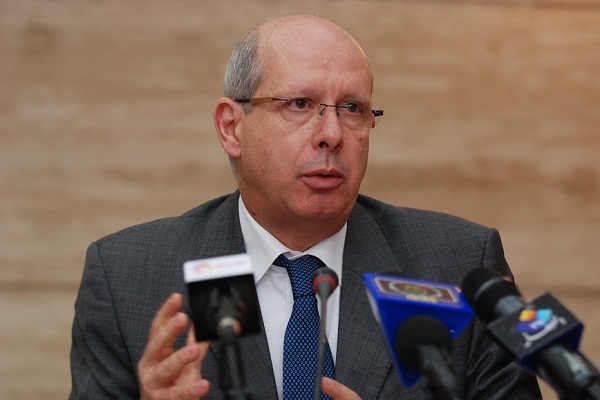
Finance Minister Abderahmane Raouya said Monday that the use of unconventional financing to meet the Public Treasury’s deficit will be accompanied by rigorous control so as to fend off inflationary drift.
“We will establish a set of parameters to avoid these drifts,” the minister said in an interview with the APS on the sidelines of the annual meetings of the IMF and the World Bank Group in Washington.
The country’s chief financier explained such an endeavor is perfectly framed by the amendment to the Currency and Credit Act which introduced this new financing instrument. The text in question determines the use of funding and its objectives, he said.
“This funding will go to investment, not a dinar on the operation, allowing companies to have cash for their growth and thus create employment,” Mr. Raouya added.
The use of this financing is an economic choice, made necessary by the need to avoid the option of international indebtedness, stressed the minister, praising the accuracy of the decision of the President of the Republic on the early repayment of the external debt of the country.
“We are in a situation where we can avert using international financing, especially since our foreign debt is now insignificant,” he explained.
He added: “Algeria has experienced a period that all Algerians no longer want to relive: an economic crisis coupled with a blind terrorism scourge”.
The Minister wished to recall the inflationary drift that occurred in 1994 when Algeria was first subjected to the IMF’s structural adjustment program for the first time in its history.
“During the structural adjustment, he recalled, the dinar lost in a short time 35% of its value in 1994 and the price of bread has increased significantly, noting that the devaluation of the dinar was one of the main measures of this program”.
In the same line, Mr. Raouya surmised that a barrel of oil at 50 dollars “remained acceptable” because it is equivalent to the government’s reference price for the state budget. The shortfall in the capital budget will be met through the use of non-conventional financing.
In addition, Mr. Raouya explained that the wealth tax introduced in the draft finance bill for 2018 was aimed at introducing tax fairness.
The Minister acknowledged the difficulty of recovering this tax, particularly with regard to the assessment of the signs of wealth of persons not identified by the tax authorities.
This is a job that will be initiated by the tax administration through the setting up of files of those persons liable to taxes. “We will have these files in the short term,” he promised.
Asked about the latest IMF forecasts of growth in Algeria, Mr Raouya said his department expected rates somewhat higher than those anticipated by the Bretton Woods institution.
The Ministry of Finance and the IMF will cross-check their forecasts at the next mission of the Fund in Algeria, he indicated.
The IMF’s corrections to its initial forecasts are often close to the rates projected by Algeria, he said.
While the IMF expects growth of 1.5% in 2017 in Algeria, the World Bank anticipates a rate of 2.2% for the same year.
National economic growth was set in the first quarter of 2017, at 3.7%, according to World Bank’s projections.