Walter Gehr, a UN Official to Echorouk: Security Council freezes assets of terrorist back up cells worth $100 m from 40 countries

-
-
1867
-
0
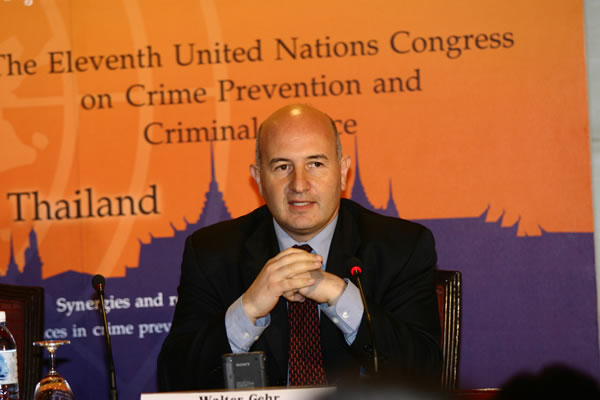
The Austrian Walter Gehr, an official at the Terrorism Prevention Branch of the UN Office on Drugs and Crime, acknowledges, in this interview with Echorouk, that the technical, financial and even political problems prevented the international counterterrorism efforts from achieving all their objectives, but says that the results of what has been done are not few.
Echorouk: Mr. Walter, don’t you think that the United Nations is still unable to realize a serious and lasting counterterrorism work, as if its moves are only a response to a circumstantial U.S impact after the 9/11 attacks?
Walter Gehr: There is no doubt that America’s events and its international position had an important role in the international counterterrorism move since 2001, but if we go back to the first and most important international text reference, namely the resolution 1373 of September, 28, 2001, and the measures that came out, we can only say that it had a decisive impact in the formulation and consolidation of international efforts to combat terrorism. This cannot be denied, the resolution, clearly, called upon the UN member states to implement a number of measures in order to enhance their legal and institutional capacity to respond to terrorist activities, including, in particular, the criminalization of terrorism financing, and exchanging information with other governments on any groups that are practicing or planning terrorist attacks, and cooperation in the investigation and detection of terrorism, in the arrest of terrorists and during the prosecutions. Finally, and this is very important, the international resolution called upon all the countries to join the international legal conventions and treaties that combat terrorism.
Echorouk: What are the direct problems which faced the UN counterterrorism commission during the implementation of its programs?
Walter Gehr: I think that there are two main problems that possibly obstructed the effective implementation of the UN counterterrorism programs. The first one was financial, due to the commitments of international donors which were not ambitious and had no basic necessities, and the second came later, which is the emergence of bodies and new regional and international groups that lead the same role. This pushes me to say that these problems destroyed the international efforts and focus, and then it weakened the role of the UN counterterrorism commission.
Echorouk: What are these new bodies which, as you said destroyed the international counterterrorism efforts?
Walter Gehr: There are many bodies, but I may mention in particular the working group arising from the G8, which held previously a meeting in Mali to coordinate counterterrorism efforts in the Sahel region. The G8 includes the largest international donors which provide a finical support to the UN counterterrorism programs, and creation of a private commission leads the group to providing the financial support for itself to the expense of its previous obligations at the level of the UN.
Echorouk: If we take as an example the mission of preventing the financing of terrorism. What are the practical results?
Walter Gehr: The Security Council so far included more than 500 persons and bodies on the list of entities accused of supporting terrorism, and as a result it has frozen financial assets of some 40 countries in this list, valued at more than $100 m, and the commission of monitoring helps the Security Council in encouraging the implementation of the sanctions.
Echorouk: Did terrorism and crime backup cells fail to find a safe stronghold in other countries where the bank accounts are legally and politically protected?
Walter Gehr: Of course, they did, but a lot of work is still waiting for the international community to fight against supporting and financing terrorism. May be there is a default of some parties or countries at the practical level because their cooperation is not enough. However, this does not mean that, at both the political and legal levels, these countries can not practice it publically, or in a matter that left a clear impact.
Echorouk: Do you think that the UN does not face the problem of coordination between various bodies and countries?
Walter Gehr: This is a real challenge facing the international counterterrorism mission since the beginning; coordination between the twenty-four bodies at least in the UN that are engaged in counterterrorism efforts, with the mission of helping member states in implementing the counterterrorism strategy in an integrated manner, supporting the UN’ efforts to respond to any terrorist attack with nuclear, chemical or biological weapons, combination between the different partners to discuss the use of internet for terrorist purposes, and the protection of vulnerable targets as well, including the UN staff .
Echorouk: In your opinion, what can more indicate that the international group is responding to the UN counterterrorism decisions?
Walter Gehr: Sixteen international legal texts have been prepared under the auspices of the UN and intergovernmental organizations related to it. The majority of these texts entered into force, and provide multilateral counterterrorism action, including hijacking, kidnapping, hostage-taking and terrorism financing.
Echorouk: What about the role of other international bodies and organizations?
Walter Gehr: There are other bodies and organizations belonging to the UN which show complementary counterterrorism efforts, such as the International Organization of Civil Aviation which develop international standards and treaties to protect aircrafts and airports. The International Maritime Organization imposes specific measures to protect the ports and ships covering even thousands of shops and ports.
Echorouk: Would you please tell us about the International Criminal Police Organization “Interpol”? Why all these large numbers of red notices which are not implemented?
Walter Gehr: The red notice warrant is a document sent by Interpol to its member states to require an arrest warrant against a person issues by a judicial body. Interpol has no authority to require any member state to arrest a person under its red notice. Interpol is a neutral organization which has no power to participate in the investigation or arrest of people. It can only collect data and information about the required person and verify its existence somewhere across its regional offices in 84 countries, and then communicate that data to the authorities of a country in order to arrest the required person under an Interpol arrest warrant, however; Interpol cannot oblige a country to extradite the person to the judicial authorities in another country (the country which asked for Interpol’s help), because this must be subject to a legal and political file.
Echorouk: So, why did many countries refuse to apply neither Interpol’s arrest warrants nor requests to extradite the required persons to other countries’ judicial authorities?
Walter Gehr: Interpol’s work depends on the international agreements between countries, because without these agreements, countries cannot hand over the wanted or extradite the persons required on their soil. The problem is the agreements that were signed by some countries and which are applied only after a long time. In some cases, countries resort to stop the process of arresting the accused and extradition, because the charge is not a crime in the concept of the other country. Another problem facing Interpol’s work, which sometimes completely crippled the implementation of the red notices, is the large difference between languages when writing the names of the accused, and sometimes the same accused got various names due to the different forms of writings.