Will Macron Recognize France’s Responsibility in Assassinating Ben M’hidi?
After French President Emmanuel Macron intended to build bridges with Algeria following the setback of his country’s relations with Algeria, he found no card to play other than the memory, hoping to find an outlet to revive the joint commission of historians tasked with addressing the files of France’s colonial past in Algeria, in preparation for heating the frozen Algeria-Paris axis.
The French president addressed the Algerians through the head of the French Memory Commission, historian Benjamin Stora, during his meeting with French historians at the Elysée Palace on September 19. The news was only leaked on the website of the French magazine “Le Point”, in what seemed to be an attempt by Paris to highlight its efforts to normalize relations with Algeria, by repeating the media “outings”, and then keeping this file present in the media coverage at the level of the two countries.
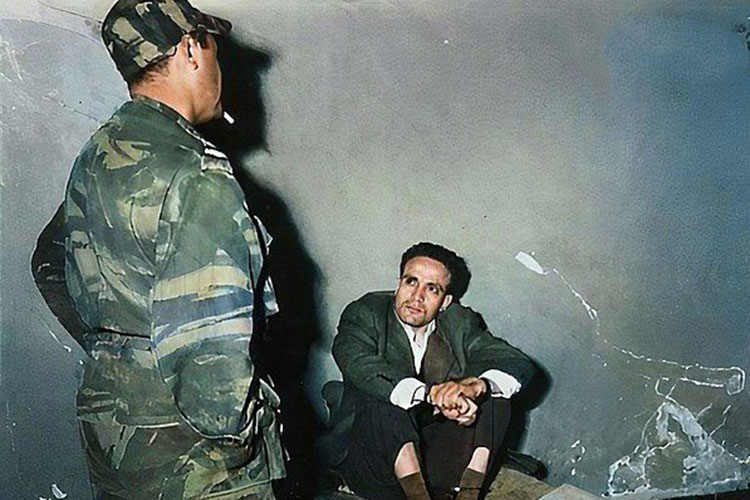
According to the same source, during this meeting, Benjamin Stora asked the French president about the possibility of France’s recognition of the assassination of Larbi Ben M’hidi, who is considered one of the icons of the Algerian Liberation Revolution and a unique and rare figure in the imagination of Algerians, in 1957 by war criminal Paul Aussaresses.
The French president’s response to Benjamin Stora’s question was: “We will see how we’ll move forward” according to Le Point, which added, on Stora’s behalf: “He did not say no, and I felt he’s waiting for the right moment to do so. I felt that the president was very determined, whatever the response of the Algerians elsewhere. He wants to continue the work (on the memory file).”
On September 19, Macron received the French members of the French-Algerian Joint Commission of Historians at the Elysée Palace, and during this meeting, he renewed “his determination to continue the work of memory, truth and reconciliation that began in 2017 and was established with Algeria within the framework of the Algiers Declaration”, according to the Elysée.
It is known that the work of the commission of historians from the two countries, tasked with researching and studying the memory file, has not witnessed any progress, but has stopped activities on the field, not officially, as the date of the last meeting (the fifth) dates back to last May, which was organized in Algeria, while the invitation of the French side to hold a meeting in Paris last July was not realized, due to the tunnel it entered after Paris’ shift in position on the Western Sahara issue, as it became more extreme in supporting the autonomy plan in this occupied territory, which was presented by the Moroccan regime in 2007.
Previously, the French president played on the chord of recognizing the responsibility of the French state in committing crimes against Algerian politicians and activists defending the liberation revolution, such as lawyer Ali Boumendjel, on the orders of Paul Aussaresses in March 1957, in addition to recognizing the state’s responsibility in the assassination of the French activist supporting the revolution, Maurice Audin, in 2018, who was kidnapped and killed by French army paratroopers in 1957.
In November 1984, war criminal Marcel Bigeard admitted in an interview with an Algerian newspaper that he found himself “forced, on orders from Paris, to hand him over alive to the special services”, but the final confession was signed by Paul Aussaresses in his book “Special Services” in 2000, and in his interview with Le Monde: “Ben M’hidi was taken to an abandoned farm owned by an extremist settler. He was forced to wait on the sidelines. Meanwhile, Aussaresses and his men, six, hanged him”.
The statement of historian Benjamin Stora is considered another flirtation with the Algerian side to resume the work of the memory commission. However, things do not seem that easy, according to many observers, what Macron did last summer by “prostrating” to the Alawite regime in Rabat cannot bring peace in bilateral relations, even if it is related to the memory file. Macron himself realized this when he confirmed to historians about a week ago at the Elysée Palace that he was betting on a “long-term reconciliation” with Algeria regarding the memory file.