Algeria “Absent” From Arab League Meeting Called By Saudi Arabia

-
-
1672
-
0
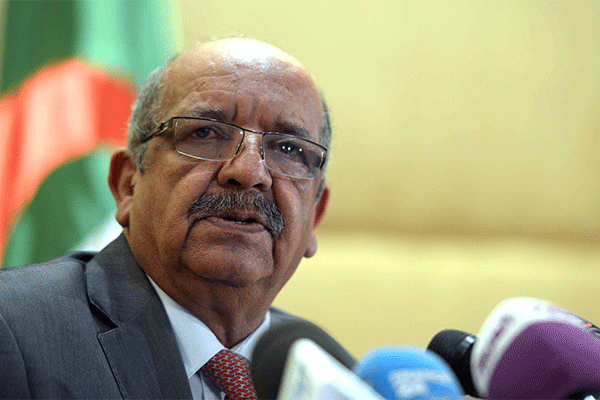
Algerian Foreign Affairs Minister, Abdelkader Messahel, missed the extraordinary meeting of the Council of the League of Arab States at the level of Foreign Ministers, which was requested by the Kingdom of Saudi Arabia and the encounter was attended on the Algerian side by the Ambassador of Algeria and its Permanent Delegate to the Arab League Mr. Nadir Arbaoui.
The meeting, which was held on Sunday and chaired by the State of Djibouti, focused on “how to deal with Iranian interference in the Arab countries” and was attended by countries close to Riyadh notably Egypt, the United Arab Emirates and Bahrain, while Algeria, along with other countries including Qatar, Yemen, Lebanon, Iraq Sudan and Morocco shunned the encounter.
The encounter was preceded by a closed-door meeting which included the foreign ministers of Egypt, the United Arab Emirates, Bahrain and Kuwait at the Arab League headquarters in the presence of Ahmed Aboul Gheit, Secretary General of the League of Arab States, during which they discussed the possibility of reaching a consensus on the final statement of the meeting.
The Algerian Foreign Affairs Ministry did not issue a statement explaining the reason for this “absence” or explaining the country’s official position on the matter.
However, observers linked the reduction of Algerian representation to the level of the Ambassador (its delegate to the Arab League) on the subject of this meeting, because the meeting was directed against a country that is Iran, considered one of the friendly countries of Algeria, as they are both linked by close relations and a friendship treaty.
The statement called for the convening of an emergency session of the UN Security Council to discuss “Iranian threats to the region” and to condemn what the statement called “Iranian interference” in some Arab countries, as well as “the launching of ballistic missiles into Saudi territory”.
The reduction of Algerian representation in the meeting of Arab foreign ministers was not biased in favor of the Iranian axis in the region because Algeria was one of the first countries to firmly condemn the attacks on Saudi territory with ballistic missiles, whose responsibility was pinned upon the Houthi militias in Yemen.
This is not the first time that Algeria has not aligned itself with Saudi positions at the level of the Arab League and other regional and international bodies and institutions.
The last such stance was marked by Algeria abstaining in favor of a proposal submitted by Riyadh at the level of the Third Committee in the UN General Assembly to condemn what it described as “Violations of Human Rights in Iran”, along with other Arab countries, including Egypt, Kuwait and Jordan.
It is known that Algeria’s diplomatic doctrine is based on the cardinal principle of self-exclusion from entering into regional and international conflicts, and by refusing to interfere in the internal affairs of others and by duly respecting the sovereignty of other states.
This reflects Algeria’s steadfast position regarding notably the Yemeni, Libyan and Syrian crises.