Algeria Rejects the Exploitation of Migrants’ Card to Pressurize, Blackmail Countries
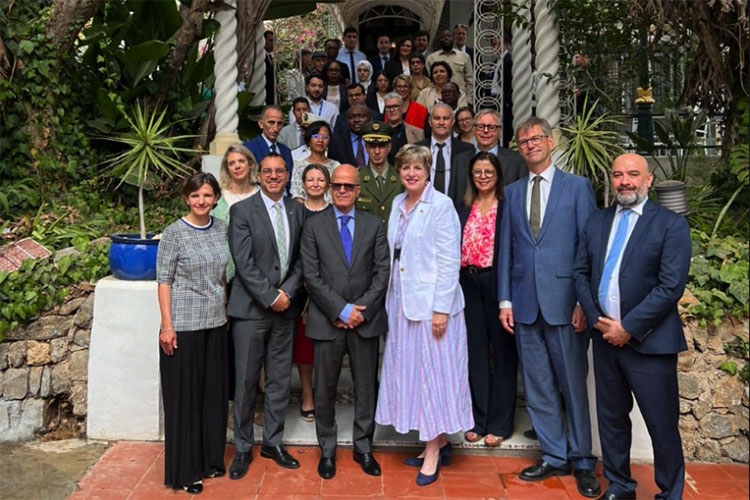
On Monday evening, international actors and partners praised the Algerian approach to the phenomenon of migration. They highlighted the uniqueness of Algeria’s vision to solve this problem, especially by identifying its deep causes.
At a round table organized by the International Organization for Migration (IOM) in Algeria, with support from the United Nations Network on Migration, representatives of the United Nations, international partners and representatives of the embassies of the countries of origin of migrant communities in Algeria discussed common challenges and innovative solutions to promote safe, orderly and legal migration and asylum management in Algeria and the entire region.
In his opening address, the General Manager of Consular Affairs and the National Community Abroad at the Ministry of Foreign Affairs, Rachid Meddah, said that the Algerian approach in this field is based on several “basic principles,” including “taking into account the specificities of each country of origin.”
He explained that migration is a “complex” and “multidimensional” human phenomenon that primarily affects vulnerable groups (children, women, and the elderly) who are exposed to many forms of exploitation.
“Algeria has ratified most international agreements related to human rights and is committed to solidarity and cooperation in this context,” Meddah added that the Algerian approach is also based on the need to address this phenomenon by combating the deep and real causes of illegal immigration linked in particular to political instability and armed conflicts.
Maddah praised the tremendous efforts made by the organization in coordination with the Algerian authorities, stressing the necessity of developing a comprehensive approach.
The diplomat confirmed that this step resulted in a plan of action that would facilitate the return of migrants to their countries of origin in the best possible conditions, explaining that Algeria, thanks to its strategic position, the economic development it has witnessed recently, and its stability, has moved from a migrants’ transit country to a receiving country.
Maddah emphasized that Algeria “is seeking to combat this phenomenon with its capabilities, and has not benefited from any external assistance,” adding that “Algeria, in its approach, refrains from using the phenomenon of immigration as a “pressure card” and “blackmail” in its policy, in contrast to what other countries are pursuing. Rather, it is based on a “humanitarian position, assistance and cooperation.”
“The serious work led by the International Organization for Migration allowed the development of a program for the voluntary return of ten thousand clandestine migrants to their countries of origin. We were able to convene a tripartite committee that includes the International Organization for Migration, the European Union, and the Algerian government to find interactive and complementary formulas to finance this process and allow illegal immigrants to return to their countries and accompany them.”
For his part, the United Nations Resident Coordinator in Algeria, Alejandro Alvarez, highlighted that migration is a “very difficult” issue that cannot be the issue of one country or one region, praising “the development and improvement of the partnership with Algeria, which does not take the issue of migration as a political negotiating card.”
Alvarez noted the “absence of hate speech” towards migrants, who are received in good conditions in Algeria, unlike some other countries in the region”.
Furthermore, the US Ambassador to Algeria, Elizabeth Moore Aubin, said that the international experience highlighted the enormity of global challenges that are difficult to handle by one country.
After mentioning that there is more than one answer to this problem, the ambassador stated that her country seeks to support the mechanisms established by Algeria to address the phenomenon of migration.