Algeria Resolution for Gaza Ceasefire: The UN Security Council to Vote Next Week
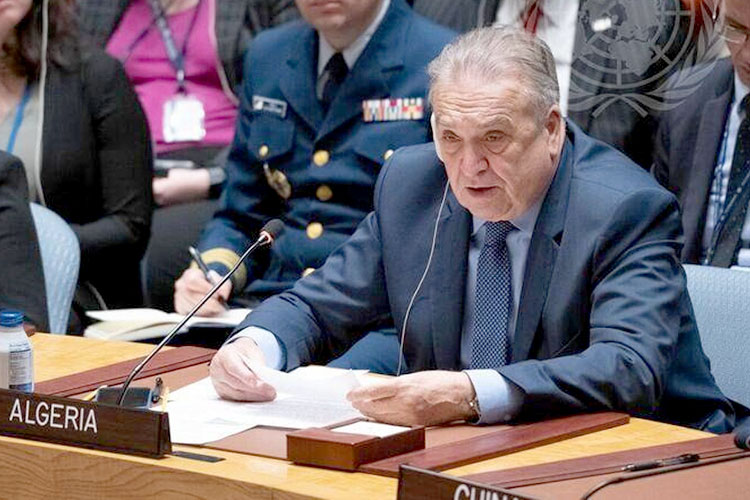
Senior Western diplomatic sources in the UN Security Council in New York expect a vote next week at the UN Security Council on a draft Algerian resolution demanding a ceasefire in Gaza that must be respected by all parties. Still, no official date has been set for the vote.
The latest leaked copy of the draft at the United Nations in New York contains the Security Council’s demand for “an immediate ceasefire for humanitarian reasons, which all parties must respect.”
The Algerian draft resolution, according to what was reported by media sources, stipulates “the rejection of the forced displacement of the Palestinian civilian population,” and once again calls on “all parties to comply with international law,” and calls for humanitarian aid to arrive “fully, quickly, safely, and without obstacles to the entire Gaza Strip and in “All over it”.
The draft resolution also calls for “the protection of civilians and civilian infrastructure, and condemns all attacks against civilians and all acts of violence and hostilities, and all acts of terrorism against civilians.” It also “demands the immediate and unconditional release of all hostages, as well as ensuring humanitarian access to meet the medical needs of all hostages.”
The Algerian draft resolution also calls for the full, rapid, safe and unhindered entry and access of humanitarian aid to all parts of the Gaza Strip, “by facilitating the use of all available roads leading to and throughout the entire Gaza Strip, including border crossings, under international humanitarian law and its resolutions.”
The draft resolution also reiterates the Security Council’s commitment “to the vision of a two-state solution, where two democratic states, Israel and Palestine, live side by side in peace within secure and recognized borders, consistent with international law and relevant United Nations resolutions”, stressing “the importance of unifying the Gaza Strip with the West Bank under the Palestinian Authority”.
The draft also refers to “the provisional measures announced by the International Court of Justice on January 26, 2024” in the genocide case brought by South Africa against Israel relating to the application of the Convention on the Prevention and Punishment of the Crime of Genocide, and “concerning the right of the Palestinian people in the Gaza Strip to be protected from all acts that fall within the scope of Article Two and Article Three of the Convention.”
It “welcomes the appointment of Sigrid Kaag as Senior Humanitarian and Reconstruction Coordinator for Gaza according to Resolution 2720, stressing the need to provide her team with the necessary resources and support to fulfil its mandate, and stressing the urgent need to expand the flow of humanitarian assistance to civilians in the Gaza Strip and the inevitability of accountability for all violations of international law.”
It is noteworthy that Algeria distributed the first draft about two weeks ago to the member states of the UN Security Council to consult it and take its comments into account, before making several amendments to it to mobilize sufficient votes in favour of it.
A UN diplomatic source suggested that the United States would likely use its veto against the draft if its language was not softened, as it did with Resolution 2720 last December.
The United States then abstained from voting and allowed the passage of Resolution 2720, after emptying it of its most important elements and softening its language so that it did not stipulate a clear and explicit demand for an ongoing ceasefire, even for humanitarian reasons.
Among the current American objections to the draft resolution is that it does not condemn Hamas, and Washington would rather neither refer to the ICJ provisions nor a ceasefire even if it is for humanitarian reasons, according to the same diplomatic source familiar with the matter.
The US administration argued that putting the text to a vote “will disrupt efforts to negotiate the release of the hostages and bring in larger amounts of aid,” which are currently taking place in Cairo. It has only called for humanitarian pauses without supporting a fair solution that would bring peace to the region, including a ceasefire.