Algeria: Special inter-ministerial meeting to face up to kidnapping crisis in North Mali

الشروق أونلاين
-
-
963
-
0
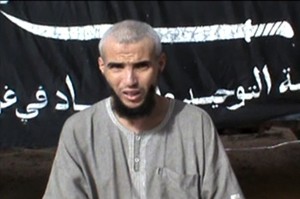
In the aftermath of the reported execution of the Algerian vice-consul Tahar Touati by his Mujao terrorist captors in northern Mali, the Algerian Prime Minister is to convene a special inter-ministerial meeting to take stock of the situation in view of the latest developments unfolding in the vexed kidnapping crisis.
- In the aftermath of the reported execution of the Algerian vice-consul Tahar Touati by his Mujao terrorist captors in northern Mali, the Algerian Prime Minister is to convene a special inter-ministerial meeting to take stock of the situation in view of the latest developments unfolding in the vexed kidnapping crisis.
- Reliable sources told Echorouk that the Prime minister will chair shortly an emergency inter-ministerial meeting in Algiers bringing together interior minister Daho Ould Kablia, foreign minister Mourad Medelci, the minister-delegate at the defence ministry Abdelmalek Guenaizia and the minister delegate in charge of maghrebian and African affairs Abdelkader Messahel with the aim of taking a set of urgent measures to face up to the serious challenge posed by Mujao terrorists in their blackmailing demands in exchange for the release of the three remaining abducted Algerian diplomats held somewhere in northern Mali.
- The reported killing of the Algerian vice-consul Tahar Touati is yet to be confirmed by official channels in Algeria once the necessary verifications are made by the relevant authorities.
- The Algerian authorities have always adopted the cardinal line of not paying ransoms to terrorist groups or yielding to their demands in order not to contribute to financing terrorism or abetting unwittingly criminality and organized under all their forms.
- The Malian crisis seen from Algeria: Analysis
- The recent military blitz by rebels in Northern Mali is far from inconsequential for its Algerian neighbor. The hypothetical secession of the Azawad (in the northern half of Mali) is not viewed favorably in Algeria, to say the least.
- In addition to the threat of instability across the country’s southern border, the Mouvement National de Libération de l’Azawad (MNLA) made the pragmatic choice to form a short-lived alliance with jihadists from Ansaar Eddine and Al-Qaeda in the Islamic Maghreb (AQIM) during their offensive. Due to Algeria’s own recent history with terrorism, this relationship was viewed with great suspicion.
- Algeria and the Sahelo-Saharian Space:
- The Sahelo-Saharian space is crucial in Algeria’s regional strategy for three reasons. First, the country’s authorities seek to gain legitimacy from their long experience with counter-terrorism. Second, Algeria played a key role in implementing various forms of international cooperation in order to confront security issues in the region.
- Third, this cross-border space is notoriously rich in natural resources, and is thus much coveted by many foreign actors such as France and the US, though also including China. One must keep in mind that in the Sahelo-Saharian space the focus on terrorism is deeply linked to these economic interests.
- In order to confront the threat posed by jihadist katibate (or brigades) and to control various forms of trafficking, the four countries of the “champ” (Mali, Mauritania, Niger and Algeria) decided to join together and form a committee of operations (CEMOC, the Centre d’Etat-Major Opérationnel Conjoint) in 2010. Even if the organization is governed by a rotating presidency, Algeria has a key role to play.
- Undoubtedly the capacities of the Algerian Army (ANP, for Armée Nationale Populaire) are far more significant than those of its three partners in the CEMOC. As the Nigerian Minister of Foreign Affairs has remarked, the Algerian army is compelled to intervene outside of the country’s borders, mostly due to the fact that the Malian army is unable to control its own territory.
- Terrorism in the Sahel as Geopolitical Rent:
- This situation might initially seem contradictory given that Algeria’s foreign policy is based on strict non-interference. Yet, at the same time, international cooperation plays a central role in the strategy of the regime. The “global war on terror” is a longstanding priority for Algeria’s international allies, most notably France and the US.
- Alleged connections between AQIM and the Nigerian fundamentalist sect Boko Haram prompted fears of a unified terrorist movement in both parts of the Sahelian space.
- The recent display of force by Ansaar Eddine and Mujao terrorist groups in Timbuktu, Gao and Kidal has exacerbated the feeling of urgency, especially in France where these events emphasize the loss of control in a region that was previously viewed as a private hunting ground.
- With the growing involvement of US and China, the former colonial power is not as influential as it once was. But France’s commitment to regional stability is still significant, especially as it seeks to secure access to Sahelian uranium that is key to its nuclear industry.