Algerian government spends $100 million per day from dwindling exchange reserves

-
-
937
-
0
Representatives of the International Monetary Fund (IMF), who stayed for a week in Algeria to preview the country’s economic and financial situation, in the next stage, in the light of the collapse of world oil prices, pointed to the inevitability of resorting to external borrowing during the next phase in a bid to redress Algeria’s eroded state budget.
Taking the floor during a press conference on Sunday at the Al Djazair hotel in upper Algiers, an IMF spokesperson suggested that Algeria must consider opting for foreign borrowing from abroad in order to allow the country to secure fresh hard currency and not just rely on the Algerian dinar with a view to absorbing the telling shock of the scathing oil price downturn.
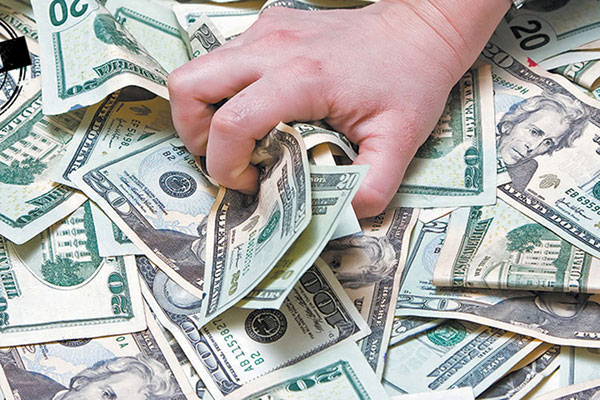
And a comparison between what it was like in terms of Algeria’s foreign revenues by the end of September and the end of December 2015, they stood at a disbursement of $ 10 billion dollars in a matter of 90 days at a rate of more than $ 100 million dollars per day, he noted.
The IMF representative further asserted that the government is however able to adjust the budget through well-studied financial allocations for the year 2016, while requiring greater control over public expenses.
He also expects the government to take the decision to hike the price of derivatives in fuel-related products, and called for the continuation of that policy with greater emphasis on the matter during the next phase in order to face up to any untoward contingency.
Prime Minister Abdelmalek Sellal has urged that the current fiscal crisis offers an opportunity to decrease reliance on oil and gas revenues—but few efficient steps have been taken in that direction.
The National Economic and Social Council (CNES), a government-associated research institute, recommended the government invest in fifteen strategic sectors to diversify the national economy. One of the limited steps the government is considering is a law meant to simplify investment procedures for national and foreign companies, but it has yet to be adopted.
While sweeping reforms and diversification of the country’s economic apparatus remain a rather distant possibility, the government has no choice but to adjust its finances to accommodate lower revenues. The International Monetary Fund (IMF) estimates that Algeria needs an oil price of $96 per barrel to balance its budget, a figure that appears unlikely in the coming years. The IMF further estimates that Algeria should also consider resorting to external borrowing to redress its dwindling state budget as another remedial alternative but such an issue isn’t now the order of the day for the government which has launched an internal mandatory borrowing scheme instead.
The decrease in oil prices has driven the country’s export earnings down, leading to a trade deficit of $12.62 billion from January to November 2015. In the meantime, Algeria has relied on its reserves to fund its budget. Foreign currency reserves were estimated at $201 billion in 2013, equivalent to roughly three years of imports.
Currency reserves had fallen to $159 billion by June 2015, according to the Bank of Algeria, and had dropped to $151 billion by the end of the year; they are expected to fall to $121 billion by the end of 2016.
In September 2015, Central Bank Governor Mohamed Laksaci warned about the gravity of the situation, noting that “between the end of June 2014 and the end of June 2015, the foreign exchange reserves shrank by $34.2 billion due to the impact of the external shock on Algeria’s balance of external payments since the fourth quarter of 2014.”