Algerians confused about taking the swine flu vaccine or not?

الشروق أونلاين
-
-
1383
-
0
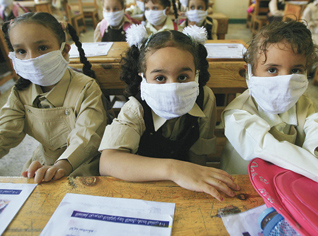
Algeria- The last Swine Flu developments in Algeria reached a dangerous phase, as the Ministry of Health, Population and Hospital Reform announced on Sunday that the swine flu deaths topped 12, and the number of lab-confirmed cases of infection with Influenza A (H1N1) in Algeria hit 370.
-
The Minister Berkat told reporters in Annaba, east of Algiers; “”The Algerian authorities are fighting against the outbreak of the fatal disease and implementing strict preventive measures,”.
-
“As part of the preventive measures the vaccination program will start on Monday and last through six months”. He affirmed
-
-
The program targets up to 20 million people, representing 60 percent of the total 34 million populations, he added.
-
-
However, the Algerians are either fearing, monitoring or refusing the swine flu vaccine which is noticing a large controversy in many western and Arab countries, through expressing fears of the vaccine complications that has unknown consequences for many of the specialists who are not sure about its credibility and effectiveness, thing which sowed a kind of confusion and hesitation for the Algerians, but a of them think that the vaccine is “a necessary evil”.
-
-
An Algerian university professor, 35, said; “I’m not interested in the vaccine, because it primarily affects children and young people, but I decided not to test it on my kids enrolled in school, because I followed a considerable number of TV shows and documentaries which sparked a debate on this subject”.
-
-
Another Algerian merchant 40 said; “This disease is fabricated by the U.S. pharmaceutical laboratories in order to increase profits without concern for negative consequences, and the best evidence that these labs signed agreements with the countries which that have requested the vaccine which indicate that the labs are not responsible for any complications”.
-
-
Mohamed 22 Algerian student said; “ I feared the vaccine after I saw the negative statements by the Head of the National Federation of the Assemblies of Parents of Students, who confirmed that the government should provide convincing guarantees of the affectiveness of the vaccine before immunizing it for more than eight million students”.
-
-
Meanwhile, a number of Algerian citizens expressed satisfaction with this vaccine, especially as it is adopted by many developed countries like USA and France, which could not risk their own citizens.
-
-
“The vaccine remains the only way to avoid the virus in light of the considerable lack of the means of prevention in all the public and private places. As for its affects, many Algerian specialists and doctors have expressed their satisfaction, particularly since they are the first subjected to experimentation”, employee 30 said.
-
-
In fact, a lot of Algerian citizens ignore the simplest information on the merits of the swine flu, thing which needs intensification of the awareness campaigns and sensitization in the different TV channels and newspapers.
-
-
Algeria received 900 thousands of swine flu vaccines, out of 20 million which will be received until May 2010, that are directed primarily for health workers, customs officials and airports and ports, then to the security agents and pregnant women, and then infants, pupils and all the Algerian citizens under 24.
-
-
-
Algerians should know that there are two swine flu vaccines, according to scientists, Pandemrix, produced by GlaxoSmithKline, and Celvapan, made by Baxter International. Of these, worries have focused on Pandemrix for two reasons – the apparent lack of testing before its approval, and the fact that it contains something called an adjuvant. Some reports claim adjuvants were responsible for Gulf War Syndrome.
-
-
Like most flu vaccines, Pandemrix started life being incubated in hens’ eggs before being extracted, genetically manipulated and prepared for injection.
-
-
It contains inactivated – or dead – parts of a swine flu strain called A/California/7/2009 (H1N1) v-like strain (X-179A).
-
-
When injected into a human being, these inactivated parts, or antigens, provoke a response from our immune system that results in antibodies being produced to protect us against exposure to a live version of the strain.
-
-
But there is nothing alive in the vaccine – only inert bits and pieces that would normally be on the outside of a virus and which are recognized and targeted by our defenses. So the vaccine doesn’t give you a dose of flu.
-
-
Many people believe this vaccine has been produced so quickly that it cannot have been properly tested.
-
-
In fact, it is a modified version of a previous vaccine that was prepared, tested and approved to guard against a strain of bird flu called H5N1- a particularly virulent and frightening form of the disease.
-
-
Scientists genetically removed the H5N1 strain and inserted the H1N1 strain. And remember, both vaccines contain only inert – dead – parts of the virus anyway. They cannot actually infect a recipient.
-
-
The bird flu version was approved by the European Committee for Medicinal Products for Human Use (CHMP) in May last year following clinical trials involving 12,000 patients. This organization and the World Health Organization have approved the H1N1 version.
-
-
Many people may have confused the swine flu jab with Tamiflu, which has well-known side-effects.
-
-
Tamiflu is a treatment for swine flu once you have it, it’s not a vaccine.
-
-
From the Latin adjuvare, meaning to aid, an adjuvant increases the efficiency of the antigens – the inactivated parts of the swine flu virus – in the vaccine. This means fewer antigens are needed to promote the production of antibodies in humans.
-
-
The adjuvant used in Pandemrix is a fatty substance which causes our immune system to react more vigorously – the adjuvant is called squalene and is extracted from fish oil.
-
-
There are tiny traces of mercury in thimerosal, the preservative used in the H1N1 vaccine. Some U.S. websites have suggested this can lead to autism in children.
-
-
However, this has been dismissed through lack of evidence by the World Health Organization.
-
-
After use of mercury-based preservatives was halted in the U.S., studies showed rates of autism went up, not down.
-
-
There’s been lots of talk about the swine flu jab causing Guillain-Barre Syndrome (GBS), a potentially paralysing neuromuscular disease. This goes back to 1976, when there was an outbreak of a different kind of swine flu on a U.S. military base. Subsequently, President Gerald Ford ordered the entire U.S. population to be vaccinated against it.
-
-
By the time the scare was over, 24 per cent of Americans had had the jab, but reports came in of a slight increase in the prevalence of Guillain-Barre among those who had been vaccinated. Could this happen here, too?
-
-
According to Professor Pennington, nobody has ever been able to figure out why the increase in Guillain-Barre occurred, but it is a phenomenon that has never been repeated.
-
He points out that people suffering from flu are eight times more likely to contract GBS – so statistically it is safer to have the jab.
-
-
If pregnant women were worried about being given a dose of swine flu, they shouldn’t be, as the vaccine contains no live virus. Should they be worried about the adjuvant? Again, according to Professor Salisbury, the Government’s main adviser on such matters, no.
-
-
However, some governments, including Canada’s and Switzerland’s, have decided not to give Pandemrix to women amid public concern over a lack of testing (although they have produced no evidence of any dangers).
-
-
At the time, a spokesman for the German Medical Association said: ‘We know the effects of the various ingredients in adjuvant vaccines, but not the combined effect. It’s understandable that people are wary of getting jabs of drug cocktails.’
-
-
Professor Salisbury says he does not know why there are international differences, but he finds it frustrating. ‘They have exactly the same evidence as we have, and we are satisfied the vaccine is safe for pregnant women,’ he said. ‘It is a shame that governments are sending out such mixed messages, because it simply confuses people.’
-
-
As for testing the vaccine on pregnant women, this is difficult. Usually, drug companies have only a few months to produce the annual flu vaccine – they cannot inject women and then wait nine months.
-
-
However, GSK estimates that as many as 90,000 pregnant women worldwide have received its swine flu vaccine without any obvious concerns.
-
-
Which simply leaves us with the all-important question: If you and your family are offered the vaccine, should you have it?
-
-
The experts and professionals all said ‘Yes’.