Algeria's Liberation Struggle/ (1954-1962): Glorious November Revolution stamps out colonial nightmare

الشروق أونلاين
-
-
1825
-
0
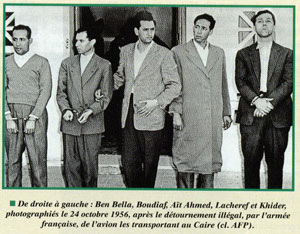
Algerian revolutionary leaders
On November 1st 1954, at midnight, the valiant forces of the Algerian Revolution struck the enemy and its collaborators in a series of bold and successful operations. On the same day, the newly – formed National Liberation Front – FLN – issued a statement setting forth its clear-cut objectives.
-
These objectives included the recognition of Algeria’s sovereignty, the release of all political detainees and the scrapping of the exception laws.
-
-
In retaliation, the French colonial Army carried out brutal repressive actions in the eastern Aures mountain range.
-
-
In a reaction, the National Liberation Army launched, on the 20th of August 1955, a large – scale offensive in the eastern province of Constantine, which was to mark a new phase in the armed revolution and to bring into focus, its irreversible character.
-
-
“The Soummam Congress: An outstanding historical landmark”.
-
-
The 20th of August 1956 was to be a most significant date in the FLN’s militant history. For it was on that date that the Soummam congress was held, which was to deepen the ideological content of the Revolution and outline the Front’s political program as well as the institutions of independent Algeria.
-
-
The Soummam congress created the national council of the Algerian Revolution, whose task it was, to guide and to coordinate the independence struggle.
-
-
During the following months and years, the FLN was to show the whole world its ability to organize and mobilize the masses. The general strike called in January 1957 was to be a bright example of the efficiency of the FLN, and neither, the colonial Army’s threats nor the heinous exactions and mass arrests could break down the mounting pro-independence action.
-
-
Another outstanding date was the 16th of December when the Tripoli congress was held, which adopted a program, advocating the setting up of a democratic and popular Algerian state, and which drew up a provisional constitution.
-
-
“Algerian November Revolution secures increasing international support”.
-
-
On the International scene, world opinion became acquainted with the Algerian Revolution first in April 1955 at the Bandeong non – aligned summit conference, then in September of the same year at the United Nations General Assembly, where an Afro-Asian resolution was tabled condemning the French colonial government for preventing the Algerian people from exercising their legitimate right to self determination.
-
-
-
During the following years, an active solidarity with the struggling Algerian people gained momentum throughout the world and especially in Africa, where the feeling of national conscience and the spirit of freedom began to grow by leaps and bounds.
-
-
The political successes of the FLN and the military victories scored by the ALN, prompted the French authorities to launch several large scale operations throughout the national territory, involving thousands of troops and the callous repression in the country’s towns and cities reached its peak.
-
-
The systematic use of torture by the colonial forces held sway and hundreds of nationalist figures were savagely tortured and then executed covertly at the behest of several senior French Army Officers like the sinister Bigeard, Jean Marie Le Pen or Aussaresses.
-
-
But the adamant resistance of the Algerian people finally got the upper hand over the brutal colonial war machine. The French government was then unwittingly compelled to get into contact with FLN representatives.
-
-
“The United Nations recognizes the Algerian people’s inalienable right to self-determination and independence”.
-
-
At the same time that is in 1960 the United Nations recognized the Algerian people’s legitimate right to choose their own future and invited the 2 sides to start negotiations on Algeria’s self determination and independence. Finally, on May 20th 1961 the French government agreed after so many dilatory manoeuvres, to start talks with the provisional government of the Algerian Republic (GPRA).
-
-
The GPRA firmly opposed France’s demand that a special status be granted to the French settlers and that the Sahara, Algeria’s southern part, be excluded from the negotiations.
-
-
On May 18th 1962, France renounced its claims and under mounting pressure from the Algerian people, who demonstrated en masse in July and December 1961, the French government recognized Algeria’s legitimate right to independence.
-
-
On July 1st 1962, what came to be known as the Evian agreements were signed and Algeria was, once again, on her own. The decisive years of bitter resistance, nationalism and sustained armed struggle have undoubtedly contributed to the moulding of the Algerian Revolutionary spirit and to the independence of the country which was wrenched thanks to the lofty sacrifice of one and a half million glorious Algerian Martyrs.
-
-
To all intents and purposes, the hideous colonial nightmare is a thing of the past but France has yet to reconcile itself with its haunting colonial presence in Algeria from 1830 to 1962.
-
-
To this effect, the French parliament’s decision several years ago to recognize the legitimate armed struggle waged by the Algerian people against the French colonial yoke as such, is a small but a right move in the right direction.
-
-
All in all, this burning file is yet to be sealed for good, may be, some time in the future only when France finally decides to opt for repentance by recognizing officially its horrendous crimes perpetrated throughout the 132-year long sombre colonization period in Algeria.