Book review: A misguided mission in behalf of Vladimir Nabokov

-
-
737
-
0
Imagining Nabokov Russia Between Art and Politics By Nina L. Khrushcheva Illustrated. 233 pages. $28; £18.99. Yale University Press.
‘A work of art has no importance whatever to society,” Vladimir Nabokov insisted. “It is only important to the individual, and only the individual reader is important to me.” Nabokov was in fact notoriously averse to groups or “movements” of any sort, whether political, artistic or social. So it’s hard not to be amused at Nina L. Khrushcheva’s contortionate attempts to recruit him as a sociopolitical figurehead for the land of his birth in her earnest and urgent “Imagining Nabokov: Russia Between Art and Politics.”
“The ‘American’ Nabokov of the second half of the 20th century is the most important cultural and literary phenomenon for Russia in the first half of the 21st,” Khrushcheva contends, hailing Nabokov as a “prophet” and proclaiming herself his “missionary.” With his independent, self-sufficient characters, “he is our textbook and our road map for today’s transitional period from a closed and communal terrain to its Western alternative, one open and competitive.”
Khrushcheva is a master of such stirring but ultimately hollow declarations, delivered up in a dizzying whirl of academic formalism, “intensely personal” reflection and wholesale generalization, often involving national characteristics – Russians are romantic, emotional, soulful, spiritual, impractical and so forth.
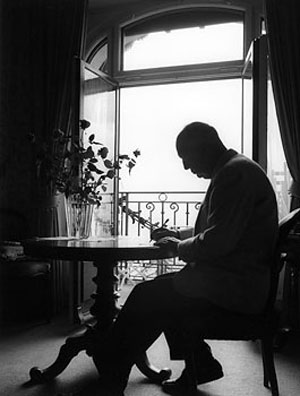
The result is a “dialogue” with Nabokov that becomes all too literal when Khrushcheva travels to Montreux, Switzerland, to converse with the novelist’s bronze statue in an unfortunate heart-to-heart blending quotations from the writer’s own work and lines composed for him by Khrushcheva. As protean as he may have been, the real Nabokov was never so humorless as this grim puppet.
Khrushcheva, an associate professor of international affairs at the New School, should be better placed than most to imagine the novelist and to assess his impact on Russian readers. Like him, she is a lover of literature, a multilingual expatriate, a “thoroughly middle class” college teacher and a member of a “deposed elite”: Nikita Khrushchev was her great-grandfather. And she is well aware that her claims to spiritual kinship with the author of “Bend Sinister” and “Invitation to a Beheading” will be ridiculed by those who find little to compare between her free passage out of Russia and the Nabokov family’s flight for their lives before the Bolsheviks.
Khrushcheva’s interest in promoting Nabokov in Russia is a worthy one. In 2001, teaching a course at Moscow State University called “Nabokov and Us,” she detected a direct relationship between her Russian students’ enthusiasm for her subject and an atmosphere of hope, openness and freedom in the country. Alas, five years later she discovers that Putin’s Russia “has all but given Nabokov up, along with his characters and his master classes, as it has given up the democratic reforms, growing too impatient to see them through.” This picture of Nabokov’s precipitately aborted adoption by his homeland is gripping, but it may be only a mirage. Khrushcheva’s impression seems almost entirely based on the opinions of the 30 students in her Moscow class on the one hand and, on the other, the mood at a small gathering she addressed at the Nabokov Museum in St. Petersburg in 2006.
The skeptical reader is entitled to suspect that the question of Nabokov’s Russian readership is far more complex than the glimpse his missionary allows us. Khrushcheva is evidently sincere in her belief that Nabokov’s Westernizing tendencies, in his character and especially in his writings, could somehow show her country the way to a modern, that is, Westernized, future. Americans might assume that’s an ennobling role, but they would be mistaken: Nabokov the individualist, in Khrushcheva’s view, became an American success story precisely because of the self-centered indifference and the relentless self-promotion she finds everywhere in his life and work.
Nabokov, she argues at length, was “Salieri to Pushkin’s innocent Mozart,” but only Salieris are likely to offer a road map of “how to survive and succeed in this Western world,” which for Khrushcheva, in the abstract at least, seems a harsh, even hellish place, quite the opposite of Nabokov’s America.
Khrushcheva professes to love Nabokov, but she puts much more heart into thrashing him: for his “conceit, coldness and emphatic indifference to all us ordinary folks, unworthy of his genius”; for his “contempt of the Russian tradition of socially minded literature”; for his “heartlessness,” his “unmitigated arrogance,” his “vanity and airs” and his skewering of other writers; for his “lack of ‘physical’ heroism” in contrast to Osip Mandelstam, dead in the gulag; for his aristocratic birth and for much else besides. Nabokov may be the first prophet to be anointed with vitriol.