De Mistura’s Visit to South Africa Disturbs the Moroccan Regime
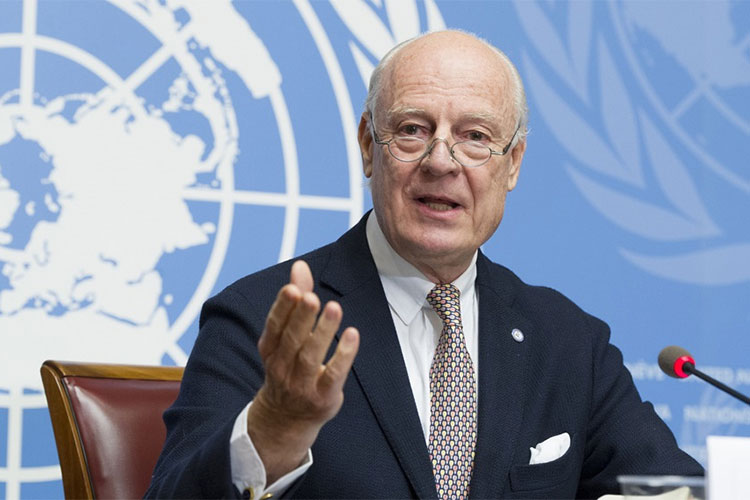
The visit that led the personal envoy of the UN Secretary-General for Western Sahara, the Swedish-Italian diplomat, Staffan de Mistura, to South Africa, shook the Moroccan regime, in a way that prompted observers to question the background of the level reached by the Moroccan reaction, which indicates the possibility of a development that may lead to consequences against Rabat’s interests.
This visit prompted the official and unofficial personalities in the Alawite Kingdom to issue tense and confused statements and remarks, the most prominent of which were those expressed by the Moroccan Foreign Minister, Nasser Bourita, who tried to reduce the impact of the visit on Moroccan public opinion when he said that the state of “South Africa was and will remain a marginal actor in the Western Sahara issue, and a dissonant voice, without any influence or weight in this file.”
The confusion of the head of the Moroccan regime’s diplomacy reached the point of attacking the UN envoy to Western Sahara, saying: “Even if de Mistura goes to Mars, he will not change anything,” he claimed. He went so far as to attack the United Nations when he spoke of “red lines,” saying; “It is not subject to discussion, negotiation, or manipulation, whether with the UN envoy or the United Nations itself.”
Before that, the Ambassador and Permanent Representative of Morocco to the United Nations, Omar Hilale, had said that “at no point was Morocco consulted or even informed,” noting that the Moroccan regime had expressed to both De Mistura and the United Nations Secretariat “Morocco categorical rejection of this visit, and also rejected any interaction with Pretoria regarding the issue of Western Sahara”, adding that “Morocco presented legitimate and objective reasons.”
The Progress and Socialism Party, led by the former minister of the Moroccan government, Mohamed Nabil Benabdallah, also issued a statement in which he said that the mission of the UN envoy is framed by the necessity of working exclusively with the parties concerned with the political process. At the same time, De Mistura’s consultation with South Africa would impede serious efforts towards reaching a political, realistic, practical, lasting and consensus-based solution to this fabricated regional conflict.”
However, the United Nations ignored the statements of the Moroccan regime, and said through Stéphane Dujarric, spokesman for the UN Secretary-General, António Guterres, that de Mistura “goes to talk to the parties he believes he wants to discuss the file with, as this is part of his mandate,” stressing that “he has the right to consult on the file with the countries concerned – member states – as well as the countries not concerned to advance the UN peace process.”
The Polisario Front, the sole legitimate representative of the Sahrawi people, did not fail to defend the visit, and said that the visit of the Personal Envoy of the United Nations’ Secretary-General for Western Sahara to the State of South Africa “falls within the scope of his mandate, especially given South Africa’s strong commitment to a rules-based international order, as well as its support and promotion of peaceful and just solutions to conflicts in Africa and beyond it.”
The state of South Africa is considered one of the strongest supporters of the right of the Sahrawi people to self-determination, and Western Sahara is considered the last colony on the African continent, and therefore it works with many African countries to undermine the expansionist dreams of the Moroccan occupation, regardless of Rabat’s anger.
De Mistura’s visit to South Africa resonated with many political and media observers in the world, some of them went on to describe the current United Nations special envoy to Western Sahara as very similar to the previous envoy, the American diplomat Christopher Ross, who is considered a supporter of the right of the Sahrawi people to self-determination.