Freedom House Report 2011: “Algeria at the crossroads”

الشروق أونلاين
-
-
531
-
0
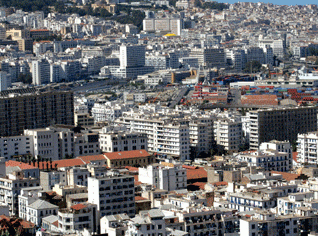
Here are extracts of the 2011 report recently released by US N.G.O “Freedom House” on Algeria's situation in several fields with on focus the slow evolution of the freedom of the press and expression, women's rights, freedom of worship and human rights.
- The Algerian constitution guarantees freedom of expression. A 2001 amendment to the Information Code further restricts press freedom by criminalizing writing, cartoons, and speech that insults or offends the president, the parliament, the judiciary, or the armed forces. Defamation and other legal charges brought against journalists continue to be a constant threat, hindering the press’s ability to cover the news. A number of sentences for defamation were handed down during the year, involving both fines and prison time.
- State agencies regularly engage in both direct and indirect censorship. Self-censorship also remains widespread, largely out of fear of defamation accusations or other forms of government retaliation. Foreign media outlets continue to face challenges in reporting freely. Officials block foreign papers when they carry content deemed subversive. In particular, coverage by international media outlets of issues related to national security and terrorism continues to be restricted. Al-Jazeera’s Algeria office remained closed in 2011.
- Algeria has a vibrant but fragile independent press, which often acts as a more effective check on official power than opposition parties themselves. There are currently more than 100 private daily and weekly newspapers, 29 of which print over 10,000 copies for each edition. Television and radio, both of which are entirely state owned, broadcast biased information, and generally refrain from covering dissenting views. However, more than 60 percent of households have satellite dishes that provide access to alternate sources of information.
- The government has tremendous economic influence over print media, as most newspapers are printed on state-owned presses. In January 2008, the government placed six state-owned printing presses under the direct control of the Communications Ministry, threatening the editorial autonomy of half of Algeria’s privately owned newspapers. The state-owned advertising agency continued to favor content with a pro-regime bias in 2010 by controlling the placement of ads by state entities and companies, which form the largest source of income for most papers.
- About 13 percent of the population accessed the internet in 2011. The government monitors e-mail and internet chat rooms, and internet service providers are legally liable for the content they host. In a break from the past, Algeria began censoring select internet sites in 2010. Bloggers, like traditional journalists, face potential defamation suits, and several have been fined for posting “defamatory material.” However, there were no reported cases of legal or physical harassment against bloggers or online journalists during 2011.
- Algerian women have come a long way with regard to their legal situation, after having made many brave sacrifices during the terrorism era. A report by the American institution “Freedom House”, published recently showed the extent of freedom progress in the country compared to other Arab States, as Algerian women ranked third after Tunisian and Moroccan women.
- The report highlighted the reforms approved by the Algerian legislature in terms of women’s rights, as well as the abolition of some laws that had always considered women second class citizens. Although the report noted women’s positive roles in various fields currently, it also brought up the disparities between the legislation and its practice on the ground. As a matter of fact, women are apparently unable to take advantage of these laws in a male-dominated and patriarchal society.
- For many years, the political and socio-cultural repressive system in which male individuals grew up has been expanding and deepening without causing the slightest deviation, interruption or disturbance in the public system, and serving the interests and values of a male-dominated society that is saturated with social exclusion and women’s suppression.
- These are three examples from the Algerian proverbial heritage, which is handed down through generations, thus partially building women’s image in the collective imagination with all its accumulations. This image pictures women as imperfect human beings on whom guardianship should be exercised, and that should be dealt with cautiously. These proverbs mirror people’s behaviors in this society, as well as their ways of thinking, lifestyles, beliefs and ethical standards. These sayings are an important factor in shaping the Algerian individual conscience and personality (with the individual being an index of the public common sense).
- Authority in the Algerian society is a vertical structure (State/Tribe) that tied its existence to the interests of some political groups to the detriment of others. This authority possesses internal self-suppression means aimed to contain the possibilities of straying from the herd, where loyalty to the country is at the heart of loyalty to the governor (chieftain). As for laws, they are a mere ornament of the interface of fragile democracy.
- As a result of these briefly presented concepts, a hateful racism against women has become over time an applicable way of life. This system was strengthened – following religious justifications – with the involvement of some Jihadi fundamentalists and Salafi preaching group figures in the management of State institutions; as a part of dividing the spoils at the end of the clash between the authority and the extremists, which had evolved into a civil war that killed a quarter million people, mostly women and children.
- Consequently, it has become necessary to intervene in order to protect women through a strong and independent UN body, whose mission is to improve the situation of women and girls around the world. Thanks to the actions of groups advocating women’s issues, the General Assembly of the United Nations has indeed adopted, on 07/02/2010, a resolution stating the establishment of a “United Nations entity for gender equality and the empowerment of women”. This is a real turning point that can exert a profound change in the lives of Algerian women, when this entity starts working officially in January 2011.
- The major concern now is that this entity remains confined to formal acts of propaganda, without getting into the core of women’s issues by encouraging the government as well as putting pressure on it, for Algerian women to obtain their rights by matching laws and practices, and promoting gender equality in terms of access to education, health care, and employment… This can be achieved by enacting new laws in line with international agreements on fundamental rights of women, and in response to national and global transformations.