French “Armament Observatory” Calls For Locating Nuclear Landfills In Algeria

-
-
192
-
0
The director of the “Arms Observatory” in France, Patrice Bouveret, called on Sunday, on Paris authorities to reveal the place where the nuclear waste was buried in Algeria.
Bouveret stressed – in an interview with Radio France International – that his country “should take the initiative to solve the problem of nuclear waste that it left in the early sixties in Algeria, and no one knows its whereabouts, because it is a military secret”.
“When France stopped its nuclear tests in 1966, it simply left in the place the total waste associated with the years during which it carried out 17 nuclear tests,” the French expert added.
He explained that Paris has kept the place or places of burial of nuclear waste underground and the documents related to it a “military secret” to this day, and for these considerations, Bouveret asserts: “There is no information available about where it was hidden in the Algerian desert.”
Incidentally, he called on his country’s authorities to “stop silence about this issue and cooperate with Algeria to purify the area of these nuclear tests of its waste, whose serious damage to the environment and to humans continues to this day”.
The “International Campaign for the Abolition of Nuclear Weapons” also subscribes to this call, which has already made many calls in this regard to the French authorities, to no avail so far.
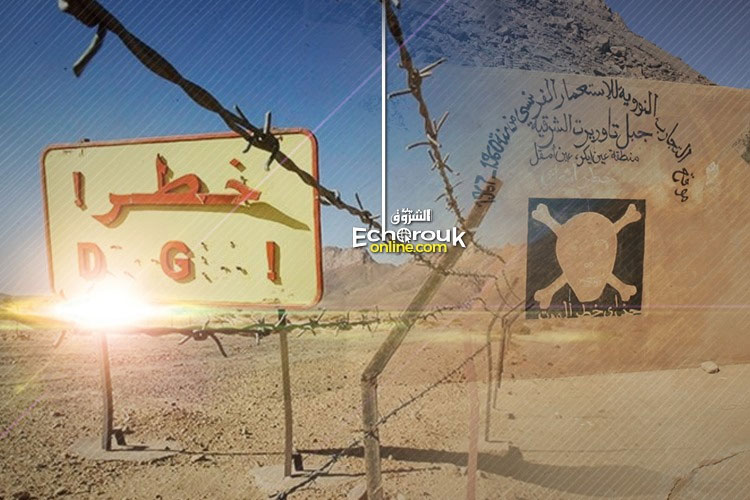
As a reminder, France carried out, during the period between 1960 and 1966, fifty-seven (57) nuclear tests and two explosions, that is, four air explosions in the Reggan region, thirteen underground explosions in Ain Ekker, and thirty-five additional experiments in Hamoudia, in the Reggane region and five Experiments with plutonium in the area of Ain Ekker, 30 km from the mountain, where the experiments were carried out underground.
The first explosion was carried out in the Reggane area on February 13, 1960, with a force of between 60,000 and 70,000 tons of TNT.
According to experts, this bomb was five times more powerful than the bomb fired on Hiroshima, and according to historians and experts, these nuclear tests in the south of Algeria remain among the worst crimes committed during 132 years of devastating occupation, and illustrate the policy of genocide practiced by the colonizer which official France must bear responsibility and fully recognize.
Even 60 years later, the risks posed by contaminated spaces and materials and the possibility of radioactive residues leaking out are still an emergency.
Under the terms of the TIAN, France is compelled to help identify and decontaminate risk areas even if it has not signed it, this is an ethical and historical obligation for France. In order to protect the population, and in particular nomads and their herds, priority should be given to delimiting contaminated areas according to a well-conducted program of measures and assessments.
The information that could be provided by the French side could be taken as a reference, even if it is partly obsolete.
The risk of radioactive upwelling from galleries, “chimneys” and boreholes plugged during testing remains a very likely possibility.
It must even be considered as a major risk that must be taken into account. The Hoggar region lives under the threat of a leak of radioactive gas confined in the basaltic rock.
France’s moral duty is to hand over to the Algerian state as soon as possible the maps for burying the contaminated material and to help it decontaminate the soil polluted by the radioactive waste.
It must refrain from repeating the 2007 scenario of the late handover of maps of anti-personnel mines laid by the French army between 1956 and 1959, which subsequently proved to be obsolete as the mines were moved over tens or even hundreds of meters following rains, mudslides and soil displacement. Had it not been for the magnificent demining work of the ANP, the number of dead and permanently disabled would have been much higher.