Heated Trial Of The Moroccan Regime And Sanchez In The Spanish Parliament
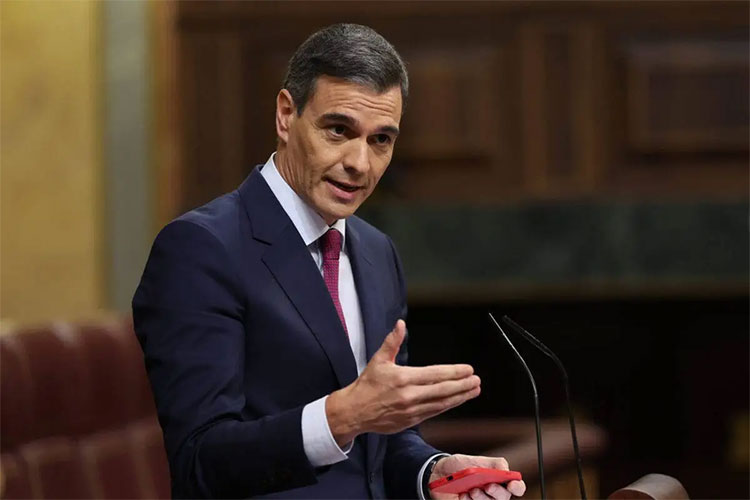
The Spanish Parliament is once again sending a warning message to the Prime Minister, Pedro Sanchez, asking him to reconsider the Spanish position on the Sahrawi issue and to return to the position of historical neutrality, which still represents a consensus for the rest of the political actors, with the exception of the ruling Socialist Workers’ Party.
The warning crystallized during the voting session last Thursday on a proposal presented by the opposition Popular Party, which won the majority in the legislative elections held last year, in which it calls on the government to restore Madrid’s historical position of neutrality on the Sahrawi issue, which it has followed for decades, since its withdrawal from the Sahrawi territories occupied in 1975, as well as the commitment to keep the air and sea space of Western Sahara under Spanish administration, as recognized by the United Nations.
The initiative presented by the opposition Popular Party received the majority of votes in the Spanish Parliament, with 215 “yes” votes compared to 121 “no” votes, making up the votes of the ruling Socialist Party, and 13 deputies abstained from voting, in a new setback for the government of Pedro Sanchez, the third of its kind. Madrid decided to abandon its neutral position on the issue in the spring of 2022.
The initiative, which was approved by the Parliament, stipulates that the Moroccan regime will be informed of its content, in a position that confirms that Pedro Sanchez, when he decided to change his country’s position on the Sahrawi issue, did not consult with his political partners and departed from the political consensus in Spain on this issue, for which the Spanish party bears the great historical responsibility, because of his complicity with the Moroccan regime on the eve of its announcement of its withdrawal from the occupied Sahrawi territories.
The meeting was an opportunity to discuss many of the issues that have disturbed the Spanish party and for which the Moroccan regime has been responsible in recent times, in particular the “Pegasus” spying scandal, which affected the mobile phones of the Prime Minister and the Ministers of the Interior, Defense and Agriculture, and which involved the Moroccan intelligence services, based on Credible investigations by human rights NGOs and internationally respected newspapers.
The complicity of the Spanish government in the massacre that left hundreds dead and thousands injured among illegal sub-Saharan African immigrants in the valley of Melilla in June 2022, after their failed attempt to cross to the Spanish mainland, a massacre in which those involved are still alive, was also discussed. The Moroccan company and the gendarmes are free, not even a condemnation from the United Nations.
The meeting was a trial for the collusion of the government of Pedro Sanchez with Rabat, and a sharp criticism of the Moroccan regime for the scandals in which it has been involved, such as buying the liabilities of European representatives in exchange for silence on the atrocities it has committed against the Moroccan and Sahrawi peoples, as well as “the harassment to which journalists and activists are subjected, “He pointed out that there are journalists sentenced to prison in the form of Tawfiq Bouachrine, sentenced to 15 years, Omar Radi, sentenced to 6 years, and Slimane Raissouni, sentenced to 5 years, in addition to the lawyer and human rights activist Mohamed Zayan, who is in prison and is over eighty years old.
Among the deputies who strongly attacked the government of Sanchez and the Moroccan regime was John Iñárritu, who refused to describe the Alawite Kingdom as a friendly state, saying that “allied countries do not spy or pressure friends”, surprised that Sanchez’s party included in its program for 2019 the issue of self-determination of Western Sahara, before withdrawing in 2022, while another deputy, Nestor Rigo, considered the approval of the autonomy plan an “insult” and considered it support for a regime that “does not respect human rights”.