Interview- Abderrahmane Saïdi responds to Ahmed Merani: Nahnah refused to lead FIS

الشروق أونلاين
-
-
4043
-
0
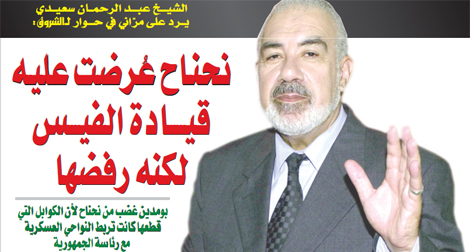
President of the consultation council at the MSP Abderrahmane Saïdi told Echorouk in an interview Mahfoud Nahnah had clear positions towards events experienced by the Islamic movement, in response to the FIS ex-member Ahmed Merani’s remarks.
Ahmed Merani told Echorouk late Nahnah obtained money from Saudi Arabia. What do you think about that?
First of all, we say to Ahmed Merani “shame on you for talking about a dead person in that way.” Why had he kept silence for 22 years? What are his evidences?
So, Nahnah did not obtain that money.
He did not obtain any money although he knew personalities and international organizations.
But he rejected the invasion of Kuwait at that time.
Nahnah was against the invasion of Kuwait. When the war was declared on Iraq, he stood by the Iraqi people’s side against the international alliance. His position was moderate. He was a member of a world delegation in Arab capitals such as Riyadh.
He led marches condemning the invasion of Iraq. I remember a march led by Nahnah and Slimani to the Iranian embassy in Algiers to call on Tehran to give back seized Iraqi aircrafts.
What is the story of phone cables Nahnah was jailed for?
It was in 1976. Nahnah, Bouslimani and Mohamed Kerat had the idea and Boudjemaa Ayad excuted it. It did not targeted public phone intended to citizens but it was about the red line which linked the first military zone and the President’s Office.
President Boumdiene was angry not for cutting phone lines but for the access to the phone cables.
Why did Nahnah do that?
It was a message to the regime to move. He wanted to say that many scholars and preachers rejected many parts in the National Charter at that time.
How were they sentenced?
At that time, there were no media neither human rights organizations. It was a military trial. Lawyer Farouk Ksentini defended Nahnah. He was sentenced to 16 years in prison.
Merani said Nahnah worked for the Djazaara clan. Is this right?
Nahnah was behind the idea of the group name. In 1979, Malek Benabi’s office was at La Fac Centrale. A room for prayer was opened there. Nahnah used to teach some groups. At that time, a few people were active. They fought against communist, secular and Marxist tendencies. Nahnah was the only Arab speaking member.
As for the Djazaara clan, it was formed of commands late in the 1970’s. Merani does not know them.
Who were they?
Habib Heddam, Anouar Heddam’s cousin, Boudjelkha, a teacher at the University of Bab Ezzouar, Mustapha Brahimia and others. There was another group: Thabet Hemmi from the province of Tlemcen (west of Algiers) and Mohamed Said. They were led by Boudjelkha. He works now at a Malaysian university.
At that time, Nahnah was in prison and had nothing to do with them. In 1976, he coordinated with them in politics.
Merani said the Djazaara clan does not like Nahnah. Why is that?
The Djazaara did not hate Nahnah only but all the groups. I think it did that because it was a question of conflicts and ideas.
Why didn’t Nahnah participate in La Fac Centrale’s events?
The events took place in 1982 following a conflict between pedagogical and university residence commissions. Abbassi called for protests without consultation. Nahnah was freshly released from jail. He did not participate because Soltani and Sahnouni asked him to do that to avoid arrest by security forces.
Yet, he participated in the writing of a 14-point-communiqué. He urged his supporters to avoid turning the protests into clashes.
Why wasn’t Nahnah a founding member of the FIS?
Merani said Nahnah refused to join the FIS and described it as “children’s party.” Nahnah did not say that. Kechi and Kerar visited him and suggested to him to lead the party but he refused.
But skirmishes took place between Nahnah and the FIS commands.
We had relations with some of the FIS commands. Some of them had different opinions than ours but we had never hated each other.
But many fatwas were issued to kill Nahnah.
I did not hear about that but I was told about some extremists. They issued fatwas to kill him. We do not have any evidence about Abbassi’s involvement in that.
But he was harmed by FIS members in mosques.
Yes, he was harmed in mosques. In the province of Medea, he was beaten by shoes.
How did Nahnah react to the call for political strike?
At that time, he urged for calming down the situation. He was involved in the 7+1 initiative. It called for the revision of the law on elections and rapprochement between the Islamic and Nationalist movements. Nahnah expressed his opinions publically and did not care about blames.
How did he react to the electoral process ban and the dissolving of the FIS?
He was against that because he thought it would have serious consequences on the country. He believed that the solution was dialogue.
How did Nahnah obtain acknowledgment of the Muslim Brotherhood?
It is not a matter of acknowledgment but Nahnah was among the well-known preachers. He was influenced by the Muslim brotherhood’s thoughts. Because of that, he was respected by them.
What is the reality of the conflict between Nahnah and Djaballah’s groups about the Muslim brotherhood’s representation?
I do not call it a conflict. Djaballah was working with Nahnah. When he was released, Djaballah was in charge of organization in the eastern part. Yet, he wanted to compete with him in this sense.
In 1986, Djabballah withdrew. Bouslimani told me about the conflict which started in 1982. Some preachers tried to reach rapprochement betw een the two men’s visions but it was in vain. Then, Chorfi Refai and Abu Djerra were assigned to organize the eastern part of the movement.
How was the relation between Nahnah and Ali Benhadj?
When Benhadj appeared, Nahnah was in jail. Benhadj’s tendency was not clear for Nahnah. There was no hostility between them but they had different opinions about questions related to Islamic preaching and fatwas. Nahnah believed that Benhadj’s attitudes were not wise. Because of that, he was convinced that no dialogue neither a stable relation can be established with Benhadj.
Fatwas were issued to kill Nahnah but it was Bouslimani who was murdered.
When Bouslimani was killed in 1993, we formed a vigilance commission in the province of Blida (west of Algiers). We allocated four houses for Nahnah. He had other houses in Algiers but no one of us knew all the places. Personally, I knew two houses only. Hussein Zouani led vigilance elements to guard and protect Nahnah from extremist groups.