Jittery France on edge in the aftermath of “Charlie Hebdo” bloody attack

-
-
1586
-
0
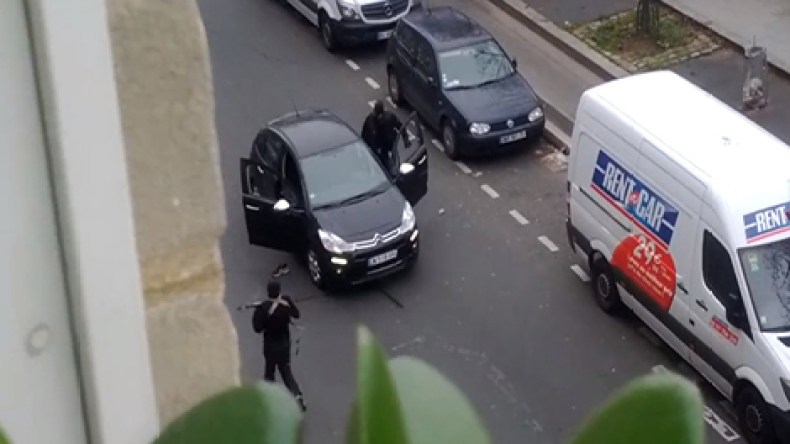
A man wearing a bullet-proof vest fired on police officers with an automatic rifle on Thursday just outside the French capital Paris, killing one of them, a police union official confirmed.
It was not immediately clear whether the attack was related to the Charlie Hebdo newespaper massacre.
Interior Minister Bernard Cazeneuve rushed to the scene of the ill-fated incident near Porte de Chatillon south of Paris, which happened just a day after two gunmen killed 12 people in an apparent Islamist attack on satirical weekly Charlie Hebdo.
Meanwhile, French security forces desperately hunted two brothers Thursday suspected of gunning down 12 people in an Islamist attack on a satirical weekly, as a stunned and outraged France fell silent to mourn the victims.
With thousands of police scouring France after the bloodiest attack in the country for half a century, the two men — still armed — were apparently spotted at a petrol station in the northern Aisne region.
Bells pealed out across France at the stroke of midday, public transport stopped and people gathered outside the headquarters of the Charlie Hebdo magazine in the pouring rain, holding aloft banners.
Television pictures showed children at a Muslim school in the northern city of Lille holding up sheets of paper with “not in my name”.
Wednesday’s massacre triggered poignant and spontaneous demonstrations of solidarity around the world and more than 100,000 poured onto the streets of France.
The controversial magazine Charlie Hebdo has repeatedly lampooned the holy Prophet of Islam Prophet Mohammed, God’s Peace and Blessings Be Upon Him, in the name of the so-called “freedom of expression”.
As fear spread in France, several other incidents rocked the jittery nation, although it was not clear whether they were linked to Wednesday’s attack.
Declaring Thursday a national day of mourning — only the fifth in the last 50 years — President Francois Hollande called the bloodbath “an act of exceptional barbarity”.
But more than 24 hours after the brazen assault, the masked, black-clad gunmen were still on the loose.
Police issued arrest warrants for Cherif Kouachi, 32, who was convicted in 2008 for involvement in a network sending fighters to Iraq, and his 34-year-old brother Said. Both were born in Paris and had, now and then, menial jobs in markets and fast-food restaurants.
The manhunt stretched into the night with search-and-seizure operations in Strasbourg and towns near Paris, while in northeastern Reims, police commandos raided a building later scoured by white-clad forensic police.
As fear spread in France, several other incidents rocked the jittery nation, although it was not clear whether they were linked to Wednesday’s attack.
Mosques in France targeted by attacks
Muslim places of worship in two French towns were meanwhile fired upon on Wednesday night, leaving no casualties, prosecutors said on Thursday.
Three blank grenades were thrown at a mosque shortly after midnight in the city of Le Mans, west of Paris. A bullet hole was also found in a window of the mosque.
In the Port-la-Nouvelle district near Narbonne in southern France, several shots were fired in the direction of a Muslim prayer hall shortly after evening prayers. The hall was empty, the local prosecutor said.
An explosion at a kebab shop near a mosque in the eastern French town of Villefranche-sur-Saone on Thursday morning also left no casualties. Local prosecutors have described it as a “criminal act”.
France is on edge following the deadly assault by heavily armed gunmen on satirical magazine Charlie Hebdo on Wednesday that left 12 dead. No link has yet been established between the attacks.
French Islamic groups urge Muslims to condemn the scourge of terrorism
France’s main Islamic groups urged Muslims across the country to observe a minute of silence on Thursday and for imams to condemn terrorism in the wake of the massacre at the Charlie Hebdo satirical magazine.
The groups called on “Muslim citizens of France to observe a minute of silence today at midday (1100 GMT), along with the rest of the nation, in memory of the victims of terrorism.”
In Paris attack, clash on whether to limit press freedom
Two sides in conflict over whether there should be limits to the liberty of self-expression clashed violently in a usually tranquil side street on the Right Bank of Paris.
When it was over, a dozen people lay dead – including some of the most prominent political cartoonists and satirists in France, and the police officers assigned to protect them.
Wednesday’s attack at the offices of the newspaper Charlie Hebdo seems the latest chapter in a clash of values.
In France, the conflict over what limits to place on press freedom has often involved the satirical weekly, whose mix of crude, often obscene artwork and brashness has few if any parallels in Anglo-Saxon media.
Press freedom and the right to self-expression in general differs vastly in the world, with even a generally liberal country like Sweden passing laws that criminalize hate speech and prohibiting expressions of contempt directed against a group or one of its members.