Libyan factions agree on forging national unity government but differ on Parliament’s formation

-
-
927
-
0
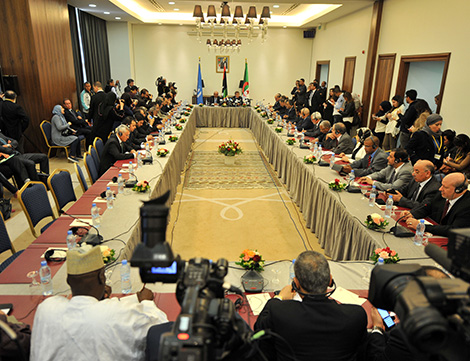
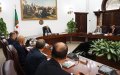
Talks between Libya’s rival parliaments on forging a unity government for the violence-wracked country have been a “great success,” the UN envoy said on Tuesday, but there were no signs of a major breakthrough.
“The result of the second round of the inter-Libyan dialogue is a great success,” Bernardino Leon said in Algiers. “The Libyan parties have succeeded in finding a common position on most of the points of a draft accord put forth by the United Nations.”
Representatives of the two sides are to resume the UN-brokered talks in Morocco on Thursday, a diplomat told newsmen.
That is a day later than planned by the United Nations and comes despite a statement adopted unanimously by the Security Council late on Monday saying it awaited the resumption of talks “with impatience”.
For his part, Algerian Minister delegate for Maghrebian and African Affairs Abdelkader Messahel said that Algeria hopes the Libyan parties at issue will sign an agreement acceptable by all “as soon as possible” in order to allow Libya enter a new era of peace, reconciliation and stability.
Mr Messahel was speaking at a joint press conference with the United Nations Special Representative and Head of the United Nations Support Mission in Libya Bernardino Leon after the second round of inter-Libyan dialogue and in response to a question on the possibility of unifying the processes of resolving the crisis in Libya.
Mr Messahel underlined that the multiplicity of these processes is a “strategy initiated by the United Nations as it encompasses a political aspect, a parliamentary one and one relating to civil society and other issues regarding the Libyan tribes.”
Libya has been gripped by chaos and violence since its 2011 revolution that toppled and killed veteran dictator Muammar Gaddafi.
It has had rival administrations and parliaments since an Islamist-backed militia alliance seized the capital Tripoli in August, prompting the internationally recognized government to take refuge in the east precisely in Tobruk.
The resulting power struggle has been exploited by the so-called “Islamic State” (ISIS) and other terrorist groups like “Al Qaeda” and “Ansar Sharia” to establish a growing nefarious presence in the country to the alarm of the international community.
Meanwhile, former GNC vice president Abdelhafid Ghoka said in Algiers that the sides had agreed in principle on forming a unity government but that differences remained over the future parliament.
“The government will consist of people who have no other nationality than the Libyan one,” he said, adding that the fate of parliament “will be at the heart of the talks.”
Mr Ghoka said the General National Congress (GNC) had ceased to exist with the election last June of a new parliament. That was disputed by Abdelhakim Belhadj, head of the Libyan nationalist “El Watan” party and former military commander of Tripoli.
“To say the General National Congress is finished is unacceptable,” he said. “That is the view of one person, and the question remains open.”
The UN Security Council, which has threatened sanctions over spiraling violence, has called on the rival sides to “agree on arrangements on the formation of a national unity government to end Libya’s political, security and institutional crisis.”
It also warned it was “prepared to sanction those who threaten Libya’s peace, stability or security or that obstruct or undermine the successful completion of its political transition.”