MPs Refuse Blocking Of “Death Websites” And Pornographic Websites!

-
-
1333
-
0
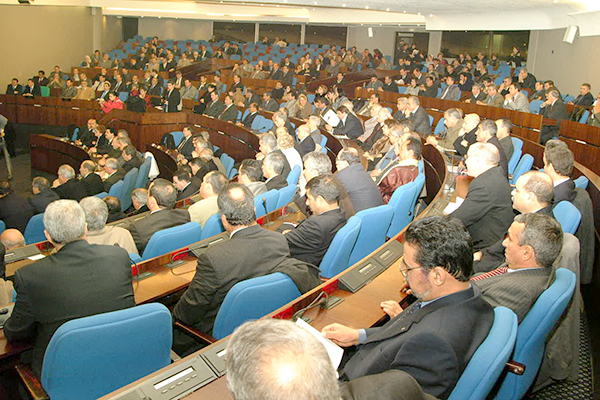
The MPs of the National People’s Assembly refused to vote on most of the amendments demanding that the state bans pornographic websites and all that cause damage to the members of society, as part of a proposed bill on post office and telecommunications.
On the other hand, an article was passed stating that all anonymous telephone lines must be authenticated within a period not less than six months after the issuance of the relevant law in the Official Gazette.
The draft of the general rules relating to the post office and telecommunications was thus adopted, Tuesday by a majority of votes by the deputies of the National People’s Assembly (NPA) during a plenary session presided over by Mr. Saïd Bouhadja and in the presence of the Minister of Post, Telecommunications, Technology and Digitalization, Ms. Imène Houda Feraoun.
The law, for the adoption of which abstained the deputies of the Workers’ Party (PT), sets the conditions for developing and providing “quality” postal and telecommunications services, as well as the general conditions for their exploitation by the operators and defines in addition the institutional framework of an “autonomous and independent regulatory Authority. “
This law applies to “postal and telecommunications activities, including television and radio broadcasting with respect to transmission, broadcasting and reception excluding the content of the audio-visual activities and electronic media within the scope of the organic law n°12-05 of 18 safar 1433 corresponding to January 12, 2012 relating to information”.
The law states that the activities of the post and telecommunications “are subject to State control”, which monitors in the framework of prerogatives attached to its general missions “the definition and the smooth implementation of standards for establishing and operating different related services”.
The State also ensures the “security of telecommunications networks, the continuity and regularity of the services offered to the large public, the respect of the rules of fair competition between operators and with regard to users and customers, as the supply complies with the requirements of legal and regulatory norms for universal service, respect for requirements for national defense and security of public opinion, in addition to the respect for the principles of morality, by operators, in line with their legal and regulatory obligations “.
The newly-adopted law stipulates furthermore, that the State, within the framework of its control prerogatives of the post office, maintains “the exclusive use of the territorial postal service and ensures the exploitation by operators according to the conditions and methods of exploitation as defined by the provisions of this piece of legislation”.
As part of its telecommunications control prerogatives, the State “exercises, in accordance with the constitutional provisions, the sovereignty over all of its wireless space and exclusive use of the radio frequency spec”.
As a reminder, the Committee on Transportation, Signals and AFN Telecommunications examined, on 16 December, 19 proposed amendments to the text, focusing mainly on the redrafting of certain articles to enable the incumbent operator to benefit from the state support to cover the entire national territory and to exempt it, in the field of telecommunications, from appearing before the Competitiveness Council.
The amendments proposed, furthermore, the obligation for the Council of State to settle litigations within the time limits set in Article 21 on pain of nullity, as an injured operator can claim its rights in keeping with the law.
It was also proposed to identify all “unknown” phone lines and the meting out of coercive measures to any defaulting operator. The drafters of the amendments finally proposed the writing of the postal check in Arabic language.
In a related context, the Minister of Post and Information and Communication Technologies, Ms. Houda Feraoun, indicated in a press conference held on the sidelines of the vote session on the Postal and telecommunications Law that the door of investment is open for upgrading Internet services and other specific areas.
She added that the monopoly of the historical operator in this field does not mean exclusion of others. “The preservation of national sovereignty in the telecommunications sector is unquestionable … and the field is open to private investment and not to looting,” she underscored.
Ms Houda Feraoun also pointed out that her ministerial department seeks to spur national content of internet services, while describing the international reports speaking of low internet services in Algeria as “false”, arguing that the latter aim to pressurize Algeria into entering the world market.