Tears of the Desert One Woman's True Story of Surviving the Horrors of Darfur by Halima Bashir and Damien Lewis

-
-
1245
-
0
One of the mysteries of Gordon Brown's scattergun approach to foreign policy is his apparent belief that Zimbabwe is the most shaming conflict in Africa. Largely at his insistence, leaders at the G8 meeting in Japan this month spent much of the time fulminating against Robert Mugabe, only for Russia and China, predictably, to block any follow-up action at the United Nations.
For all the grotesque abuses there, Zimbabwe is a sideshow compared to the systematic atrocities committed against the inhabitants of the southern and western parts of Sudan. Some 400,000 Sudanese are estimated to have died in the past six years, with five or six times that number displaced in refugee camps.
Diplomacy has so far failed to stop the evil visiting Darfur, largely because China, desperate for Sudan’s oil, has obstructed most initiatives. Things could get more difficult for the regime, however, following the recent indictment of President Omar al-Bashir at the International Criminal Court on charges of genocide and crimes against humanity.
The horrors of the Sudanese civil wars are often presented as a battle between Arab/Muslim forces in the north and African/Christian tribes to the south and west, but this is misleading. Halima Bashir, the co-author of Tears of the Desert, is a Zaghawa, a semi-nomadic black African tribe that converted to Islam in the 13th century. She grew up in a tiny settlement in Darfur, the daughter of a rich farmer, who owned a car and “many cattle, sheep and goats”.
Bashir was an intelligent child, so bright that she broke through the gender barrier to go away to school, and subsequently went to university in Khartoum, where she trained as a doctor. She succeeded in taking her medical degree, despite the anti-African bias of the Arab university administration and student body. By her account, members of the ruling elite from the Arab north of Sudan regard the black Africans as savages and potential slaves. This loathing is not religious (for the Zaghawa, too, are Muslims) but racial.
Her upbringing was relatively modern and enlightened, certainly for a girl whose family lived in one of the most primitive parts of Africa. But this did not spare Bashir from the awful ceremonies of her tribe, most notably what she calls female circumcision, but which, as a doctor specialising in gynaecology, she might more honestly recognise as genital mutilation. Her description of her submission to this procedure, with the fattest woman in the village sitting on her while parts of her vagina were sliced away with a razor blade, without anaesthetic, is almost too gruesome to read.
As she began practising as a doctor, Sudan’s genocidal war broke out around her. The dreaded Janjaweed militia (the “devil on horseback”) attacked the tribal villages of Darfur. The systematic rape of women and girls became an instrument of war, and when Bashir spoke of it to investigators, she, too, became targeted, and was savagely beaten and gang-raped. Thus, Bashir has twice been sexually violated, first by her mother and grandmother in the genital mutilation, and then by the fighters of the civil war who destroyed her homeland and her family.
Bashir’s story is so compelling that one wants to believe it all, but parts of it seem somehow bogus. This book is described as a memoir and has a co-writer, Damien Lewis, who has a track record of campaigning against the Khartoum government. There is nothing wrong with that in itself, but it makes one wary, and the narrative tone is confused. The book contains page after page of direct dialogue between Bashir, as a child, and her siblings, parents and school friends – conversations that she could not possibly have remembered. A memoir writer must be given licence, but for me this pushes the bounds too far.
Of course, it would be nice to think that her father, a devout Muslim living in the arid wastes of Darfur, would have said the following when telling his daughter how the British came to conquer Sudan. “They knew the meaning of hard work. They never stopped. So maybe it was that. Maybe with hard work and good timekeeping, they managed to conquer the world.”
Nor are the details entirely credible once Bashir reaches Britain, having sold the family jewellery to pay a man to smuggle her out of Sudan. When, fresh off the plane at Heathrow, she approaches a policeman and demands asylum, we are asked to believe that his response to a veiled Muslim woman was as follows: “New here are you, love? Here for the first time?” No date is given for this encounter.
The problem with such unconvincing interludes is that they suck credibility from the rest of the narrative. The account of the gang rape, the destruction of her village, the murder of her father, these events ring appallingly true. But overall, this memoir seems to have been designed to become a Richard & Judy bestselling title, and then fast-tracked to a Hollywood studio.
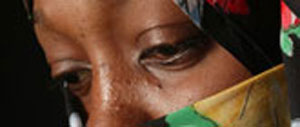
Zaghawa such as Bashir are black Africans, the women are usually veiled, their faces scarred by ritual cuttings. The unidentified figure on the cover of this book is a beautiful coffee-coloured black woman, who looks nothing like a Zaghawa and resembles Halle Berry, or possibly Thandie Newton. One cannot help thinking that in the writing and marketing of Tears of the Desert, the authors and the publisher are trying to have it both ways. The shame is that this detracts from the power of Halima’s underlying story.